The answer in 30 seconds
Vacuum the hair you can reach. Filter the air for a different reason.
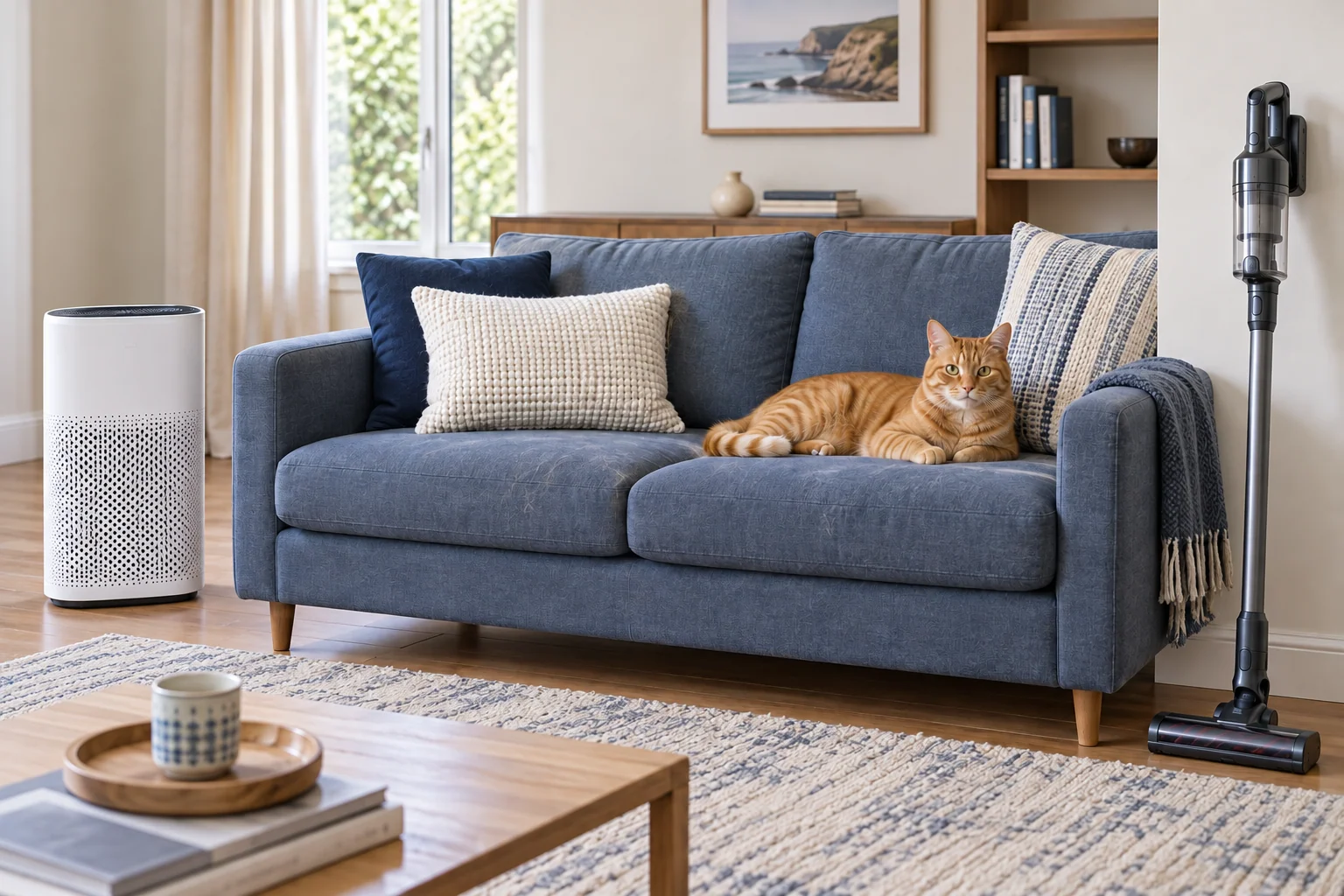
For cat hair on a sofa, rug or floor, surface cleaning comes first. An air purifier cannot lift fur embedded in upholstery. It may collect some floating hair that reaches its intake, but that does not replace vacuuming.
A room air purifier is a possible addition when airborne particles are the concern. Choose it by clean-air delivery, room size, a usable fan setting and upkeep, not just a “pet” label. The EPA describes portable air cleaners as room or area devices, not complete-home solutions that remove every pollutant.
Neither appliance diagnoses or treats a person's allergy. If you already own a suitable vacuum and your complaint is visible fur, maintaining it and changing the cleaning routine may be enough.
Make a one-room planFirst name what you want removed.
Hair, allergens and smells are often bundled into one sales promise. Separate them before comparing appliances. A device can perform well at one job and leave another almost unchanged.
| Your problem | Useful first step | What not to assume |
|---|---|---|
| Hair attached to fabric or collected on floors | Use a surface-appropriate vacuum attachment or other suitable cleaning method. | A nearby purifier will pull embedded fur off the sofa. |
| Particles suspended in room air | Consider source control and, where useful, correctly sized particle filtration. | A vacuum continually filters the whole room between cleaning sessions. |
| A persistent smell | Locate and deal with its source. Check whether any proposed filter addresses gases. | A particle-filter label or high particle CADR proves odour removal. |
| Symptoms attributed to the cat | Discuss diagnosis and exposure management with a qualified health professional. | Less visible hair or a green display confirms that allergens are gone. |
For a urine accident, the separate question is cleaning the contaminated material, not choosing a room filter. Our enzyme cleaner versus vinegar comparison covers that job.
Before replacing the vacuum, check the part that touches the hair.
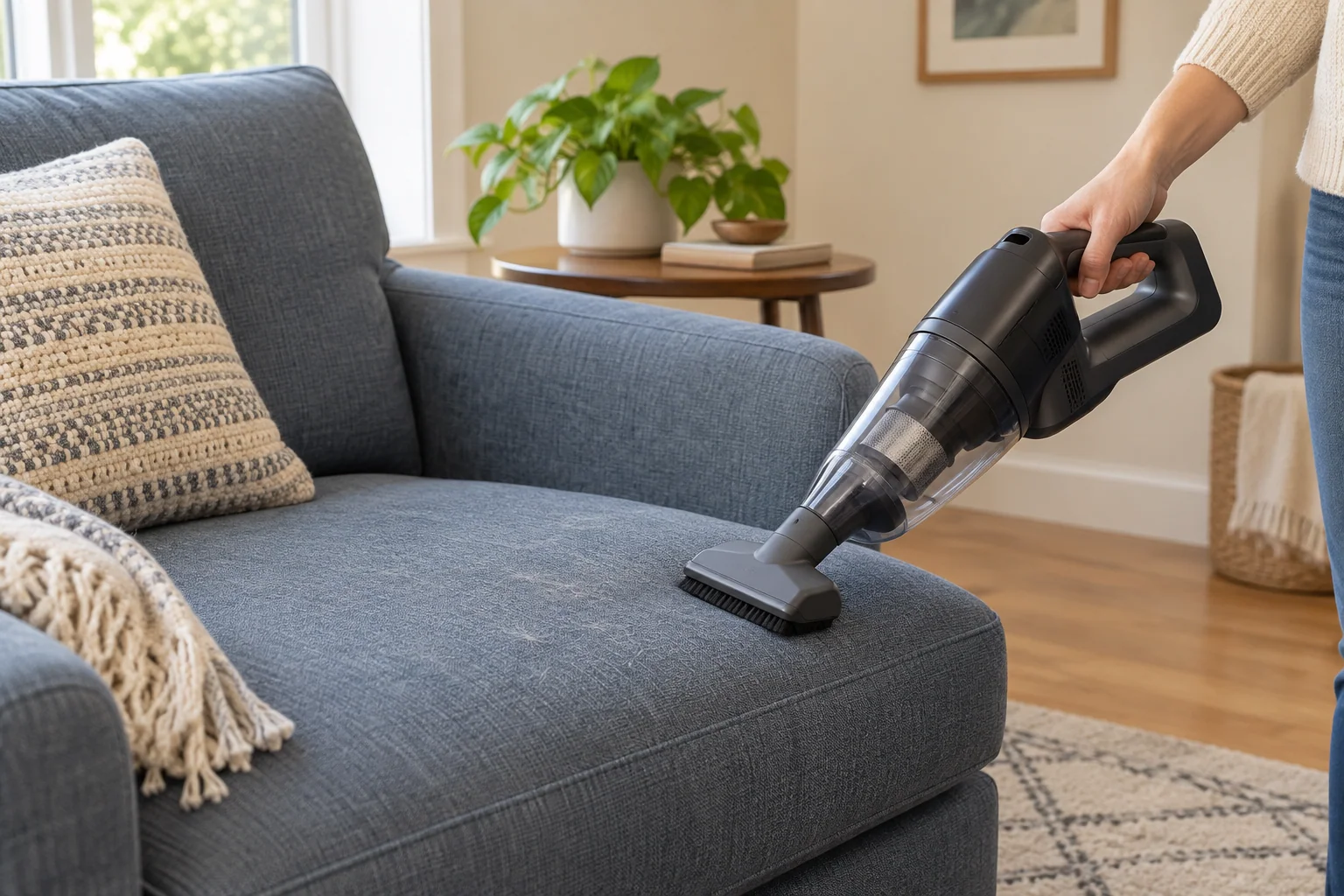
Look at where cleaning fails. Fur left in a sofa seam suggests a different attachment problem from hair tangled around a floor head. An overfilled container, blocked path or overdue filter also deserves attention before a new purchase.
Follow the existing machine's manual: inspect the head and air path, empty or replace the collection container as directed, and service filters on the specified schedule. Wash only parts marked washable and allow the prescribed drying time. Do not improvise a filter substitute to improve suction.
A filter claim is not a whole-machine test
A vacuum must collect debris and retain what it collects. A high-efficiency filter label alone does not document the sealing, exhaust emissions or performance of the assembled appliance. Ask for model-specific evidence rather than transferring a claim about one filter material to the entire machine.
The American College of Allergy, Asthma and Immunology includes high-efficiency vacuum cleaning among measures that may help reduce pet-allergen exposure. That is not evidence that every vacuum marketed for pets has equivalent performance.
For a buying brief, list your surfaces, upholstery attachment, weight you can handle, collection method and recurring supplies. If the problem is loose coat before it reaches the room, that belongs to our grooming-tools comparison. Do not use a household vacuum directly on the cat.
For a purifier, ask how much clean air reaches the room.
“HEPA” concerns particle filtration, but it does not tell you how quickly an assembled purifier processes a particular room. Clean air delivery rate, or CADR, combines airflow and particle removal into an output measure. Compare like-for-like units and the stated test conditions.
A room-size example with the units left intact
AHAM Verifide's rule of thumb is a smoke CADR in cubic feet per minute of at least two-thirds of the room area in square feet. Its example is a 10 ft × 12 ft room: 120 sq ft calls for at least 80 CFM. Ceilings above 8 ft (about 2.44 m) need more capacity.
Do not apply “two-thirds” directly to square metres. For orientation, 80 CFM is approximately 136 m³/h; that unit conversion does not itself assess your room, ceiling height or operating speed.
The EPA's buying guide notes that CADR is usually measured at the highest speed. If you will only tolerate a quieter setting, ask for performance at that setting. An impressive maximum figure is less useful if normal household use requires much less airflow.
Odour filtration needs a separate question
The same EPA guide distinguishes particles from gases and discusses activated carbon for gases. There is no widely used equivalent CADR rating for gas removal. A thin carbon layer or “pet odour” badge therefore does not establish the duration or extent of odour control. Ask which gases were tested and when the media needs replacement.
Filtration supplements source control and suitable ventilation. It does not make an unclean source disappear. For safety, avoid devices sold as ozone generators for occupied spaces; ozone is a lung irritant, not a household freshness strategy.
A cleaner-looking room is not an allergen measurement.
ACAAI explains that pet allergy involves proteins associated with skin, saliva and urine. Visible fur is not a complete proxy for those exposures. That is why a hair-covered cushion and airborne allergen levels are different observations.
ACAAI discusses room filtration and cleaning within broader exposure management. It does not make either an individual treatment guarantee. Persistent symptoms need appropriate medical assessment, especially when breathing is affected. Do not delay care to run a home appliance experiment.
What does the green light actually measure?
The EPA says low-cost monitors measure only the pollutants or environmental factors their sensors are designed for. Read the model's sensor description: a particulate-matter value is not a direct assay for the cat allergen Fel d 1.
Our interpretation: a lower PM reading can describe that sensor's particle measurement, but cannot by itself establish an allergen-free room or predict symptom relief. Likewise, hair in a pre-filter shows collection, not a percentage reduction in household allergy risk.
Original practical resource · Version 1.0
Make a one-room plan before buying a second appliance.
Choose the room where the problem matters most and write one concrete goal. “Remove fur from the blue sofa” is more useful than “make the house healthier”. This is a household planning aid, not an air-quality audit or clinical test.
- Locate the problem. Record the surface, airborne-particle concern or smell and what you have actually observed. Keep symptoms separate for medical advice.
- Check the existing routine. Note the attachment, machine condition, washable covers and cleaning constraints. Try appropriate maintenance before assuming replacement is necessary.
- Check the room. Measure floor area and ceiling height. Record where an appliance can stand with the manufacturer's required clearance and an accessible socket.
- Plan for the cat. Keep a familiar quiet refuge and essential resources accessible. Do not trap the cat beside a noisy machine or route cables across its path.
- Budget the routine you can sustain. Use the intended fan setting, hours, cleaning time and genuine replacement-filter costs. An unknown price stays unknown.
The AAFP/ISFM environmental guidelines support accessible safe places and separated resources. Our cleaning-plan application is to protect that choice while using household appliances, not to prescribe a universal safe distance or decibel limit.
Open the printable one-room cleaning plan. It is free to use without an account, purchase or required backlink. Editors and carers can cite André Ribeiro, Félinscope, One-room cleaning plan, version 1.0, 12 October 2026; the section link provides its method and limits.
Calculate the routine, not just the purchase price.
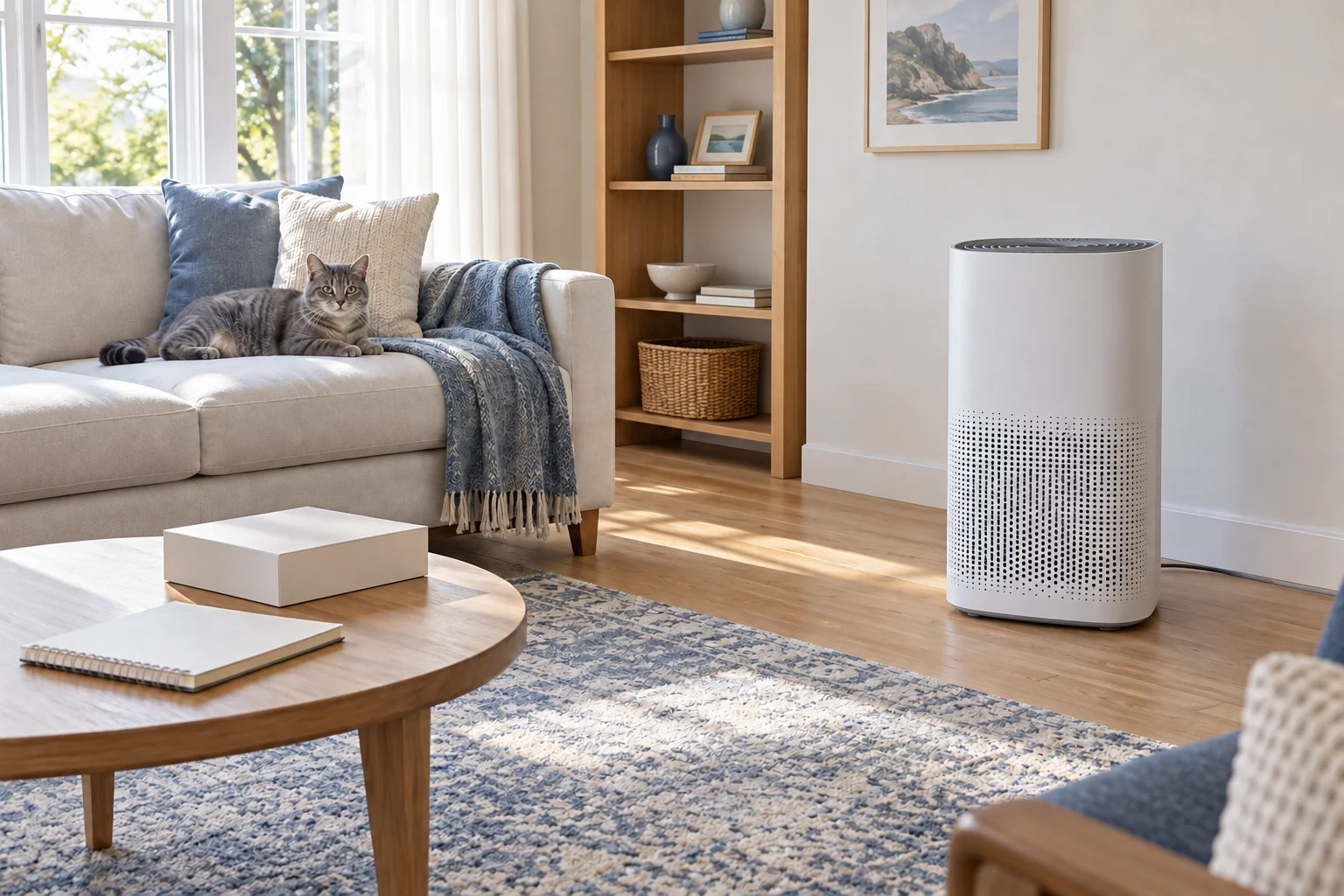
A purifier running for many hours and a vacuum used intermittently have different schedules. Our calculator keeps their budgets separate and then adds them if you want both. It does not rank cleaning performance or claim that the cheaper appliance replaces the other.
The electricity method follows the standard watts, time and tariff calculation explained by Virginia Cooperative Extension. Use electrical input at the relevant setting. For a cordless vacuum, charging input and charging time are the relevant pair, not advertised suction “air watts”.
Build a budget from your own figures
All numerical fields start blank. Use your tariff, chosen operating setting and expected consumables. These are fixed-input estimates, not a product test or a prediction of air quality.
Private by design: entries stay in this page's memory. The calculator does not save, transmit or track them. Reloading or leaving loses the entries; copy or download if you want to keep them.
A label only. Changing currency does not convert values; update your figures yourself.
Use the unit price from your bill in the selected currency, not pence or cents. Excludes standing charges.
Air purifier budget
Use a measured value or the manufacturer's figure for that setting. Maximum rated power may overestimate normal use.
Between 0 and 24. Use an average that represents the year.
Your expected replacement filters for one year, including delivery if relevant. Enter 0 only if no cost is expected.
Purifier annual estimate
- Annual electricity use
- Not calculated
- Annual electricity cost
- Not calculated
- Annual consumables
- Not calculated
- Estimated annual running cost
- Not calculated
Vacuum budget
Use electrical input, not air watts or suction power. For a cordless model, use measured charging power and charging time.
For a corded model, enter cleaning time; for a cordless model, enter charging time. Maximum 10,080 minutes.
Your expected bags and replacement filters for one year. Enter 0 only if no cost is expected.
Vacuum annual estimate
- Annual electricity use
- Not calculated
- Annual electricity cost
- Not calculated
- Annual consumables
- Not calculated
- Estimated annual running cost
- Not calculated
The combined budget appears only when every field and the currency are entered correctly. Blank means unknown, not zero.
Calculation method and limits
Purifier electricity use = watts × hours per day × 365 ÷ 1,000. Vacuum electricity use = wall-input watts × minutes per week ÷ 60 × 52 ÷ 1,000. Multiply each result by your tariff, then add its annual consumables.
Calculations use unrounded values; displayed totals are rounded to two decimal places. The annual schedules are 365 days and 52 weeks respectively. Purchase price, repairs, standing charges and unrecorded standby use are excluded.
Actual power varies with setting, charging stage and device behaviour. A measured average is more useful than a maximum rating. A lower running cost does not establish equivalent cleaning, filtration or health benefits.
Keep estimates in one currency and check replacement-pack sizes. A two-pack price is not a single-filter cost. Follow the exact replacement guidance and actual condition; there is no universal annual filter bill. Add purchase price and expected repairs separately if you need a broader ownership budget.
A worked budget, without inventing product performance
Hypothetical figures, not prices or measurements of real products: suppose electricity costs 0.30 per kWh in your chosen currency. The purifier uses 40 W for 12 hours a day; the corded vacuum uses 600 W for 60 minutes a week.
| Annual estimate | Purifier | Vacuum |
|---|---|---|
| Electricity use | 40 × 12 × 365 ÷ 1,000 = 175.20 kWh | 600 × 60 ÷ 60 × 52 ÷ 1,000 = 31.20 kWh |
| Electricity cost | 52.56 | 9.36 |
| Assumed annual consumables | 60.00 | 24.00 |
| Estimated running cost | 112.56 | 33.36 |
Both together total 145.92 per year under those assumptions. That result excludes purchase prices, repairs and unrecorded standby consumption. It is not evidence that the vacuum delivers the same benefit for less money. Changing the purifier speed also changes its air-cleaning output, not just the electricity line.
If equipment still has a job to do
For a purifier shortlist, record room dimensions, CADR units and speed, replacement-filter reference, local supply, annual cost and placement instructions. For a vacuum, record surfaces, collection system, attachments, filtration evidence and maintenance. Ask for missing information before treating a “pet” badge as an answer.
The country-labelled links below open Amazon category searches, not tested selections. Results can include unsuitable sizes, unrelated accessories or unsupported claims. Search wording does not verify a model's filtration, safety or suitability.
Affiliate disclosure: as an Amazon Associate, Félinscope earns from qualifying purchases. We have not verified each listing's current price, stock or performance. Maintaining a working machine and buying nothing remains a legitimate outcome.
As an Amazon Associate I earn from qualifying purchases. These country-labelled searches are not recommendations: verify the exact model, seller, price, delivery and return terms.
All source links in this article are ordinary, non-affiliate references. Read our affiliate policy.
Common questions
Can an air purifier remove cat hair?
It may collect some hair carried to its intake. It cannot reliably remove fur attached to upholstery or settled around the room. Use surface cleaning for that job; choose room filtration for an identified airborne-particle concern.
Should I buy a purifier or a better vacuum first?
For visible hair on surfaces, check the vacuum's condition, attachments and cleaning routine first. A purifier is a separate decision about room air. There is no universal order for every household and no obligation to buy both.
Does HEPA mean the machine removes all cat allergens?
No. A filter designation does not prove complete-room removal or symptom relief. Airflow, containment, placement, use and continuing sources matter. Follow professional advice for allergy management.
Can I use a purifier to avoid cleaning the litter area?
No. Deal with the source and maintain appropriate hygiene. Particle filtration is not the same as gas or odour removal, and masking a smell does not resolve its cause.
Does a purifier's PM display measure cat allergens?
Not unless the device has a specifically validated measurement for the allergen concerned. An ordinary PM sensor reports a particle metric, not a direct Fel d 1 result or a medical clearance.
Does the calculator recommend the cheaper appliance?
No. It estimates energy and consumable spending from your inputs. It does not measure hair collection, clean-air delivery, noise or health outcomes, so it cannot establish an equivalent-performance winner.
Sources, method and limits
André Ribeiro prepared this documentary comparison using eight primary references, checked on 12 October 2026. We separated air-cleaning guidance, allergy information, feline environmental guidance and energy arithmetic. No purifier or vacuum was physically tested for this article; no clinical or veterinary review is claimed.
The decision table, one-room plan and hypothetical budget are Félinscope's editorial synthesis. The calculator performs transparent arithmetic, not an effectiveness simulation. We measured no particle reduction, allergen concentration, noise or power draw. All three images are AI-generated illustrations.
- US EPA: Guide to Air Cleaners in the Home. CADR, fan speed, gases and source control.
- US EPA: Air Cleaners and Air Filters in the Home. Scope of portable units and filtration limits.
- AHAM Verifide: Air Filtration Standards. CADR units and room-sizing example.
- US EPA: Low-Cost Air Pollution Monitors and Indoor Air Quality. Sensor scope and interpretation limits.
- ACAAI: Pet Allergies. Allergens, diagnosis and exposure-management measures.
- US EPA: Ozone Generators that are Sold as Air Cleaners. Ozone exposure and effectiveness concerns.
- Virginia Cooperative Extension: Estimating Appliance and Home Electronic Energy Use. Electricity-use and cost arithmetic.
- Ellis and colleagues: AAFP/ISFM Feline Environmental Needs Guidelines (2013). DOI 10.1177/1098612X13477537. Safe places and resources.
See our review method and transparency policy. Corrections and newer evidence can be sent through our contact page.