The answer in 30 seconds
Neither source wins for every cat.
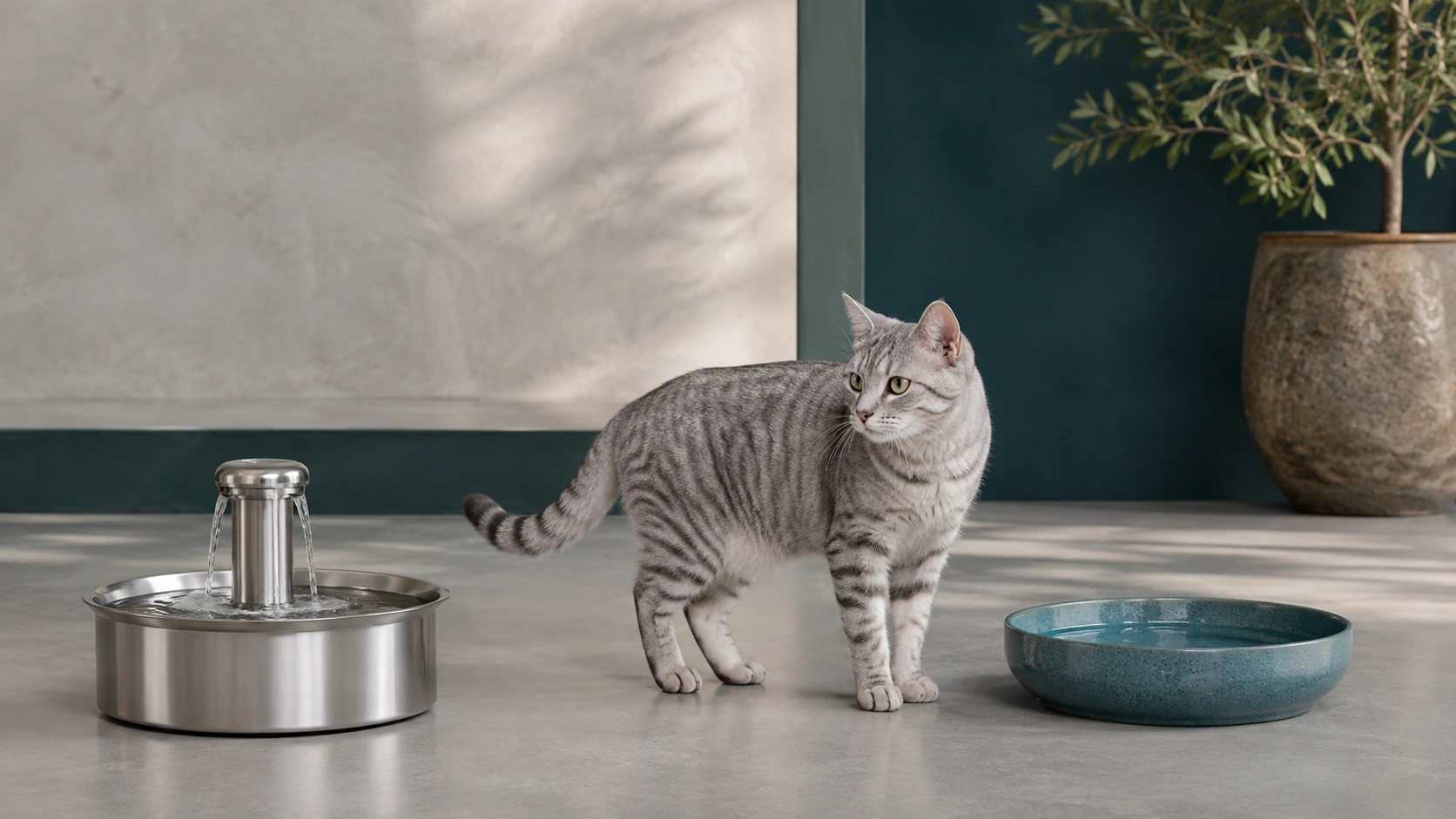
A fountain can be worth adding when the individual cat voluntarily uses it across two locations and the household can clean the complete water path. Controlled studies show individual preferences, not a reliable group-wide fountain advantage.
Bowls remain a valid primary system when they are wide, clean, quiet, accessible and distributed. Food moisture also counts: a cat eating wet food can show lower free-water drinking while taking in more total water.
Do not remove an accepted bowl to force a result. Keep a power-free source during introduction, cleaning and outages. A sudden change in drinking or urination belongs to veterinary assessment, not a shopping verdict.
Run the 14-day planner ↓This page owns the category decision: fountain, bowl or both. Exact smart-fountain features, filter costs, apps, cordless power and UVC belong in our separate Dockstream 2 vs Eversweet 3 Pro comparison.
Four controlled studies · one honest boundary
“Cats prefer running water” is too broad
The published picture is mixed. Small trials differ in design and direction, while individual cats can show a real preference that disappears inside the group average. A 2025 scoping review likewise describes a still-developing evidence base rather than one universal container prescription.
| Evidence | Design | What it found | What it cannot prove |
|---|---|---|---|
| Grant, 2010 | Randomised two-period crossover; 12 cats completed | Mean free-water intake was higher with the fountain in the main analysis, but the result weakened when one cat with a diet inconsistency was excluded; urine concentration did not differ. | Does not justify replacing an accepted bowl or promise more intake for one cat. |
| Pachel & Neilson, 2010 | Still versus flowing water; nine cats | The group difference was not significant. Individual cats showed strong and different source preferences. | A group average cannot select the source for your cat. |
| Robbins et al., 2019 | Still, circulating and free-falling sources; 14 cats completed | No meaningful group effect on water intake or urine measures; three cats showed an individual source preference. | Water movement alone is not a universal hydration intervention. |
| van Diggelen et al., 2026 | Twelve colony and ten privately owned cats across dry, mixed and wet diets | Free-water intake was greatest on dry food, while total water intake was greatest on wet food. Food moisture changed the interpretation of the device total. | In multi-pet homes, group drinking events were divided equally; that cannot prove each cat's volume. |
Read the original work: Grant 2010 , Pachel & Neilson 2010 , Robbins et al. 2019 and van Diggelen et al. 2026 . Samples are small, conditions differ and none proves that a fountain prevents disease.
The denominator most comparisons omit
Free water is not total water
Cornell’s Feline Health Center explains that food moisture contributes to hydration. The 2026 diet study makes the consequence concrete: cats on dry food drank more free water, while cats on wet food had greater total water intake.
- Free water
- Water taken from bowls, fountains and other drinking sources
- Food water
- Moisture already contained in wet, mixed or rehydrated food
- Practical total
- Free water + food water, interpreted with health and urine, not a fountain screen alone
Do not conclude “dehydrated” from a low fountain total. First identify the cat, food moisture, spills, other sources and the observation period.
Judge the system on its worst day
Five gates matter before water starts moving
International Cat Care and feline environmental-needs guidance support fresh, accessible and distributed resources. A machine with a large tank still fails if one cat guards it or a dirty pump becomes the only route.
Accepted access
The cat approaches, drinks and leaves without startle, guarding or being trapped by another cat.
Distributed choice
Sources are separate, quiet and away from litter and food; one cat cannot control the only route.
Clean water path
The bowl surface, fountain tray, reservoir, outlet and pump can all be inspected and cleaned.
Visible failure
Low water, loss of flow, noise, slime, a flat battery or a power cut is noticed before access disappears.
Power-free fallback
A familiar clean bowl remains available during introduction, cleaning, charging, travel and outages.
Interactive household decision
Make the result survive location, cleaning and power
Enter what you have actually observed. The planner refuses to call a fountain a winner when the trial, maintenance or backup gate is still open.
A few visits can reflect novelty or a preferred corner. Keep the accepted bowl, separate the stations, hold diet steady and complete the position swap before calling one source the winner.
- Current route
- Start the 14-day audit
- Diet context
- Not recorded
- Attribution
- Direct observation possible
A reversible 14-day crossover
Swap the sources, not the whole household
The two-round layout asks whether preference follows the water source or stays with a favourite corner. Keep normal food and accepted access stable, and stop if the cat drinks less or appears unwell.
- 01
Protect the baseline
Keep every familiar water source. Record usual food type, wet-food quantity, medication, weather and any health change; do not begin during illness or a diet transition.
- 02
Map the locations
Choose two quiet, accessible positions away from food and litter. In multi-cat homes, add enough separate sources that no individual can guard the route.
- 03
Observe days 1–3
Use clean bowls to establish approach, drinking and avoidance patterns. Record visible spills and every top-up at the same time each day.
- 04
Run position A on days 4–8
Place the fountain at location A and the accepted bowl at location B. Introduce the object, then water, then motor; never remove the bowl to force use.
- 05
Reset without fragrance
Clean both water paths according to their instructions. Keep water source, fill routine, food and observation windows as stable as practical.
- 06
Swap positions on days 9–13
Move the fountain to B and the bowl to A. A preference that moves with the source is more informative than a preference that stays with one corner.
- 07
Decide on day 14
Keep bowls, add a fountain as an extra source, preserve both, or stop the test. The decision must also pass cleaning, outage and access gates.
Measurement without false precision
Water missing from a vessel is not automatically swallowed
Evaporation, fountain spray, paw play, cleaning, top-ups and another cat all change the total. Use the same observation window and record the uncertainty beside the number.
Behaviour
Approach, startle, voluntary drinking, detour, waiting, guarding and which location was used.
Water path
Starting fill, every top-up, remaining water, visible spills, power loss, pump noise and cleaning.
Context
Food moisture, mealtimes, other sources, weather, medication and the length of the observation window.
Individual volume
A shared reservoir is a household total unless reliable identification follows each event.
The maintenance comparison
A filter is not a cleaning cycle
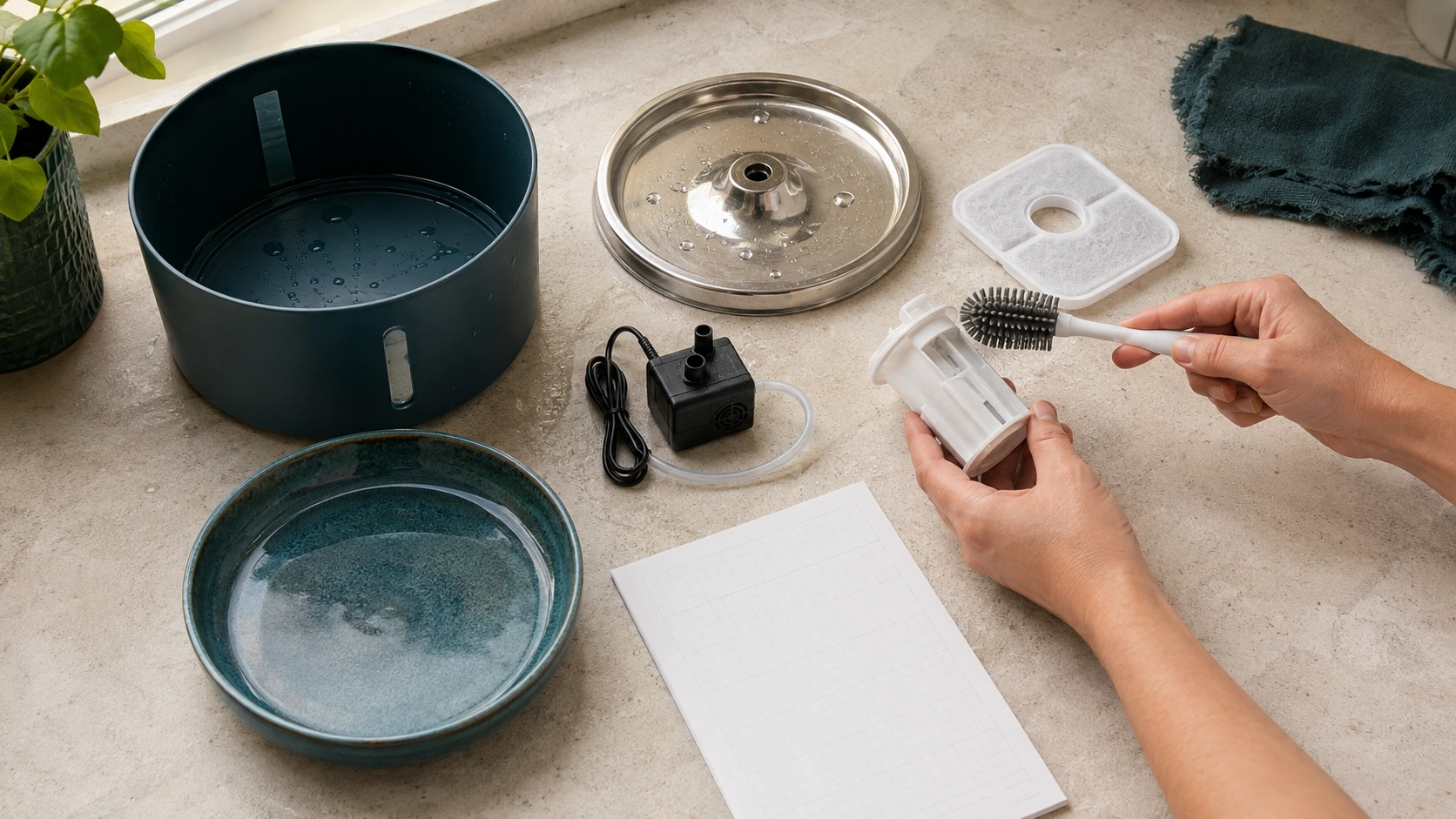
Bowls expose most of the wetted surface at a glance. Fountains add a reservoir, outlet, pump, rotor, seams and often a filter. That can still be a good trade when the cat uses the source and the parts are genuinely serviceable.
- Inspect freshness, flow, noise, debris and surface film every day if practical.
- Follow the exact manual for disassembly, electrical separation and filter replacement.
- Clean the pump and outlet; replacing a cartridge cannot remove film from them.
- Keep a clean bowl available while parts dry, charge or await replacement.
Failure-first comparison
Write the fallback before choosing the container
The useful source is one whose failure becomes visible early and does not remove all accepted water access.
Power, battery or pump stops
- Likely clue
- Flow or sound changes; tray may retain only a shallow amount
- Safe response
- Restore the accepted bowl immediately, then inspect the exact manual before restarting.
Reservoir empties
- Likely clue
- Pump tone changes, air enters the flow or an alert appears
- Safe response
- Provide fresh water first. Recalculate usable capacity, rather than advertised capacity, around the longest unattended period.
Biofilm or debris develops
- Likely clue
- Slippery surface, odour, foam, hair or reduced flow
- Safe response
- Disassemble and clean the whole water path; a new filter does not scrub the pump or outlet.
One cat controls the station
- Likely clue
- Waiting, staring, displacement or drinking only when another cat leaves
- Safe response
- Distribute additional sources out of sight of one another; a larger reservoir is not independent access.
The fountain is refused
- Likely clue
- Startle, detour, crouched approach or no voluntary use
- Safe response
- Return to the staged introduction or keep bowls. Never create thirst to manufacture acceptance.
The reading changes suddenly
- Likely clue
- A device total rises or falls, or the bowl seems untouched
- Safe response
- Check spills, cleaning, food moisture and which cat used it; escalate health changes to a veterinarian.
Health boundary
The source can reveal change. It cannot explain it.
Contact a veterinarian about a marked or persistent change in drinking or urination, appetite loss, vomiting, lethargy, weight change or suspected dehydration. Repeated straining with little or no urine can be an emergency; contact a veterinary service immediately.
- diagnose kidney, urinary or endocrine disease;
- set an individual medical intake target;
- delay care while collecting better app data;
- force a cat to accept one water source.
Direct answers
Cat water fountain vs bowl FAQ
Are cat water fountains better than bowls?
Not universally. Controlled studies do not show one group-wide winner, while individual cats can prefer still, circulating or free-falling water. The better system is the one that provides accepted, clean, distributed access and remains usable when power or cleaning interrupts the fountain.
Do cats drink more water from a fountain?
Some do, but the average evidence is mixed. One crossover study reported higher intake in its main analysis, another found no significant group difference, and a three-source study found no appreciable average effect. Test the individual cat without removing an accepted bowl.
Should I leave a bowl beside the cat fountain?
Keep a familiar bowl during introduction and as a power-free fallback, but place separate sources in different quiet locations rather than clustering every option together. Separation improves access and makes guarding easier to detect.
How many water sources does a multi-cat home need?
International Cat Care advises at least one source per cat plus an extra, distributed across the home. Treat that as a starting layout rather than a guarantee: sight lines, levels, mobility and social tension determine whether each source is genuinely accessible.
Does wet food count toward a cat's water intake?
Yes. Food moisture contributes to total water intake. A 2026 study found greater free-water intake with dry food but greater total water intake with wet food, so a lower bowl or fountain total is not automatically lower total hydration.
Can a smart fountain tell how much each cat drank?
Only if the exact system can identify individuals reliably under the way they approach and share the station. A reservoir or household total cannot assign intake to one cat. Even research in multi-pet homes has had to apportion group events, which is an explicit limitation.
How often should a cat fountain be cleaned?
Follow the exact manual and shorten the interval when you see debris, slime, odour or reduced flow. Inspect water daily if possible and clean every wetted component, including the tray, reservoir, outlet and pump. Replacing a filter is not the same as cleaning.
Is a stainless-steel fountain safer than a plastic one?
Material alone is not a safety verdict. Inspect seams, coatings, scratches, pump access, disassembly and whether every wetted surface can be cleaned. Replace damaged components according to the manufacturer rather than assuming any material stays hygienic by itself.
What should I measure during a fountain-versus-bowl test?
Record voluntary approaches, clear drinking events, location, food moisture, top-ups, remaining water, spills, cleaning and failures. Water lost from a vessel is not automatically water swallowed, and a multi-cat total is not an individual measurement.
When is changed drinking a veterinary concern?
A marked or persistent change in drinking or urination, repeated straining, little or no urine, vomiting, lethargy, appetite loss or suspected dehydration needs veterinary advice. Repeated straining with little or no urine can be an emergency; contact a veterinary service immediately.
Source ledger
What supports each conclusion
Primary studies carry the efficacy claims; veterinary and feline-welfare sources carry hydration, placement and escalation guidance. Accessed 6 September 2026.
- Grant, 2010: effect of a water fountain on intake and urine measures Randomised crossover; main result, sensitivity analysis and non-universal response.
- Pachel & Neilson, 2010: still versus flowing water preference Small controlled comparison; group result and strong individual variation.
- Robbins et al., 2019: still, circulating and free-falling water Three-period crossover; intake, urinalysis and individual source preference.
- van Diggelen et al., 2026: dietary moisture and water intake Free versus total water, home-device method, multi-cat attribution and disclosed funding limits.
- Journal of Animal Science, 2025: feline water-intake scoping review Thirty-two publications mapped across dietary and environmental factors.
- Cornell Feline Health Center: hydration Food moisture, individual fountain preference and veterinary context.
- International Cat Care: encouraging a cat to drink Distributed sources, placement, freshness, cleaning and staged fountain introduction.
- AAFP/ISFM feline environmental needs guidelines Separate, distributed key resources and multi-cat access.