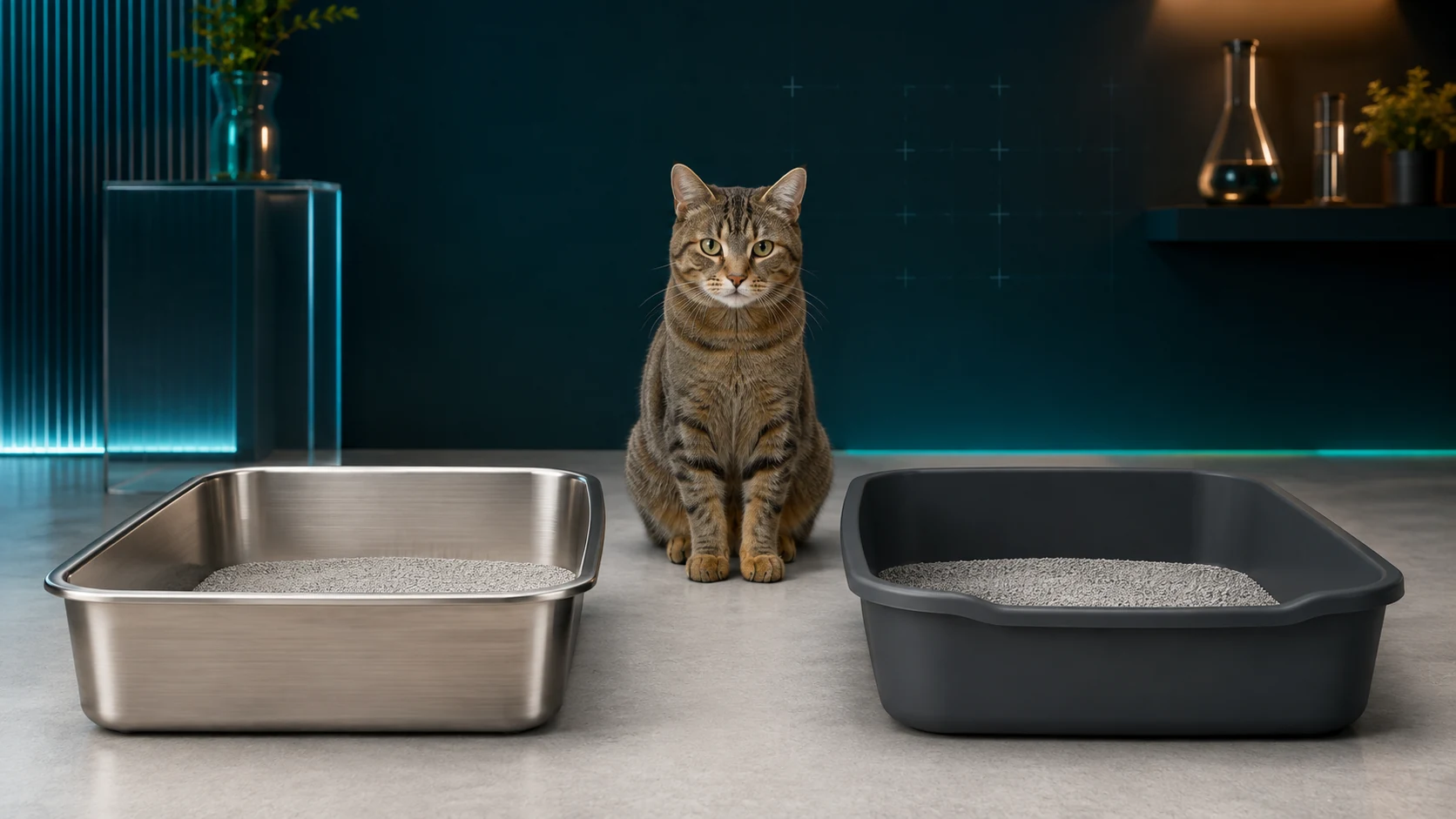
The answer in 30 seconds
Choose the best pan, not the best material.
Try stainless steel when both candidates are equally roomy and accessible, but the current plastic pan is deeply scored, unstable or difficult to return to a clean neutral surface.
Choose plastic when it provides meaningfully more usable floor, a lower entrance, safer carrying or enough affordable boxes for a multi-cat home.
Buy neither when both are too short, the entrance blocks comfortable access, or the seller lists only outside dimensions.
Measure two candidates ↓The most defensible conclusion is deliberately less dramatic than many retail pages: no controlled feline trial located for this review establishes a universal preference for stainless steel over plastic. Veterinary guidance is much clearer about size, cleanliness, location, litter and individual preference. Material belongs inside that system, not above it.
Fit-first decision · reviewed 3 September 2026
Measure the pan before comparing materials
Seller claims can overstate hygiene, lifespan and savings. Compare actual candidates by usable floor, wall height, entry, location and the cat’s acceptance before treating steel or plastic as the answer.
Material becomes the verdict
Retail-led pages often start from odour and durability, then treat steel as the automatic upgrade. That skips box dimensions, entry height and the cat’s individual acceptance.
Whole-pan trade-offs appear
The strongest editorial pages now mention size, weight, noise and access. They still leave the reader to translate an XL label into usable floor space.
Two candidates become measurable
Our planner compares the cat’s body length with each pan’s interior length, then applies mobility, condition and household workflow before suggesting a home trial.
The decision order
Material is criterion six
Run the choice in this order. A failure higher in the stack cannot be repaired by a premium surface lower down.
- 01
Usable interior length
Start near 1.5 times nose-to-tail-base length. Measure at litter level, where sloped sides and rounded corners reduce usable space.
- 02
Entrance and turning access
The cat must enter, turn, dig, posture and leave comfortably. Pain, age and disability can make a high rim decisive.
- 03
Location and escape route
A large pan in a noisy dead end can still fail. Keep resources separated and avoid forcing one cat to pass another.
- 04
Litter and cleaning
Keep substrate and scooping predictable during a pan trial. Changing three variables at once destroys the comparison.
- 05
Side height and stability
Containment for high spraying must coexist with an accessible entrance. Test sliding on the real floor.
- 06
Steel or plastic
Only now compare surface wear, weight, noise, sink fit, price and expected household use.
Whole-pan comparison
Stainless steel vs plastic, without the magic claims
These are material tendencies, not product guarantees. Construction, dimensions, seams and household use can matter more.
| Decision point | Stainless steel | Plastic | What to do |
|---|---|---|---|
| Usable floor | Frequently rectangular and rigid, but the retail range can be narrower | Broad range of shapes and very large storage-style options | Measure the interior at litter level. The roomier pan wins even when its material is less fashionable. |
| Entrance and walls | Many models use a high wall shell or clip-on surround | Low-entry, high-back, corner and cut-out shapes are widely available | Mobility and urine direction can reverse a material-led choice. |
| Surface over time | A smooth steel pan resists deep scoop scoring and does not flex easily | Light and practical, but repeated digging and scooping can leave rough grooves | Inspect the real surface. Do not replace an intact pan on a calendar alone. |
| Cleaning workflow | Rigid, smooth surfaces can be straightforward to wipe; weight and sink fit still matter | Lighter to carry and available in one-piece moulded shapes; damaged surfaces can become harder to restore | A theoretical hygiene advantage is useless if the pan is too heavy or awkward to wash consistently. |
| Sound and feel | Claws, scoop and litter can sound sharper; litter depth and room acoustics change the effect | Usually quieter and less reflective | Noise-sensitive cats deserve a side-by-side acceptance test, not an assumption. |
| Stability | Higher empty weight can reduce sliding | May flex or slide when light, but a suitable mat can help | Judge the filled setup on its actual floor. |
| Damage trigger | Replace for sharp edges, failed seams, corrosion or instability | Replace for cracks, sharp roughness, warping, instability or retained residue that normal washing no longer resolves | Condition-based replacement is more defensible than an invented one- or two-year deadline. |
| Cost | Usually higher upfront; lifetime varies by construction, care and household | Usually lower upfront and easier to duplicate across rooms | Compare cost per usable year only after both options pass fit and access. |
Interactive fit planner
Make the XL label prove itself
Enter the cat’s measured body length and the usable interior length of two candidates. The result prioritises fit, access and condition before material.
A controlled household test
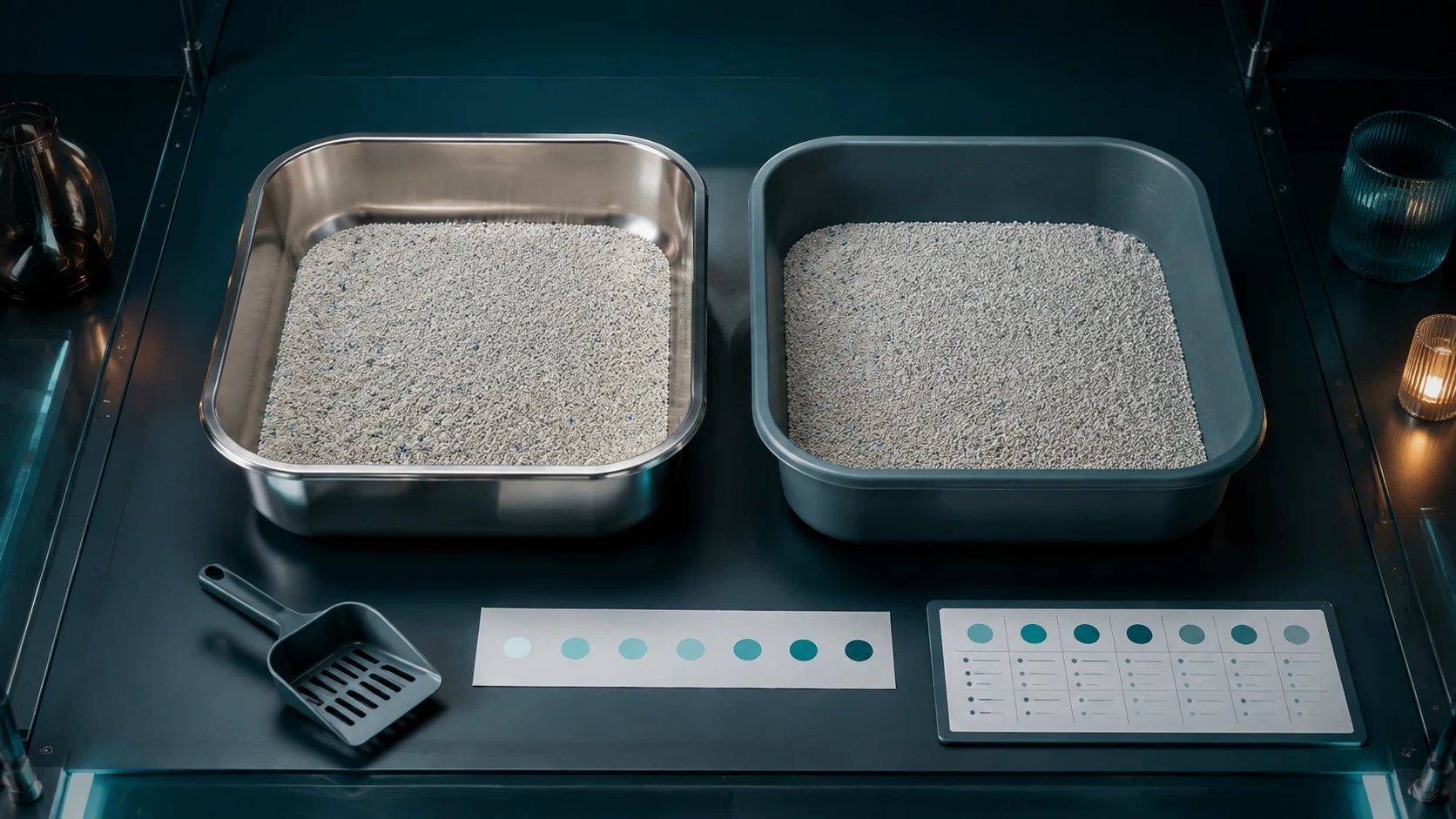
The 30-day paired-box audit
A single first use proves very little. Control the variables, swap positions and count repeated voluntary use.
- 01Days 0–3
Establish the baseline
Keep the current setup unchanged. Record daily uses, misses, digging against walls, cleaning time and whether odour returns after a normal wash.
- 02Days 4–17
Offer two matched boxes
Place both boxes in equivalent quiet positions. Use the same unscented litter type and depth, comparable usable size, the same scooping schedule and no liner in only one box.
- 03Days 18–24
Swap positions, not identities
Switch the left-right positions while keeping litter and cleaning stable. A location preference can otherwise look like a material preference.
- 04Days 25–30
Decide from repeated behaviour
Compare voluntary uses, misses, entry hesitation, wall contact, noise reactions and human cleaning effort. Keep both if different cats or different locations produce different winners.
Cost without fictional lifespans
After confirming fit, compare cost per usable year
Divide purchase price plus necessary accessories by the number of years the pan remains safe, cleanable and accepted. Because that final number is unknown at checkout, calculate scenarios rather than promises.
€90 steel ÷ 6 usable years
€15 per yearNot a lifespan claim. Recalculate if seams fail, corrosion appears, access changes or the cat rejects the pan.
€30 plastic ÷ 3 usable years
€10 per yearNot a replacement schedule. An intact, stable pan may remain usable longer; a cracked or sharply scored pan may not.
One premium pan is not three resources
Count access pointsA lower-cost material may be the better system if it allows multiple large boxes in separated locations.
Direct answers
Stainless-steel vs plastic litter box FAQ
Is a stainless-steel litter box better than plastic?
Not automatically. Steel can offer a rigid, smooth surface that resists deep scoring, while plastic offers more sizes, shapes, low entrances and lower upfront cost. The better box is large enough, accessible, stable, accepted and realistically cleanable.
Do stainless-steel litter boxes control odour better?
A smooth, undamaged steel surface is a reasonable hypothesis when an old plastic pan remains rough or retains residue after normal washing. Material alone cannot correct overdue scooping, soiled seams, unsuitable litter, poor location or urine outside the pan.
What size litter box should I buy?
Feline guidelines commonly use about 1.5 times the cat’s nose-to-tail-base length as a practical starting point. Measure the usable interior at litter level; an exterior XL label may overstate the space the cat can actually use.
How often should a plastic litter box be replaced?
There is no universal evidence-based calendar in the sources reviewed here. Replace based on condition: cracks, sharp or deeply rough areas, warping, instability, failed seams or residue and odour that persist after appropriate cleaning.
Are metal litter boxes too noisy for cats?
They can produce a sharper sound when claws, litter or a scoop contact the pan, but individual cats and rooms differ. Keep litter depth constant and compare voluntary use rather than predicting preference from material alone.
Which material is better for a senior cat?
Entry height and stable footing usually matter before material. Choose a large box with a comfortably low entrance and monitor posture, pain and elimination changes with a veterinarian.
How should I switch from plastic to stainless steel?
Add the new box without removing the accepted one, keep litter type, depth and scooping schedule stable, and observe use. A paired test is more informative than changing the pan, litter and location at the same time.
Where can I compare current litter-box options?
Félinscope provides clearly labelled Amazon category-search links for France, Belgium, the United States, Canada, the United Kingdom and Ireland. They open search results, not a verified exact product; dimensions, construction, seller, price and returns must be checked.
Primary evidence and limits
What supports the decision stack
Veterinary guidance supports the importance of size, cleanliness, location, resource provision and individual preference. It does not establish a universal steel-versus-plastic winner.
- AAFP/ISFM guidelines for diagnosing and solving house-soiling behaviour in cats · box size, number, placement, substrate, cleaning and individual preference.
- Correction to the AAFP/ISFM house-soiling guidelines · corrected large-box dimensions and the practical 1.5× body-length guideline.
- AAHA/AAFP feline life-stage guidelines: general litter-box considerations · accessible setup, box number and household placement.
- Journal of Feline Medicine and Surgery, 2025: litter-box size and litter type study · controlled comparison across 40, 50 and 60 cm box widths and evidence of individual use patterns.
- Journal of Feline Medicine and Surgery, 2013: covered versus uncovered litter boxes · most cats showed no overall cover preference, while a minority showed strong individual preferences; supports cafeteria-style testing.
- Cornell Feline Health Center: house-soiling behaviour · medical assessment, box management and the need to separate health problems from environmental hypotheses.
Source review completed 3 September 2026. No hands-on long-duration pan test was performed for this article. Product availability and retailer results can change.