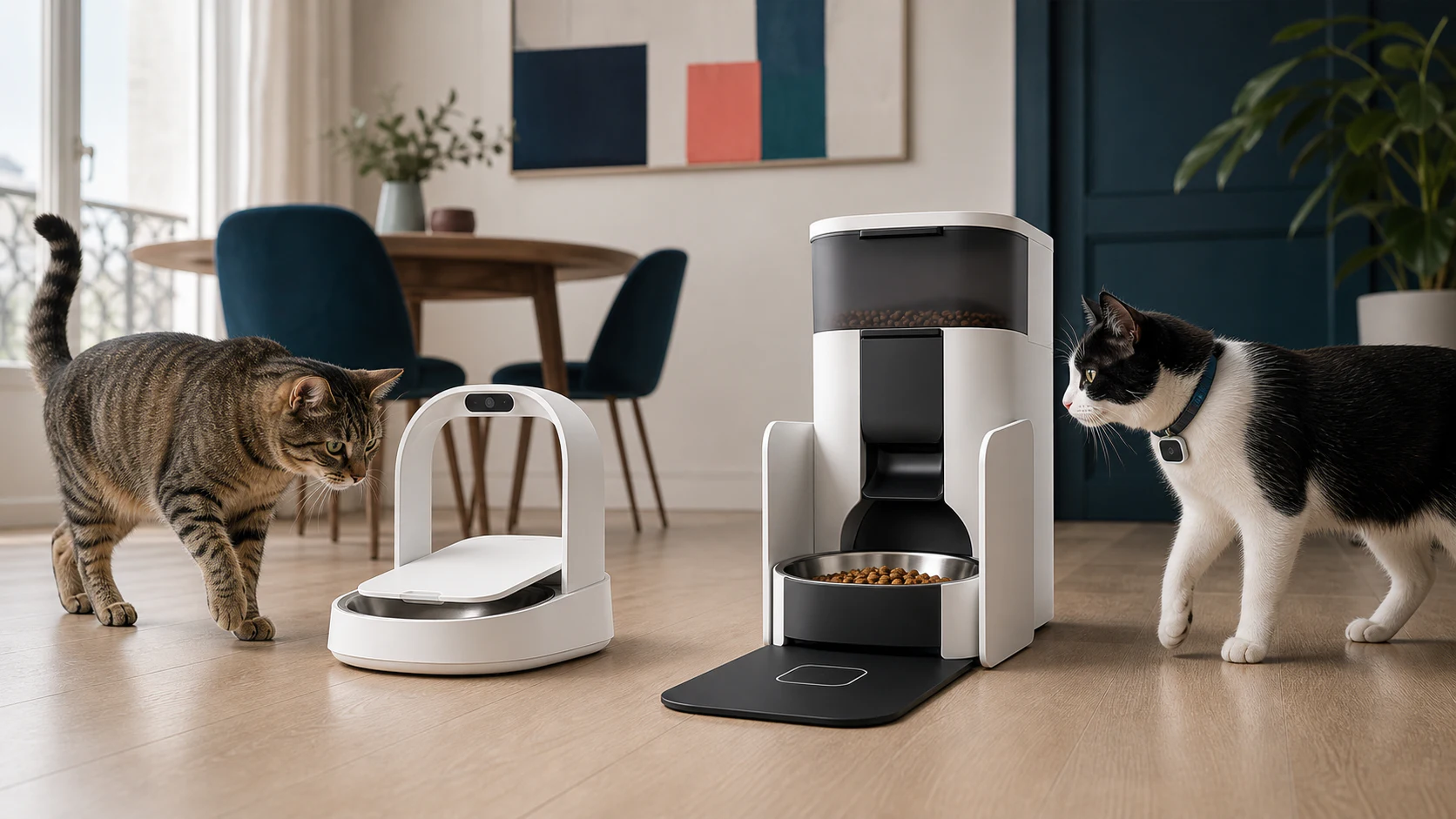
The answer in 30 seconds
SureFeed wins for wet food and no collar. PETLIBRO wins for scheduled kibble.
Choose SureFeed when the recurring problem is food theft from a prepared wet, dry or prescription meal. The standard model can recognise a compatible implanted identification chip, needs no app and can authorise up to 32 identities.
Choose PETLIBRO One RFID when one collar-wearing cat on dry food needs small scheduled portions that another animal cannot access. Its 3 L hopper, ten daily schedules and eating trends add timing and quantity control that SureFeed standard does not provide.
Choose neither without a fallback when a missed meal has immediate medical consequences. Test the machine, retain a manual feeding plan and separate animals when social pressure is part of the problem.
Decision links · Sponsored destinations appear later, after the fit and failure checks.Two neighbouring products, two different jobs
SureFeed vs PETLIBRO One RFID comparison table
We compare the standard SureFeed Microchip Pet Feeder with PETLIBRO One RFID model PLAF301. SureFeed Connect, PETLIBRO fountains and ordinary PETLIBRO dispensers are different products.
| Decision point | SureFeed standard | PETLIBRO One RFID | What it changes |
|---|---|---|---|
| The job | Protect food already placed in a bowl | Dispense and protect scheduled dry-food portions | SureFeed controls who. PETLIBRO controls who, when and roughly how much. |
| Identity key | Common implanted microchip or included Sure Petcare tag | Dedicated PETLIBRO collar tag only | PETLIBRO does not read the implanted identification chip. |
| Food | Wet or dry; about 400 ml in the supplied bowl | Dry food only; 2–15 mm kibble in a 3 L hopper | A wet-food prescription rules out the One RFID for this job. |
| Scheduling | None on the standard model | Up to 10 scheduled meals per day | One RFID is the stronger small-meal tool for dry diets. |
| Authorised pets | Up to 32 stored identities sharing access | One active tag per feeder | Two different PETLIBRO diets usually mean two units. |
| App and network | Not required on the standard model | PETLIBRO app; 2.4 and 5 GHz Wi-Fi | SureFeed has fewer account and network dependencies. |
| Power | 4 C batteries; maker states typical six-month life | Mains power plus 3 D batteries for backup | Test low-battery and outage plans before relying on either for a medical diet. |
| Collar | Optional when the implanted chip is used | Required; supplied snap-release tag weighs 4.2 g | A cat that will not safely retain a collar decides the comparison immediately. |
| Eating records | No app history on the standard model | Time and frequency trends in the app | Logs are useful prompts, not proof of calories eaten or a medical diagnosis. |
| Typical failure cost | Meal remains behind a lid or another pet follows closely | Tag, reader mat, rotor, power, app or schedule can fail | The more serious the diet, the more important the supervised fallback. |
Model pages and support documents checked 28 August 2026. Manufacturer features and market availability can change.
RFID is a technology, not a compatibility promise
The buying decision starts on the cat’s neck
Sure Petcare’s comparison page says the standard feeder reads common implanted microchips or its included collar tag. PETLIBRO states explicitly that One RFID currently reads its own collar tag and does not recognise implanted microchips.
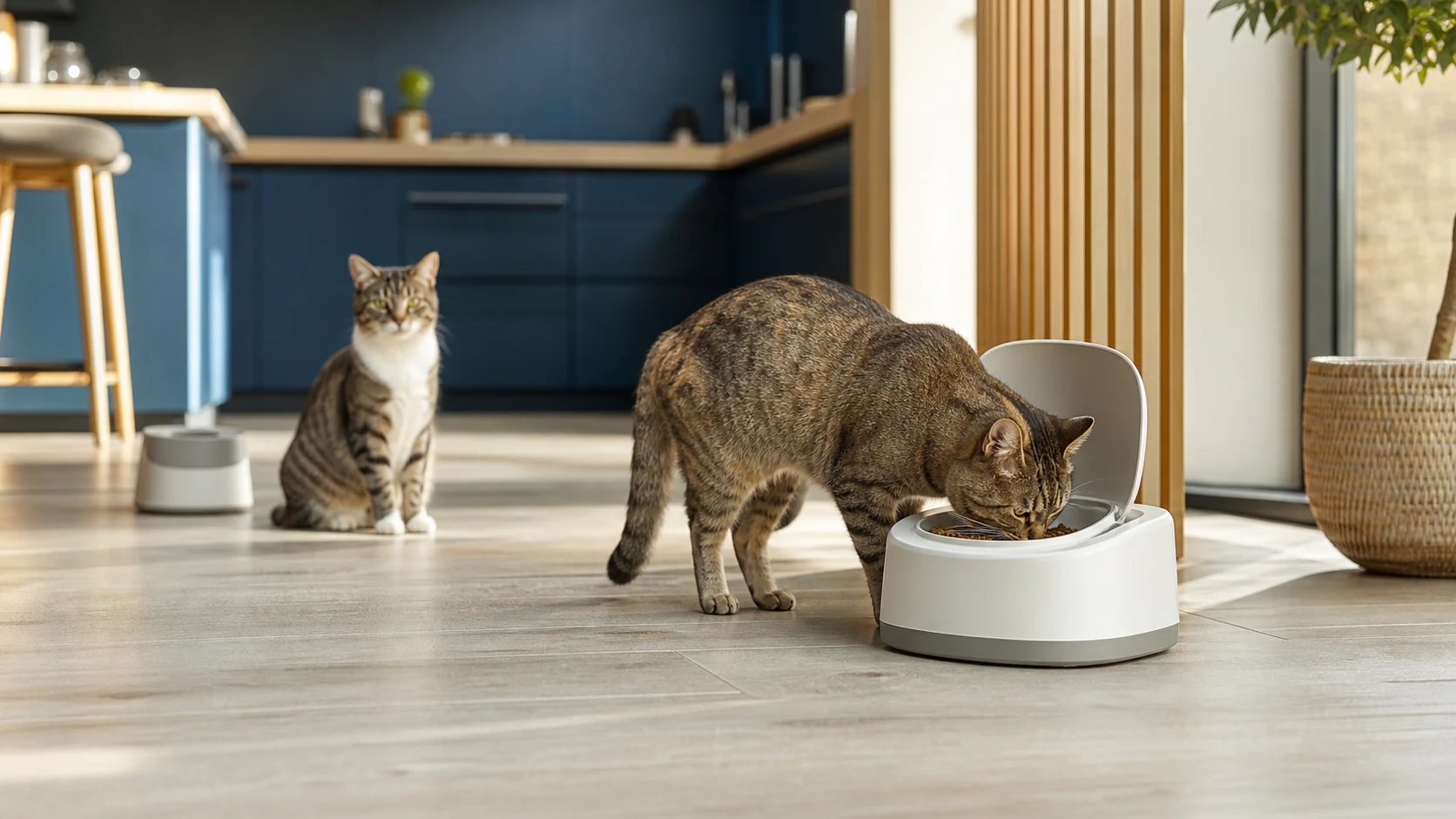
SureFeed recognises the animal
The implanted chip acts as the key. No battery or charging is added to the cat, and the manual states that stored identities remain in memory when feeder batteries are changed.
PETLIBRO recognises an accessory
The 4.2 g proprietary tag must remain on a collar and enter the reader-mat zone. If the tag is lost, removed or poorly positioned, the authorised cat loses access.
Collar safety becomes part of food security
Cats Protection recommends a quick-release or snap-opening cat collar, correctly fitted and checked. A safer breakaway design can also detach, which is exactly why a backup meal plan matters.
Guarded bowl or scheduled pantry
Wet food, kibble and the missing kitchen
SureFeed does not cook or dispense. You place up to about 400 ml into its bowl and the lid controls access. PETLIBRO stores up to 3 L of 2–15 mm kibble and releases scheduled portions before controlling the lid.
SureFeed only
The seal reduces exposure when closed, but the bowl is not refrigerated. Follow food-safety guidance and remove leftovers according to temperature and diet instructions.
SureFeed
A daily ration can remain available only to the authorised cat. Weigh the ration: the lid does not stop that cat returning repeatedly.
PETLIBRO
Up to ten scheduled meals can support fractionation. Calibrate the actual grams delivered because an app “portion” is not a universal nutritional measure.
Trend, not diagnosis
A visit or dispensing log does not prove the full portion was swallowed. Weight, behaviour, leftovers and veterinary context remain necessary.
Cornell Feline Health Center notes that age, health and household conditions affect feeding frequency. The machine should implement the feeding plan, not invent it.
Choose the household before the brand
Eight profiles that settle the comparison faster
The “best feeder” changes when the diet, collar tolerance, network and consequence of a missed meal change.
| Household profile | Better fit | Why |
|---|---|---|
| Wet prescription food | SureFeed | It protects a prepared wet ration and can recognise an implanted microchip. It does not refrigerate the food. |
| Dry food split into 5–10 small meals | PETLIBRO One RFID | The hopper and schedule solve timing as well as access for a collar-wearing cat. |
| Cat refuses collars | SureFeed | Use the compatible implanted chip instead of making a proprietary tag part of every meal. |
| Two cats share exactly the same food | SureFeed or a simpler feeder | SureFeed can authorise multiple identities; a selective machine may be unnecessary if there is no theft or diet conflict. |
| Two cats need different dry portions | Two PETLIBRO units | Each feeder is paired with one active tag. Budget for two machines, two safe locations and a backup plan. |
| Unreliable Wi-Fi | SureFeed standard | It works locally without an account. PETLIBRO states configured schedules continue during network errors, but remote controls do not. |
| Need to know whether a cat approached food | PETLIBRO One RFID | App trends add context, but direct observation and weight checks remain necessary. |
| Food theft has medical consequences | SureFeed plus separation | True microchip access reduces tag dependence, while separate rooms or supervised meals reduce tailgating and social pressure. |
FelineVMA multi-cat feeding notes warn that microchip feeders can fail to open and contribute to a negative food or bowl association. Technology should reduce conflict, not move it into one high-value doorway.
If tension also appears away from meals, treat the room as a separate problem. Our FELIWAY Classic vs Optimum guide starts with separated resources, a measurable outcome and a stopping rule.
If individual access is not the priority, compare camera-assisted portion evidence separately in our Granary 2 Vision vs YumShare Solo 2 guide.
What happens when the clever part fails?
Compare the recovery path, not only the feature list
- 1Access failure
Teach the cat gradually, keep a supervised meal available and check that the authorised animal can enter without being blocked from behind.
- 2Power failure
SureFeed depends on C batteries. PETLIBRO uses mains power with D-cell backup. Replace batteries on a schedule and never assume an alert is the only warning.
- 3Network or app failure
PETLIBRO says saved schedules continue during network errors. You still lose remote changes, sharing and some visibility. Keep the physical buttons and manual feed path familiar.
- 4Food theft or social blocking
Move feeders apart, use separate rooms when necessary and watch the approach route. A correct electronic key cannot prevent every intimidation strategy.
- 5Health change
Reduced appetite, vomiting, weight change, repeated approaches or a missed medical meal calls for direct observation and veterinary advice, not just a notification setting.
PETLIBRO’s support library includes dedicated fixes for tag recognition, offline status, rotor errors, schedules and low-food notifications. That list is useful because it shows where the recovery plan must be practical.
English content, country-specific checkout
Each Amazon card opens the store it names
The six routes below carry the explicit Félinscope tracking tag for that country. They are searches, not product recommendations: verify that a result is the standard SureFeed model or the exact PETLIBRO PLAF301, not an accessory or lookalike.
As an Amazon Associate I earn from qualifying purchases. These country-labelled searches are not recommendations: verify the exact model, seller, price, delivery and return terms.
PETLIBRO partner route
This validated Impact link currently opens PETLIBRO Belgium in French. Confirm PLAF301, plug, delivery country, warranty and return address.
Open PETLIBRO Belgium ↗Keep proof of the exact listing
Save the invoice, model code, seller, current warranty and returns visible at checkout. A tracked route does not certify the result.
Acceptance before automation
A calm 10-day setup plan
The fastest installation is the one the cat keeps using. Do not make access technology, a new bowl position, a new collar and a new diet appear on the same day.
- 1Days 1–2 · familiar food, familiar place
Place the inactive feeder near the established meal area without blocking escape. Reward voluntary investigation.
- 2Days 3–4 · training mode
Use the manufacturer’s staged lid-learning process. For PETLIBRO, introduce and check the snap-release collar separately before relying on the tag.
- 3Days 5–6 · supervised access
Watch head position, noise response, lid timing and whether another animal follows or waits nearby.
- 4Days 7–8 · test failure
Simulate low power or disconnected Wi-Fi without skipping a real meal. Confirm that every carer can open, clean and feed manually.
- 5Days 9–10 · compare outcomes
Check leftovers, body weight, stress, food theft and cleaning time. Keep the old feeding option until the new routine is genuinely stable.
Direct answers
SureFeed vs PETLIBRO One RFID FAQ
Is SureFeed better than PETLIBRO One RFID?+
SureFeed is better when the priority is protecting wet or dry food for a cat identified by an implanted microchip. PETLIBRO One RFID is better when a collar-wearing cat needs scheduled dry-food portions. They automate different parts of feeding.
Does PETLIBRO One RFID read an implanted microchip?+
No. PETLIBRO states that the PLAF301 recognises its dedicated RFID collar tag and currently does not recognise implanted identification microchips.
Does a cat need a collar for SureFeed?+
Not when a compatible implanted microchip is registered. SureFeed also includes its own RFID collar tag for a pet without a compatible chip.
Can PETLIBRO One RFID dispense wet food?+
No. The One RFID is designed for dry food measuring about 2–15 mm. SureFeed accepts prepared wet food, but its sealed lid does not chill or preserve it indefinitely.
Will PETLIBRO One RFID work without Wi-Fi?+
PETLIBRO says configured schedules continue during network errors. App changes, alerts, sharing and remote controls still depend on the device and network connection.
Can one PETLIBRO One RFID recognise two cats?+
PETLIBRO states that one feeder can synchronise with one active collar tag. Two different individual diets therefore usually require two units.
Can one SureFeed feeder serve two authorised cats?+
Yes. The standard feeder can store up to 32 authorised identities, but every authorised animal shares access to the same prepared food.
Which is better for a diabetic or renal cat?+
The veterinary feeding plan decides. SureFeed is usually the more relevant access-control tool for wet or prescription food, while PETLIBRO can schedule dry portions. Neither replaces supervised feeding, appetite monitoring or veterinary advice.
Can another cat steal food while the lid is open?+
It is possible for an opportunistic animal to follow closely, reach from the side or create pressure around the feeding point. Observe early meals and use separated locations or compatible rear barriers where needed.
Are the affiliate links tracked for my country?+
The Amazon section opens direct, tagged searches for France, Belgium, the United States, Canada, the United Kingdom and Ireland. Product matching is not guaranteed. The validated PETLIBRO partner route currently opens Belgium in French only. Confirm the final country, model, seller, price and returns.
Primary and feline-care sources
What we checked
- PETLIBRO One RFID product page: model PLAF301, tag, capacity, dimensions, kibble range, power and Wi-Fi.
- PETLIBRO implanted-microchip FAQ and support library: identification limit, schedules and documented recovery topics.
- PETLIBRO privacy policy and return policy: account and commercial context.
- Sure Petcare feeder comparison and standard feeder manual: microchip/tag access, authorised identities, bowls, training and batteries.
- Cats Protection collar guidance, Cornell feeding guidance and FelineVMA multi-cat feeding notes: safe collar choice, feeding context and household behaviour.
Sources and commercial routes checked 28 August 2026. Manufacturer pages, firmware, stock and affiliate destinations can change. The manual delivered with the exact unit takes precedence.
Final decision
Choose the right key and the right job.
SureFeed is a private dining room without kitchen staff: you prepare the food, and the implanted chip can control access. PETLIBRO One RFID is a scheduled dry-food pantry with a bouncer: it serves portions, but the correct proprietary tag must arrive with the cat. Decide whether your problem is theft, timing or both before comparing app screens.
These buttons return to the clearly labelled research section; the verdict is unchanged by commission.