The answer in 30 seconds
Daily toothbrushing is the preferred home method for removing plaque when the mouth is comfortable and the cat accepts it. A suitably chosen dental treat can support a care plan, but a seal on the bag does not establish that it performs like brushing. Neither option removes established calculus or replaces veterinary dental assessment and treatment. AAHA home oral-hygiene guidance
Before buying, check three things: the product's exact accepted claim, its feeding instructions and calories, and whether your cat needs an examination rather than a new accessory. The best next step may be a discussion with your vet, with nothing added to the shopping basket.
First, check whether this is still a shopping question
New reluctance to eat, altered chewing, drooling, bleeding or inflamed gums, or persistent bad breath deserve veterinary attention. Do not start scrubbing a painful mouth or use a crunchy treat to test it. Cornell advises a veterinary consultation before brushing when gingivitis is present because brushing may hurt. A cat that stops eating needs prompt advice, not a trial of another dental snack. Cornell Feline Health Center
This guide compares home-care choices. It does not diagnose dental disease, assess individual dietary needs or decide when a dental procedure is required.
Dental treats and brushing do different jobs
| Question | Toothbrushing | Dental treats |
|---|---|---|
| What is the starting point? | Regular mechanical removal of plaque from accessible tooth surfaces. | The claim supported for the exact product, used according to its instructions. |
| What has to fit the cat? | Comfortable handling, a suitable small soft brush and a gradual introduction. | Age and size instructions, dietary restrictions, the recommended quantity and willingness to eat it. |
| What has to fit the household? | A repeatable, calm routine rather than occasional forceful cleaning. | Counting the daily amount and including its calories alongside every other extra. |
| What is not established by choosing it? | That all surfaces are being reached, or that the mouth is free of disease. | That every product called dental has the same evidence, or is equivalent to brushing. |
| What remains necessary? | Veterinary assessment and treatment appropriate to the cat. | The same professional care; the bag is not a substitute. |
The brushing role follows AAHA guidance. Product-specific claims and testing conditions are explained in the Veterinary Oral Health Council protocols. The household comparison above is our editorial decision framework, not a head-to-head clinical trial.
Plaque and tartar are not interchangeable claims
Plaque is a soft, bacteria-rich film. Tartar, also called calculus, is a hardened deposit. The VOHC assesses claims for controlling plaque and tartar separately. An accepted tartar claim should not be silently rewritten as evidence for both. VOHC protocols and submissions
Here are examples from the official feline list, checked on 25 September 2026. They illustrate the distinction; they are not a ranking or a complete buying list.
| Exact listed product family | Claim shown in the feline list |
|---|---|
| Feline Greenies Feline Dental Treats | Tartar |
| Purina DentaLife Daily Oral Care Cat Treats, two flavours | Tartar |
| Purina Pro Plan Veterinary Diet Dental Bites, cat treats | Plaque and tartar |
| Healthymouth Toothpaste/Brush Kit Combination for Cats | Plaque |
Source: VOHC feline accepted-products list, August 2026. The kit entry applies to that combination, not every brush or toothpaste. Match the actual local pack to the current list before relying on a claim.
There is a useful wrinkle in the evidence: the VOHC list records both claims for the Pro Plan Dental Bites entry, while the US manufacturer page describes tartar control. We report that difference rather than blending the two descriptions. It does not establish a formulation change. If the distinction affects your choice, confirm the current pack and ask the manufacturer or your vet. Pro Plan product page
What a VOHC seal does not prove
The VOHC reviews submitted trial evidence against its requirements; it is not a promise that the Council independently conducted each product's study. Its protocols specify controls and use according to instructions, and dental-product trials begin with professionally cleaned teeth. VOHC protocols and trial requirements
Our inference is deliberately limited: an accepted product has evidence for its listed claim under those conditions. The seal alone is not a direct comparison with a particular brushing routine, proof of removal of old deposits, or a guarantee for an individual cat. We have not tested these products ourselves.
That distinction also helps when reading retailer descriptions. “Dental”, “crunchy” and a picture of clean teeth are not enough to identify the endpoint, dose or study conditions. Start with the official list and the exact product instructions, then read the sales page.
Check the daily amount, not just calories per piece
A small number on the calorie line can hide a larger daily total. Multiply the calories per piece by the manufacturer's stated daily amount, then include other treats, toppers and food rewards.
For a concrete, market-specific example, the US Purina DentaLife chicken page lists 1.4 kcal per piece and 17 pieces daily for optimal benefit for adult cats weighing at least 5 lb. It says not to feed this product to cats below that weight. That makes the stated daily amount 23.8 kcal. These are the US page's instructions, not a dose for every DentaLife pack worldwide. Purina US product and feeding information
WSAVA's general guidance limits treats to no more than 10% of a cat's daily calories. This is a reference for the combined extras, not an additional allowance for every treat type. Individual nutrition plans can impose tighter restrictions. WSAVA: feeding treats to your cat
Worked example, not a feeding prescription: if a cat already has a professionally agreed daily allocation of 200 kcal, the 10% reference is 20 kcal. The 23.8 kcal example above would exceed that before any other extras. This does not mean all cats need 200 kcal, or that you should raise the daily allocation to fit a snack.
If the label amount does not fit the existing plan, ask about another approach. Simply halving the dose does not establish the same dental effect. For cats on restricted diets, check compatibility before adding a product.
Your label calculation
Use your pack's figures and the daily calorie allocation already agreed for your cat. The calculation is:
Daily dental-treat calories = pieces per day × kcal per piece.
Combined extras = dental-treat calories + other extra-food calories.
This is arithmetic, not a nutrition recommendation or a safety verdict. If a required figure is unknown, leave it unknown and ask for it. Do not infer a portion from your cat's weight alone.
Calculate the label amount
Use the amount on your own pack and the daily calorie allocation already agreed for your cat. Leave a missing number blank until you know it. Decimal pieces are accepted for interpreting a label, not a suggestion to split treats.
Arithmetic only. The 10% figure is general guidance, not an individual feeding recommendation. A value below it does not confirm dietary suitability or dental benefit.
Make brushing a comfortable routine, not a contest
Once your vet has confirmed that home brushing is appropriate, ask for a demonstration suited to your cat. Introduce the brush and brief mouth handling gradually, use cat-appropriate toothpaste, and stop if the cat becomes distressed. Do not use human toothpaste. Progress depends on the cat, not a fixed seven-day timetable. Cornell guidance on preventing gingivitis
For household organisation, record the smallest step that went comfortably today and what ended the session. “Allowed the brush nearby” is a useful observation; it is not a completed tooth-cleaning session. This distinction keeps a training log honest and gives your veterinary team something concrete to work with.
Our cat nail clippers versus grinder comparison addresses a different grooming task. Choosing a different tool in either setting does not remove the need to notice discomfort and respect handling limits.
If brushing is not currently workable, describe the actual barrier to your vet: mouth discomfort, handling tolerance, brush access or maintaining the routine. The alternative should answer that barrier, not merely have a more persuasive label.
A four-line checklist before you buy
- Mouth: is routine home care appropriate, or does a change need checking first?
- Claim: what does the exact feline product's current evidence cover?
- Instructions: does the local pack suit the cat and fit the existing dietary plan at the stated amount?
- Routine: can the household repeat the approach comfortably and keep veterinary follow-up?
Keep a photo of the pack, its calorie line and its instructions for the next appointment. Do not change a prescribed diet or buy multiple add-ons just to complete a routine. A simpler plan that addresses the actual constraint is a reasonable outcome.
Optional shopping links
If your care plan calls for a purchase, compare a small soft pet toothbrush or the exact dental treat you have checked. Regional search results can contain unrelated products and are not a VOHC-curated selection. Confirm the feline label, ingredients, instructions and current accepted claim yourself.
Some links below are affiliate links. Félinscope may earn a commission from qualifying purchases. That does not turn a search result into a recommendation or a verified dental claim. How our affiliate links work
As an Amazon Associate I earn from qualifying purchases. These country-labelled category searches are not a VOHC-vetted model list or product endorsement. Check the exact feline pack, claim, dose, seller, delivery and returns.
Frequently asked questions
Can dental treats replace brushing for cats?
Not as a blanket substitution. Treats have product-specific evidence, while brushing is an active plaque-removal method. If brushing is not possible, ask your veterinary team to build an alternative plan around the reason, rather than assuming any dental snack is equivalent.
Does VOHC acceptance mean the product controls plaque and tartar?
Only if both claims are listed for that exact product. Some feline treats have a tartar claim alone. The current official list is a better starting point than a general category description.
Can I use fewer treats to save calories?
You can calculate what a smaller amount contains, but that does not establish the same dental benefit. If the instructed amount conflicts with the cat's nutrition plan, ask about a compatible option instead of assuming a reduced dose is equivalent.
Will brushing prevent every dental problem?
No. For example, Cornell notes that the cause of feline tooth resorption is not fully understood. A home routine must not be presented as prevention of every oral disease. Cornell's dental-disease overview
How we made this comparison
Félinscope compared veterinary home-care guidance, VOHC claim categories and trial requirements, the current accepted-products list, and manufacturer feeding information. Sources were checked on 25 September 2026. The calorie example is transparent arithmetic using one US product, not a feeding trial. The comparison, checklist and label calculation are editorial tools, not clinical validation.
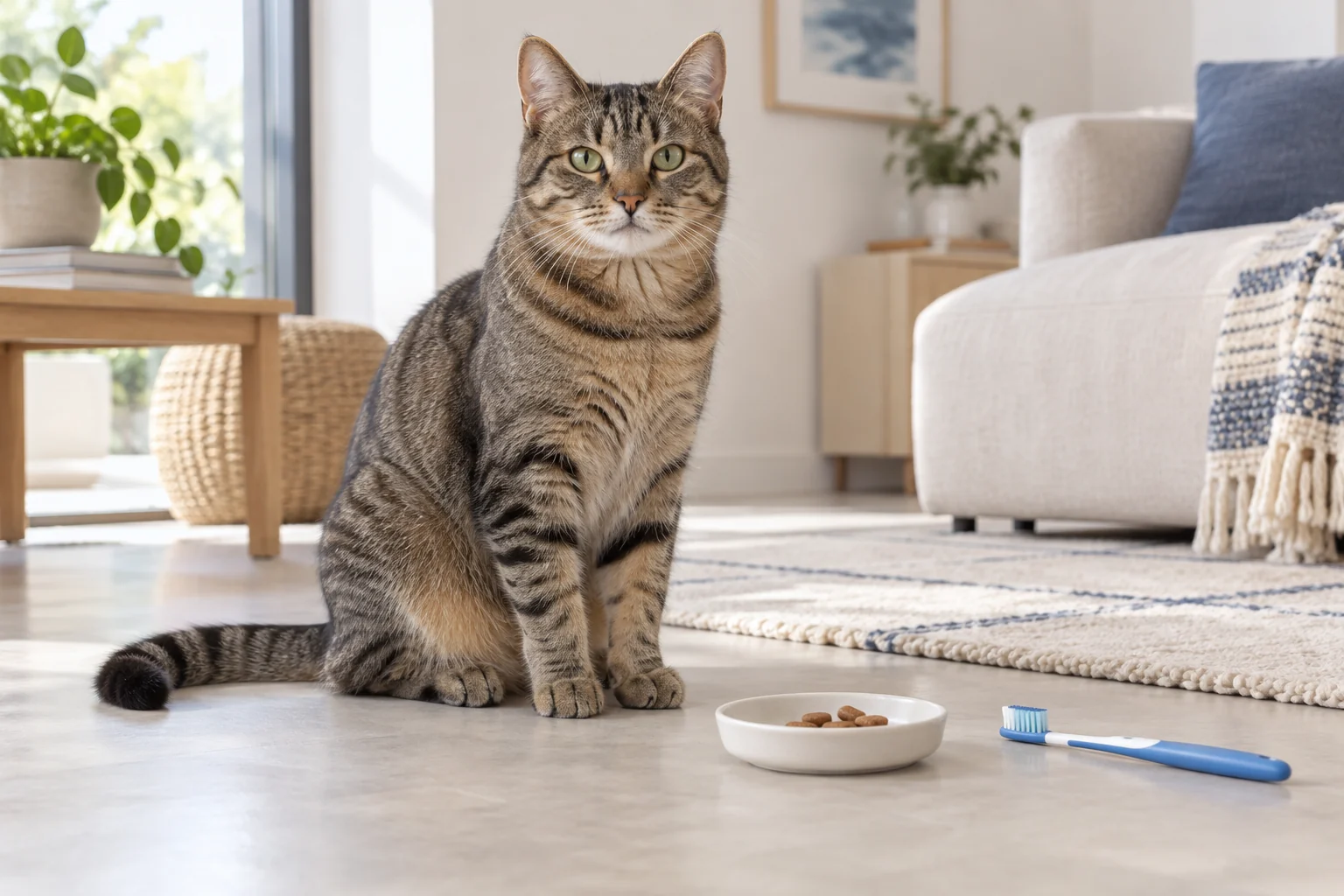
We did not conduct hands-on dental testing or commission a clinical trial, and this article is not individually reviewed veterinary advice. Product names illustrate evidence boundaries rather than a paid ranking. The hero is an AI-generated editorial illustration with unbranded accessories, not a product photograph or test record. About Félinscope
Sources and further reading
- AAHA: recommending dental products and home care
- Cornell Feline Health Center: feline dental disease
- VOHC: protocols and submissions
- VOHC: trial protocol requirements
- VOHC: current accepted products
- VOHC: feline list, August 2026
- Purina US: DentaLife chicken instructions and calories
- Pro Plan US: Dental Bites product page
- WSAVA: feeding treats to your cat