The answer in 30 seconds
Keep a comfortable routine. Do not add a motor without a reason.
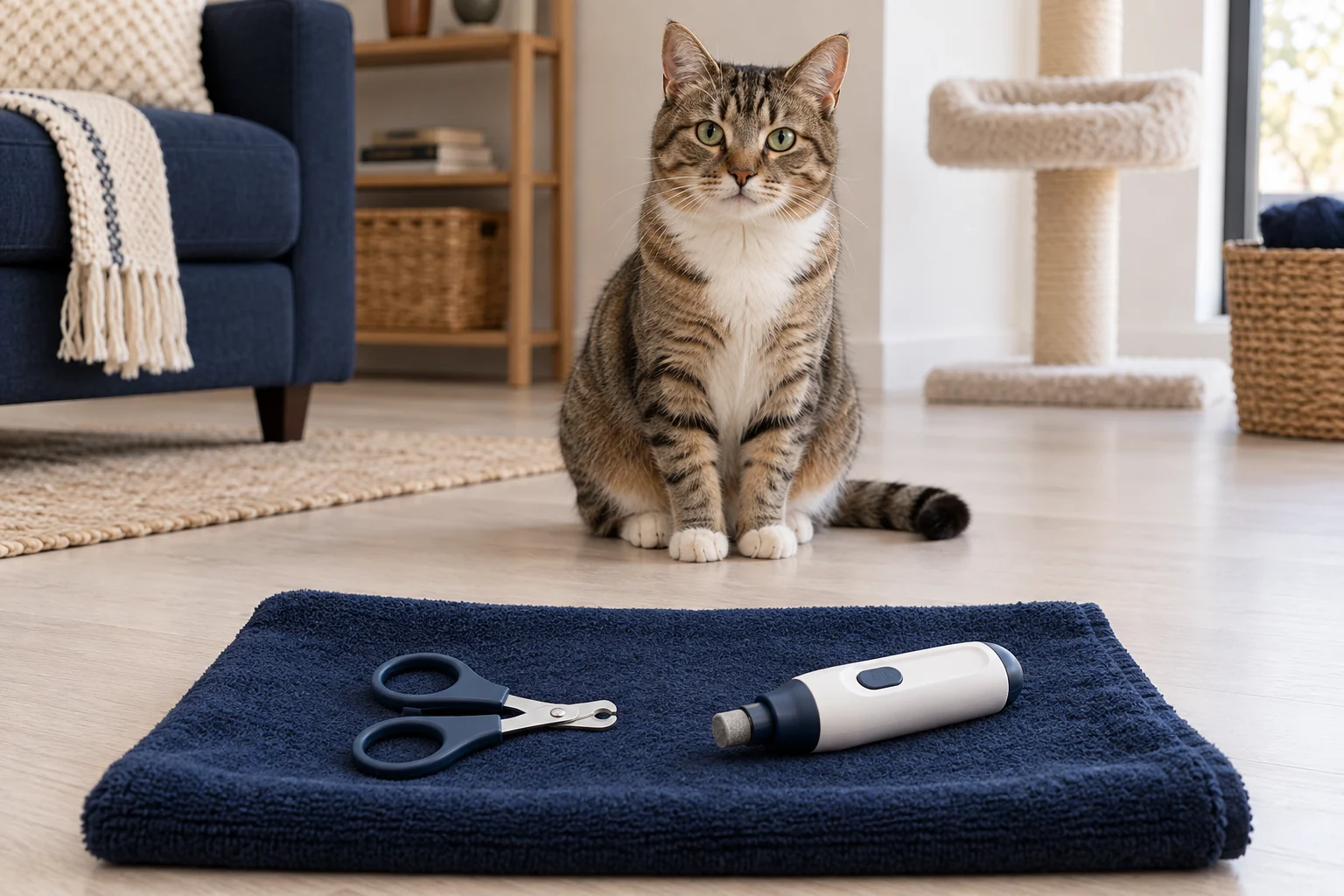
Small, sharp cat clippers are our practical starting point when brief paw handling works and you know which tip to remove. Consider a pet nail grinder when gradual shaping serves a real purpose and the cat accepts the extra sound, vibration and handling.
That is an editorial decision rule, not proof that one category is safest. A grinder does not make the quick disappear, and a clipper is not a reason to rush. VCA advises stopping and seeking veterinary help if a cat resists restraint.
Find your starting point ↓Before comparing equipment
Does this cat need a trim, or a closer look?
Cats Protection notes that a young, active cat may not need routine claw trimming, while an older cat or one with mobility problems may need help. Do not turn a shopping comparison into a mandatory grooming schedule.
The quick is the sensitive, blood-supplied part inside the claw. Removing nail gradually does not make it safe to reach that tissue. If you cannot identify a safe stopping point, get an in-person demonstration before using either tool.
Keep suitable scratching opportunities available. Our vertical versus horizontal scratcher comparison covers orientation and placement, a different decision from choosing a trimming tool.
Different mechanisms, different demands
What changes when you swap the tool?
On a small screen, scroll the table sideways.
| Decision | Cat nail clippers | Pet nail grinder |
|---|---|---|
| How it works | Blades cut a small part of the claw. | A rotating abrasive removes material gradually. |
| Handling pattern | Position, make a controlled cut, release. | Position, make brief passes, lift away and reassess. |
| Sensory demand | No motor, but the tool and cutting sound still need introduction. | Motor sound and vibration are additional things to accept. |
| Main equipment checks | Appropriate size, comfortable grip and sharp, aligned blades. | Cat suitability, secure abrasive, clear instructions and manageable grip. |
| Upkeep | Inspect, clean and maintain or replace as the maker specifies. | Check abrasives, clean as directed and manage battery or charging needs. |
| What it cannot promise | A fast cut is not automatically a comfortable session. | A smooth finish is not automatically a safer session. |
Fear Free's equipment guidance warns that dull blades can squeeze the nail, while grinders bring heat and hair-catching concerns. Neither side of this table is a measured injury-rate ranking.
Four realistic starting points
Match the equipment to the unresolved problem.
Keep the tool you already use comfortably.
If the clippers are sound, the cat cooperates and no extra shaping is needed, a grinder adds another device to maintain. There is no requirement to finish every clipped nail electrically.
Next action: inspect, not upgrade.Separate the two kinds of tolerance.
A cat accepting a paw touch has not necessarily accepted a buzzing tool. For that household, researching a well-fitting manual clipper is more relevant than comparing grinder speed settings.
Next action: keep the motor out of the decision for now.A grinder can be worth evaluating.
Look for a pet-specific model whose manual includes cats, obtainable replacement abrasives and a body you can control. Being comfortable with its sound still does not establish comfort during nail contact.
Next action: check the exact instructions and handling demands.Pause before buying either.
A different tool may leave the original problem untouched. Arrange help to distinguish a handling issue from a claw that needs care. This is not a reason to hold the cat more tightly.
Next action: a care plan before a shopping list.These situations are our synthesis of the sources below, not a diagnostic checklist. They deliberately allow a no-purchase result.
Read past the reassuring label
“Quiet”, “with light” and “safe” are not the same claim.
A quiet-motor statement concerns the device, not your individual cat. An LED describes illumination, not an automatic decision about how much claw to remove. A guard describes an attachment, not a guarantee against removing too much. Treat each as a feature to investigate rather than a verdict.
For a grinder, read the precautions.
The Dremel 7350 PET manual warns about heat from prolonged contact or pressure and hair getting caught. It specifies brief contact and cooling passes for that model. Follow your chosen tool's own manual; do not copy another device's timing or accessories.
For clippers, look at the fit in your hand.
VCA describes both scissor and guillotine designs and notes that many owners prefer small cat-specific scissors. That is not evidence that one style wins for every person. If the blade position is difficult to see or the grip feels awkward, the attractive feature list has not solved the basic task.
We did not find a head-to-head feline trial in the sources reviewed that justifies a universal “safer” winner. We therefore do not publish a safety score, a promised decibel threshold or a stress-free guarantee.
The five-question buying check
Ask these before choosing a listing.
- Is the exact tool intended for cats? A search result saying “pet” is not enough. Read the manufacturer's species and size guidance, not just a marketplace keyword.
- Can you see and control the working end? Compare the full tool, not a glamorous close-up. Think about your grip, access to the switch and the view around your fingers.
- What becomes a consumable? For clippers, find the maker's care and replacement advice. For grinders, identify the correct abrasive and whether it is sold separately in your market.
- What does normal ownership require? Account for cleaning, storage, charging and replacement parts. Compare the complete kit; a low headline price may exclude the part you need next.
- What if it does not suit the household? Read the seller's return conditions before use, especially any hygiene restrictions. Do not assume a used grooming item can be returned.
For example, Dremel's 7350-PETD documentation identifies a rechargeable tool for dogs or cats and lists its sanding accessories. This illustrates the level of information to look for. It is not a recommendation of that model or a verification of its comfort claims.
Observe the step, not just the outcome
A better note than “my cat hated it”.
If a session is uncomfortable, record where the change appeared. This helps you ask a more useful question before replacing equipment. The note below is an editorial aid, not a training protocol or a reason to continue a stressful session.
- What was happening?
- Tool in sight, hand near the paw, paw touched, motor heard, or nail contact.
- What did you actually observe?
- Describe movement or behaviour without deciding the cause: for example, the cat pulled its paw away.
- What happened after you stopped?
- Record the response and any visible claw concern for your veterinary team.
- What remains unknown?
- Whether the difficulty is the tool, handling, a previous experience or discomfort.
Fear Free separates sight, sound, touch and vibration during introduction, advises progressing only when the animal is comfortable, and recommends professional help when significant stress persists. One completed nail is not a target worth overriding those signals for.
For a first trim or an unclear stopping point, ask your vet or nurse for a demonstration. This article helps select equipment; it does not replace an individual assessment or teach a complete trimming procedure.
Optional equipment research
Compare local options only after choosing the job.
You do not need to buy through these links. They open country-labelled Amazon searches for cat clippers and pet grinders, not a tested shortlist. Search results may include unsuitable items, so apply the five checks above to the exact listing.
As an Amazon Associate I earn from qualifying purchases. These country-labelled searches are not recommendations: verify the exact model, seller, price, delivery and return terms.
Already have appropriate, working clippers and a comfortable routine? Keeping them is a complete outcome, not a compromise. Read our affiliate policy for how commercial links are handled.
Common questions
Before you change tools
Are nail grinders safer than clippers for cats?
Not automatically. A grinder removes material gradually but adds a rotating abrasive, sound and vibration. Clippers avoid the motor but still require controlled positioning. We found no comparative feline trial in the sources reviewed that establishes a universal safety winner.
Can a nail grinder hurt a cat?
Yes. It can remove too much nail, create uncomfortable heat or catch hair. Follow the exact pet tool's instructions, keep hair clear and stop if the cat is uncomfortable. Gradual removal is not a guarantee against injury.
Should I buy both clippers and a grinder?
Only if each solves a real need and your cat accepts both. A comfortable clipping routine does not require an electric finishing step. Keeping a working tool is a valid result of this comparison.
What if my cat dislikes both tools?
Pause the shopping decision. Ask a veterinary team for help with paw handling and whether the claws need attention now. Trying stronger restraint or another motor is not a substitute for a workable care plan.
Does a quiet motor or an LED light make trimming safe?
Neither feature locates a safe stopping point for you. A noise claim does not show that your cat will accept the device, and a light does not replace a clear view, careful handling or an in-person demonstration when you are unsure.
Will trimming stop my cat scratching furniture?
Do not buy either tool as a cure for scratching. Scratching is normal feline behaviour and appropriate scratching surfaces remain important. This comparison concerns claw-care equipment, not behaviour suppression.
Sources checked 21 September 2026
Evidence and limits
This comparison combines veterinary and welfare guidance with primary tool documentation. Educational advice is not a comparative device trial; a manufacturer's description is not independent performance testing. We have not measured cutting force, heat, sound, durability or injury rates. No professional has clinically reviewed this Félinscope article.
- Cats Protection: how to trim cat clawsWhether trimming is needed, changes that need veterinary attention and the role of scratching.
- VCA: how to trim a cat's nailsVeterinary guidance by Courtney Barnes and Catherine Barnette, DVMs, on clipper choice and handling. Not a grinder-versus-clipper trial.
- Fear Free: Trimming Away the TerrorTwo-page educational handout hosted by the University of Illinois College of Veterinary Medicine. Tool introduction and equipment precautions, not a university clinical trial.
- Dremel 7350 PET: original instructionsEnglish nail-grooming precautions on printed page 15. Instructions are model-specific; dog-oriented nail-length advice is not applied to cats here.
- Dremel 7350-PETD: manufacturer documentationAn example of declared cat compatibility, charging and consumables. Performance descriptions are manufacturer claims, not our measurements.
For separate equipment decisions, explore scratcher orientation or deshedding tools versus grooming vacuums. Coat care, scratching and nail trimming are different jobs.