The answer in 30 seconds
Choose the direction that keeps winning after the scratchers change places.
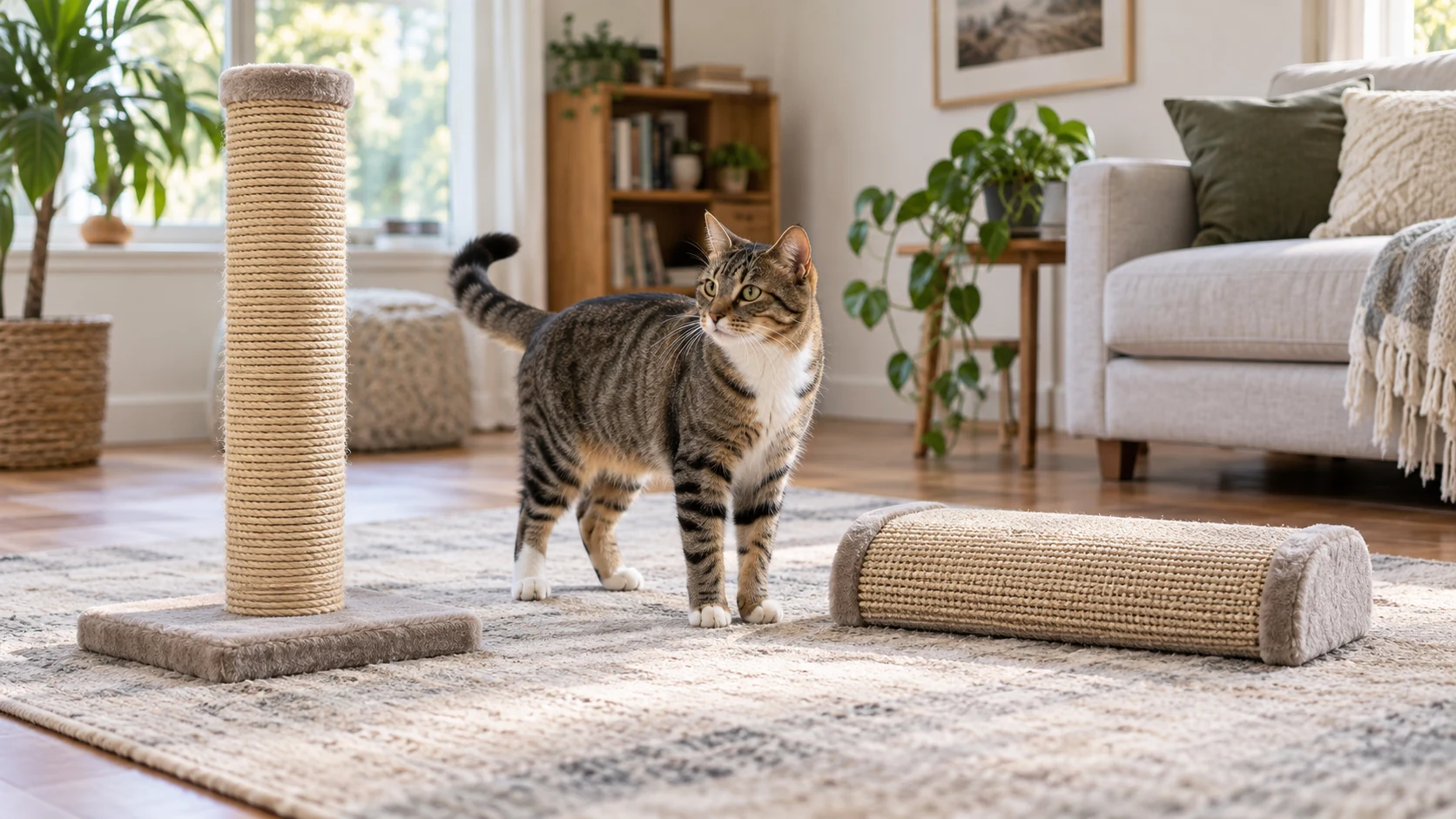
Start vertical when the cat already stands and pulls down a wall, door frame or sofa arm, but only with enough continuous scratchable reach and a base that stays rigid.
Start horizontal when the cat crouches and rakes carpet or a mat, but use enough length and a non-slip base.
Do not decide from one visit. Compare the same surface in both directions, reverse their positions, and read orientation totals separately from room-side totals. Mixed evidence supports keeping both, not inventing a winner.
Run the two-round logger ↓This page owns one intent: the orientation of scratching equipment. Surface material is held as a control, not ranked as a separate “sisal vs cardboard” contest. Play and food puzzles remain in our Catit Senses vs TRIXIE Fun Board comparison; coat removal remains in FURminator vs Oneisall LM2.
The category-label trap
A post and a pad rarely differ in orientation alone
Leading buying guides correctly tell readers to watch posture, choose a stable product and place it near an established scratching site. The missing step is causal discipline: commercial posts are often sisal, tall and heavy while pads are often cardboard, short and mobile. A cat choosing one has answered a bundle of questions.
Our comparison therefore begins with a no-buy question: can two options be made similar enough that a direction result means anything? If not, describe the test honestly as a bundle comparison and resist the cleaner headline.
Orientation is one of six gates
Close the confounders before counting choices
A fair household test does not need laboratory equipment. It does need the discipline to leave important variables unchanged.
Orientation
Vertical, horizontal or angled describes the direction of the scratching stroke, not overall product quality.
Surface
Sisal rope, woven sisal, cardboard, wood and fabric feel different. Do not change material while claiming to test direction.
Usable reach
The scratchable zone must cover the cat’s natural stroke. Product height can include a bare base, toy or platform that claws cannot use.
Stability
A tall post that rocks and a light pad that skates both change the experience before orientation can be judged.
Location
A doorway, sofa corner or waking area may carry more value than an identical surface placed out of the cat’s route.
Body today
Age, comfort and mobility can change posture. A new lower choice may be health information rather than a shopping preference.
Vertical, horizontal and the honest third option
Match body mechanics, then prove the match
The table describes selection clues, not promises. Individual preference can differ, and a product that fails size or stability should not be used to judge its entire orientation.
| Decision | Vertical post | Horizontal pad | Angled surface |
|---|---|---|---|
| Posture clue | Cat stands or lengthens upward and pulls down a wall, sofa arm or door frame. | Cat crouches and rakes a rug, mat or floor-level edge backwards. | Cat braces into a sloped sofa end, ramp or diagonal surface. |
| Minimum design job | A scratchable reach that exceeds the cat’s observed stretch, plus a structure that stays rigid. | Enough scratchable length for the cat’s normal body position, with a base that cannot slide or curl. | A fixed slope that does not flatten, skid or force an awkward wrist and shoulder position. |
| Common false negative | The post is too short, unstable or covered in a surface the cat has not selected. | The pad moves, is too small, or sits on the wrong side of the room. | Angle, material and location all change together, so the cause of use remains unknown. |
| Space trade-off | Smaller floor footprint can hide a dangerously narrow or light base. | Low profile improves access but occupies a longer usable floor zone. | Intermediate footprint; rigid geometry and a clear approach still matter. |
| When it earns a shortlist | It leads in both rounds after the complete options exchange positions. | It leads in both rounds after the complete options exchange positions. | Existing behaviour is diagonal or the matched vertical/horizontal result remains genuinely mixed. |
FelineVMA guidance recognises vertical, horizontal and angled preferences, different substrates and change with life stage. It supports offering a suitable choice; it does not turn one shape into a universal winner.
Why apparently conflicting evidence can all be useful
Population and method change the answer
A large owner survey, a short controlled kitten test and a small practice questionnaire do not estimate the same thing. Put the method beside the claim before citing a conclusion.
| Source | Population | Method | Finding we can use | Limit we must keep |
|---|---|---|---|---|
| Wilson et al. · 2016 | 4,331 owner responses from 39 countries | Internet survey of owner-reported home behaviour | Upright posts and multi-level trees, rope, variety and taller structures were associated with more use or less unwanted scratching in parts of the analysis. | Observational self-report. Product features occurred together, so association is not a clean causal verdict on orientation. |
| Zhang et al. · 2019 | 40 kittens younger than eight weeks | Six two-choice tests; 20-minute video-recorded access in a simulated living room | S-shaped cardboard led several comparisons; in one matched screen-surface test, the upright position led the horizontal position. | Very young kittens, brief trials and specific shapes. The study cannot declare one format best for adult cats at home. |
| Moesta et al. · 2018 | Clients of one small-animal practice; 82.9% response to 140 questionnaires | Pilot paper survey and owner-ranked frequency | Designated posts were reported used more often than pads; owners also described mixed materials, angles, sizes and placements. | Small pilot survey. Type was associated with use, but isolated material, angle or length did not provide a universal rule. |
| FelineVMA guidance | Clinical and caregiver guidance | Evidence-informed professional recommendations | Cats may prefer vertical, horizontal or angled surfaces; preferences can change with life stage and degenerative joint disease. | Practice guidance, not a blinded head-to-head product trial. The individual cat still has to be observed. |
Interactive position-swap test
Separate orientation totals from side totals
The fixed A/B sequence makes the hidden location preference visible. Use two comparable periods in ordinary routines; do not shorten a round because the early result looks convenient.
Confirm the same scratching surface, stable equipment, usable dimensions, a real position swap and voluntary episodes only. Otherwise a neat total can still answer the wrong question.
- Vertical total
- 0
- Horizontal total
- 0
- Side A total
- 0
- Side B total
- 0
A reversible eight-stage protocol
Make the next observation more informative than the last
This is a practical home audit derived from study-design principles and professional guidance. It is not a treatment protocol, and it never requires withholding an established acceptable scratching surface.
- 01
Map the existing stroke
For three ordinary days, note where scratching starts, the direction of the paws, approximate reach, time and what happened immediately before it. Do not move the cat or manufacture an episode.
- 02
Match the surface
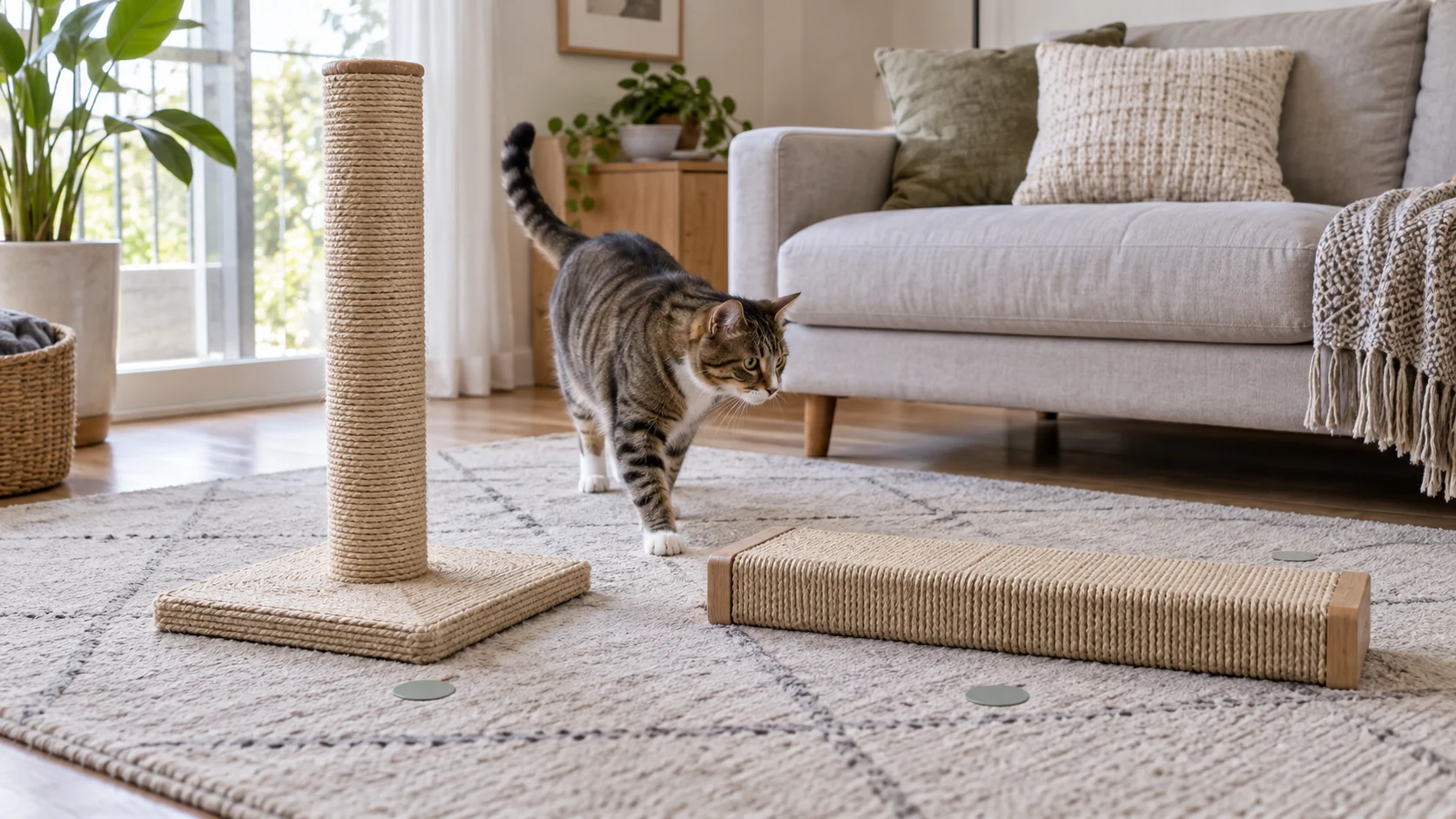
Set up one vertical and one horizontal option with the same scratching material. If that is impossible, record the mismatch and treat the result as a combined format-plus-material test.
- 03
Close the fit gate
The upright scratchable zone must cover the observed full stretch; the floor option must cover the normal raking stroke. Count usable surface, not the marketing dimensions around it.
- 04
Close the movement gate
Press and pull the structures safely before access. The upright option must not rock or tip; the floor option must not skate, fold or lift at an edge.
- 05
Run Round 1
Place the options on Side A and Side B of the same relevant zone. Keep ordinary routines stable and count only spontaneous, deliberate scratching episodes.
- 06
Swap the complete options
Move the entire vertical scratcher to Side B and the entire horizontal scratcher to Side A. Do not rotate only a loose sample or change scent, reward or surrounding furniture.
- 07
Read direction and side separately
Add vertical totals across both sides, horizontal totals across both sides, then Side A and Side B totals across both formats. A side that keeps winning is a placement clue, not an orientation victory.
- 08
Change one variable next
If no direction repeats, keep both or test surface material in a new matched comparison. Never convert an inconclusive result into a confident purchase claim.
Usable surface, not box dimensions
Measure the stroke the claws can actually complete
Published and commercial rules often quote a single post height. A more defensible household check begins with the individual cat and the continuous scratchable zone.
- Observe: mark the lowest and highest points of an ordinary full vertical stroke, or the start and end of a floor rake.
- Measure: record that span without stretching or holding the cat.
- Inspect: exclude bare baseboards, caps, toys, seams and platforms from the usable surface.
- Load-check: safely pull the upright structure or push the pad from several directions before access.
- Preserve margin: shortlist a surface that does not make the observed stroke end at an edge.
Location is part of the function
Put an acceptable mark where marking already matters
The 2013 AAFP/ISFM environmental-needs guidelines treat scratching areas as key resources and recommend multiple, separated resources. FelineVMA guidance adds that scratching surfaces belong where cats spend time. That makes a hidden spare-room post a different intervention from the same post beside a waking or marking route.
Keep the stretch close
Place an appropriate surface near a regular sleeping area without blocking the exit or creating a trap.
Compete on location first
Protect the furnishing temporarily and place the acceptable surface immediately beside the established site before moving it gradually.
Respect prominence
Doorways, room transitions and visible paths can matter because scratching also leaves scent and visual cues.
Disperse access
One “perfect” post can be functionally unavailable if another cat controls the approach. Provide separated options and escape routes.
Professional basis: AAFP/ISFM environmental-needs guidelines and FelineVMA environmental setup .
The health stop rule
A sudden lower posture is not a shopping result
FelineVMA notes that scratching-surface preference can change with life stage, particularly when degenerative joint disease develops. International Cat Care lists stiffness after rest, limping, reluctance to jump, reduced activity and less scratching among possible mobility-related changes.
Pause the comparison and contact a veterinarian when a previously comfortable cat suddenly avoids its normal reach, changes posture, appears stiff or lame, withdraws, or shows other new behaviour. Keep a stable, non-slip, low-effort surface available while seeking individual advice.
A horizontal or gently angled option may improve access, but it cannot diagnose or treat pain. If warmth is also being considered, use the separate self-warming versus electric heated-bed safety audit; a warm resting surface still cannot explain a mobility change.
Direct answers
Cat-scratcher orientation FAQ
Is a vertical or horizontal cat scratcher better?
Neither orientation is universally better. Start with the posture the cat already uses, then compare matched, stable and correctly sized options in two positions. A repeatable choice after the swap is more useful than a category label.
Do cats need both vertical and horizontal scratchers?
Many homes benefit from more than one scratching option, especially when one cat uses several postures or several cats share the space. But buying both is not a substitute for usable size, stability, preferred surface and relevant placement.
How tall should a vertical scratching post be?
There is no single number that fits every cat. Measure the individual cat’s observed stretched scratching reach and choose a post whose continuous scratchable zone extends beyond it while remaining rigid. Do not count a bare base, perch or toy as scratchable height.
Why does my cat ignore a new scratching post?
Orientation may be wrong, but so may the surface, usable reach, stability or location. New smell and a competing established site can also matter. Test one variable at a time and reward voluntary use; do not place or force the cat onto the post.
Is sisal better than cardboard for cats?
This page does not assign a universal winner to materials. Rope performed well in a large owner survey, while a controlled kitten study found strong use of particular cardboard shapes. Age, shape and study method differed, so use the same material when testing orientation and test materials separately.
Where should I put a cat scratcher?
Use locations the cat already values: near an existing scratching site, a resting area where the cat stretches after waking, or a prominent travel route. In multi-cat homes, disperse resources so one cat cannot easily block every option.
Can a horizontal scratcher help a senior cat?
It may offer an easier posture for some cats, and FelineVMA guidance notes that preferences can shift with age or joint disease. A sudden change, lower reach, stiffness, limping or reluctance deserves veterinary attention rather than a product-only response.
Should I use catnip to test a scratcher?
Not in the first orientation comparison. An attractant can change approach behaviour and not every cat responds to it. Keep rewards and scents equal or absent until the matched position-swap rounds are complete.
Does a cat tree count as a vertical scratcher?
Only if it provides a stable, continuous scratching surface that fits the cat’s natural reach. A tree also adds climbing, resting and route functions, so its use cannot be assigned to scratching orientation alone.
How long should I run the home test?
Use behaviour, not an arbitrary calendar alone. Complete two ordinary rounds with the positions reversed and enough voluntary episodes to avoid deciding from one novelty visit. The on-page logger waits for at least eight total episodes, but it is a practical decision aid rather than a validated research threshold.
Source ledger
What supports each conclusion
Research sources carry their own population and method limits. Veterinary organisations carry environmental, training and mobility guidance. Accessed 8 September 2026.
- Wilson et al.: Owner observations regarding cat scratching behavior Large international internet survey; structure, height, surface, variety and age associations, with owner-report limits.
- Zhang et al.: Preference of kittens for scratchers Controlled two-choice tests with 40 kittens younger than eight weeks; shape, surface and one matched orientation comparison.
- Moesta et al.: Survey of cat owners on feline scratching Pilot practice questionnaire; designated-item use, mixed product features and limits of isolated feature claims.
- AAFP/ISFM: Feline Environmental Needs Guidelines Scratching as a normal environmental resource; choice, separation and placement context.
- FelineVMA: Setting Up the Environment for Success Vertical, horizontal and angled surfaces; substrates, location, life-stage change and degenerative-joint-disease boundary.
- FelineVMA: Training Techniques for Undesirable Behaviors Tall sturdy alternatives, several options, positive reinforcement and explicit rejection of punishment.
- International Cat Care: Home Modifications for Cats with Mobility Problems Caregiver-visible changes including stiffness, limping, reduced activity and less scratching; accessible home setup.