The answer in 30 seconds
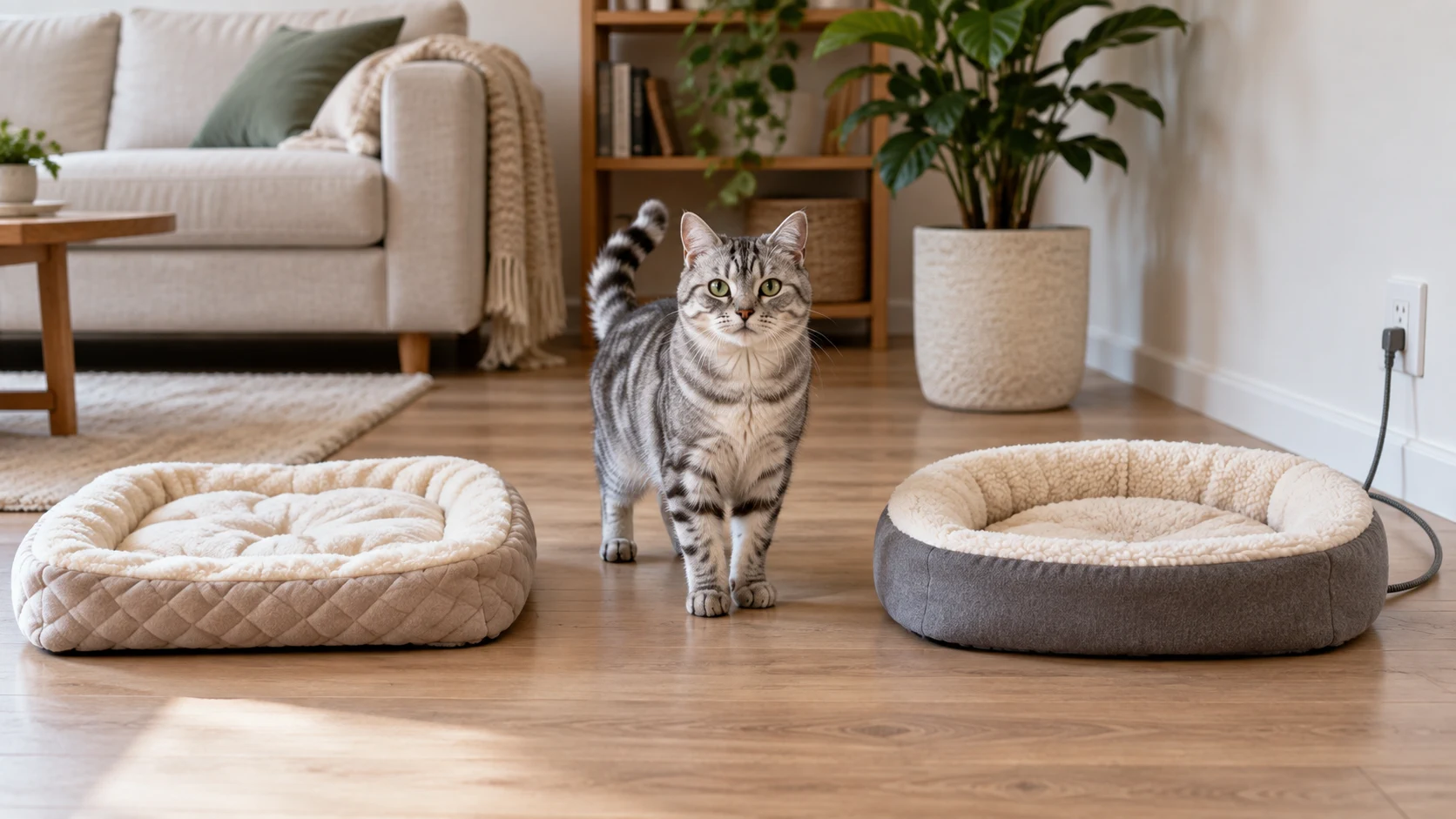
Start with an ordinary bed and the cat’s ability to leave.
Choose a self-warming bed when a passive, electricity-free surface wins a position-swapped trial and its materials, cover and care route fit the room.
Consider a pet-specific electric bed only when the complete exact model, market, manual, electrical record, outlet, protected cable, cleaning method and unheated exit all pass. Then keep the trial monitored and reversible.
Choose an ordinary bed or neither when the baseline already works, the cat does not use either candidate, evidence remains incomplete or warmth is being asked to solve a medical or outdoor-shelter problem.
Run the warmth and escape audit ↓This page owns one narrow intent: passive self-warming versus pet-specific powered beds for voluntary indoor resting. It does not rank human heating pads, microwaveable packs, outdoor shelter heaters or treatments for arthritis. For a new mobility change, begin with the veterinary boundary and use our low-reach scratching guide only as a separate home-access audit.
The missing comparison
“Warmer” is not a complete decision
Broad buying advice often compares electricity, price and softness, then applies one safety sentence to an entire category. That leaves four claims unresolved: whether the cat can leave, what mechanism is actually inside, whether an electrical record covers the complete regional product, and whether the cat chose warmth rather than the sunny side of the room.
Félinscope closes those claims in order. The audit can reject the exact product, route a medical or outdoor question elsewhere, or finish with no purchase.
Eight gates before checkout
Make missing evidence visible
Every gate keeps an “unknown” state. That prevents an incomplete manual, vague marketplace badge or appealing photograph from quietly favouring the powered option.
Purpose and setting
Keep optional indoor comfort separate from outdoor shelter, illness, recovery or pain. Those are different decisions with different evidence and professional boundaries.
Independent exit
The cat must be able to enter, leave and choose a separate unheated resting place without a step, wall, person or another animal controlling the route.
Ordinary-bed baseline
Offer a familiar, insulated ordinary bed in the intended room. If it already earns repeat use, extra heat may not solve a real household problem.
Mechanism identity
Confirm passive reflective or insulating layers versus a pet-specific powered heater. Do not group microwave pads, human heating pads and outdoor beds into the same category.
Exact model and market
Match the rating label, model number, manufacturer, voltage, frequency, plug and country to the current manual and destination listing.
Whole-product evidence
For a powered bed, verify the complete product in the certification issuer’s directory. A listed wire, plug, heater or control component does not automatically cover the assembled bed.
Placement and care
Follow the exact outlet, cable, extension, moisture, cover-removal, washing and drying instructions. Inspect the route rather than trusting a generic safety badge.
Position-swapped trial
Compare the candidate with the ordinary bed, then swap their positions. Record voluntary settling and leaving so location, sun, scent and novelty do not masquerade as warmth preference.
Mechanism before material
Passive reflection versus powered warmth
“Self-warming” and “heated” are retail labels, not standardised performance grades. Verify what the exact bed does before transferring any category claim.
| Decision factor | Self-warming bed | Electric heated bed | Evidence to collect |
|---|---|---|---|
| Heat source | Insulation and/or a reflective layer intended to retain or return some of the cat’s own body heat; no power lead. | A pet-specific powered element or removable warmer, governed by the exact model and manual. | Materials list, rating label and current manual. |
| What it can establish | A low-complexity warm-feeling resting option that the cat may voluntarily prefer in one room. | A powered resting surface that may provide more consistent warmth within its specified use. | A position-swapped choice log, not a first nap. |
| What it cannot establish | A universal temperature rise, outdoor adequacy, pain relief or medical need. | Treatment, a universally safe temperature or correct use outside the named market and setting. | Keep comfort, performance, electrical evidence and medical advice as separate claims. |
| Failure path | Compressed filling, damaged reflective layer, dampness, poor placement or loss of acceptance. | All passive-bed failures plus cord, plug, control, heater, outlet, power and recall status. | Inspect before use and after cleaning; stop on damage or contradictory instructions. |
| Power interruption | No electrical function to lose, although the bed can still be unsuitable, wet or inaccessible. | Warmth may stop; indicators and controls vary. Never infer behaviour from another model. | Use only the manufacturer-permitted function check for the exact product. |
| Best first fit | The cat seeks a warmer resting surface, moves away freely and a passive bed wins the reversible trial. | A powered option remains justified after the ordinary and passive routes, and every identity, installation and exit gate closes. | The result may still be ordinary bed or no purchase. |
Environmental evidence boundary: FelineVMA guidance supports safe, accessible and separated resting resources. It does not certify a bed or establish a universal warming target. Read the 2026 caregiver brochure .
Evidence with transfer limits attached
Clinical guidance defines the boundary; product documents define the device
No single source answers both. This ledger keeps feline access, medical context, electrical identity and model instructions in their proper lanes.
| Source | What it supports | What it does not prove |
|---|---|---|
| FelineVMA environmental needs · 2026 | Resting places are key resources; a safe place should preserve control and, where threat matters, entry and exit from at least two sides. | General feline-environment guidance, not a heated-bed performance or electrical-safety test. |
| FelineVMA chronic-pain toolkit | Home adaptation can matter for painful cats and the patient-support page specifically points to safe non-electrical reflective pads covered to reduce burn or injury risk. | Clinical context belongs with the veterinary plan. It does not approve a retail product or prescribe heat. |
| International Cat Care home guide | Easy access, ramps or steps and vigilance for changing mobility support a low-effort resting route. | Written for diagnosed pain or mobility problems; not evidence that a warming bed treats either condition. |
| Cats Protection senior-cat guidance | Several warm, quiet sleeping areas around the home can reduce travel to a comfortable spot for an older cat. | Caregiver guidance, not a comparison of passive and powered mechanisms. |
| Official product-safety databases | CPSC, UK OPSS and EU Safety Gate let readers search current recalls and alerts by product, brand and model. | No search result is not a lifetime guarantee, and each database covers its own jurisdiction and reporting system. |
| Manufacturer documents | Named examples disclose passive construction or model-specific watts, voltage, indoor use, cleaning and function-test instructions. | Manufacturer claims transfer only to the exact named product and are not independent comparative testing. |
Original interactive decision aid
Can this exact bed earn a reversible trial?
The tool branches first on medical context, outdoor use, independent exit and exact-product failures. It stores nothing and cannot diagnose, certify or test temperature.
Define the purpose, observe mobility, offer an ordinary baseline, identify the mechanism, read the current manual, and verify placement and cleaning before interpreting preference.
No warming-mechanism verdict yet- Purpose
- Open
- Independent exit
- Open
- Exact mechanism
- Open
- Position swap
- Open
Audit incomplete. No warming-mechanism verdict yet
The component-versus-product trap
Read what the certification record actually covers
A plug, cord, heater or controller can carry a recognised mark while the assembled bed is not the item named in that record. Copy the company and model from the physical rating label, search the issuer’s own directory and compare the product description, voltage and market.
Then search the official system for the country of use. CPSC, UK OPSS and EU Safety Gate are different jurisdictional records; absence from one is not a transferable or permanent guarantee.
A reversible eight-stage protocol
Let place, novelty and warmth compete fairly
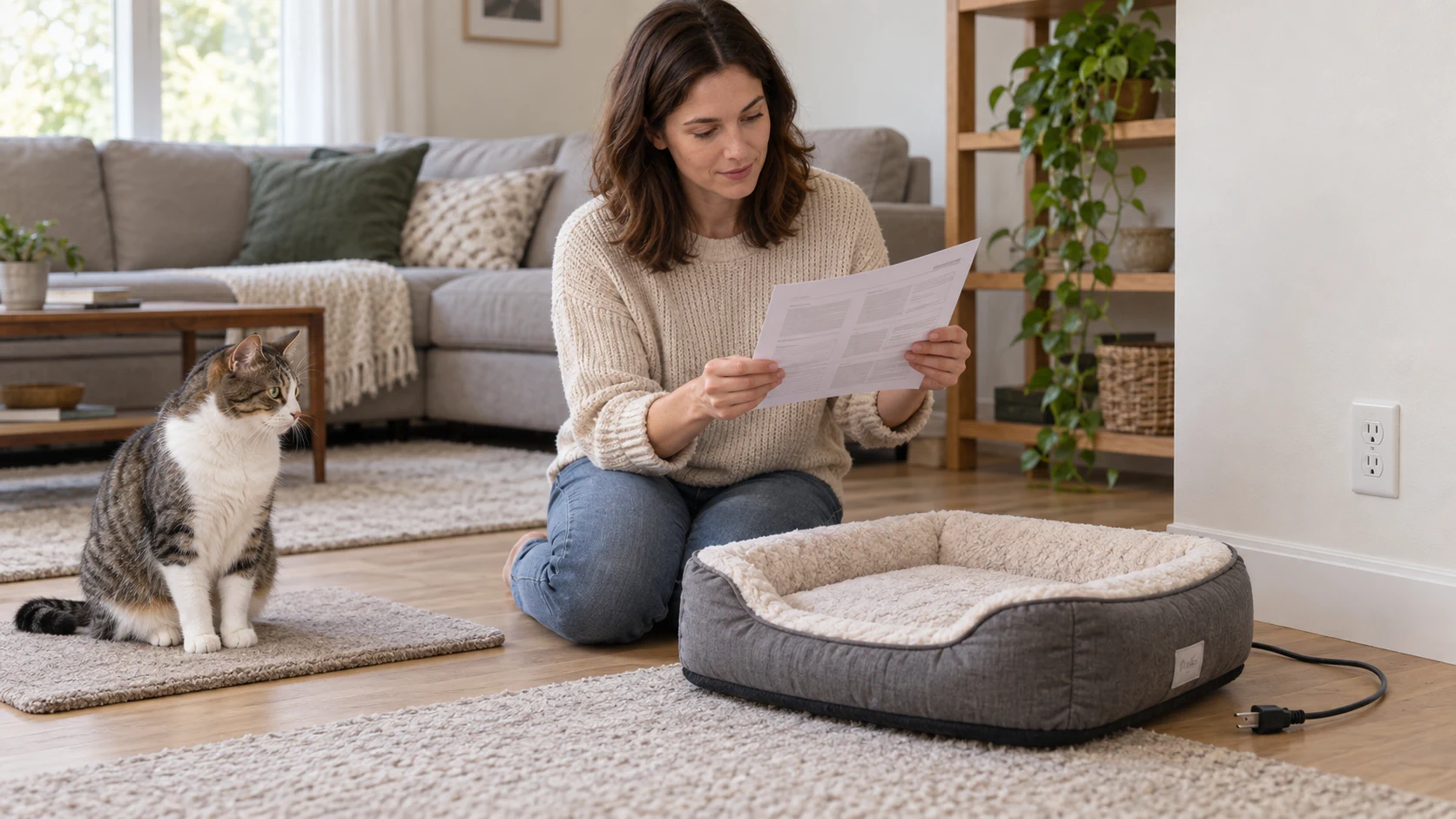
The protocol preserves a neutral choice and never withholds a familiar resting place. It records behaviour rather than pretending to measure comfort inside the cat.
- 01
Write the purpose before the product
Record the room, season and ordinary comfort problem. If pain, illness, weakness, recovery, skin sensation or a new mobility change is part of the reason, pause the shopping decision and ask the veterinary team.
- 02
Build two accessible zones
Place a familiar ordinary bed and the candidate on the same floor, away from direct sun, radiators, dampness and traffic. Keep both entrances open and leave a clear route to a different unheated rest area.
- 03
Identify the complete product
Photograph the rating label and record the manufacturer, exact model, voltage, frequency, plug and intended indoor or outdoor setting. Download the current manual from a traceable source rather than relying on a marketplace summary.
- 04
Verify the powered version
If electric, search the certification issuer’s directory using company and model, then read the scope: complete product, heater, cord or component. Search the official recall database for the market where the bed will be used.
- 05
Audit outlet, cable and cleaning
Reject damaged, pinched, chewed or contradictory equipment. Follow the exact instructions on extensions, cover use, heater removal, washing and complete drying. Do not improvise with a human or microwave heating product.
- 06
Run only the permitted function check
Some pet-bed manuals use a load such as a pillow for a brief function test because the surface may not feel warm to an open hand. That method is manufacturer- and model-specific: never copy it to another bed without its manual.
- 07
Log seven days, then swap positions
Record voluntary entries, settled minutes, exits and which alternative was chosen. Halfway through, swap the bed positions while keeping other variables as stable as practical. Stop if the cat appears distressed or cannot leave freely.
- 08
Keep the least complex winner
Ordinary bed, passive bed, powered bed and neither are all valid outcomes. Reinspect after laundering, room changes or visible wear; recheck recalls and the cord of any powered bed over time.
Warmth does not diagnose pain
A new resting change is health information first
Seeking unusual heat, stopping jumps, stiffness, altered grooming, hiding, irritability or difficulty settling can accompany many different problems. A bed purchase cannot identify the cause. If the change is new, persistent or associated with illness, weakness, injury or recovery, contact the veterinary team before adding powered heat.
For a cat with known pain or limited mobility, the care plan may include easy-access resting places, ramps, steps and other home adaptations. Preserve an unheated option and never assume the cat can regulate exposure by leaving if movement itself is compromised.
Direct answers
Self-warming and electric heated cat bed FAQ
Is a self-warming or electric heated bed better for a cat?
Neither is universally better. Start with an ordinary insulated bed and an easy exit. A passive bed reduces electrical complexity; a powered bed adds model, market, outlet, cord and cleaning gates. Keep whichever option the cat chooses after positions are swapped and every applicable safety condition is met.
How does a self-warming cat bed work?
Designs vary. Some use insulating layers and some include a reflective layer intended to return part of the cat’s body heat. It does not create heat from electricity, and a category label does not prove a fixed temperature increase. Check the exact materials and care instructions.
Are electric heated cat beds safe?
Safety cannot be assigned to the whole category. Verify the exact complete product, rating label, market, manual, certification scope and recall status; follow its placement and care instructions; protect the cable; inspect for damage; and preserve an unheated exit. Reject any mismatch or unverifiable claim.
Can I use a human heating pad for my cat?
Do not substitute a human device for a pet-specific product. Controls, surface, supervision and intended use may differ. If heat is being considered for pain, illness or recovery, ask the veterinary team what, if anything, is appropriate for that individual cat.
Does a heated bed help a cat with arthritis?
A preference for warmth does not diagnose arthritis and this page does not claim that a retail bed treats pain. New difficulty jumping, stiffness, altered grooming, irritability or changed resting behaviour deserves veterinary assessment. Home adaptations should sit inside that plan.
What temperature should a heated cat bed be?
Do not apply a universal web number to every bed or cat. Surface behaviour depends on the exact product, cover, load, room and test method. Follow the named model’s current instructions and veterinary advice where a medical condition changes the risk.
Can a self-warming bed be used outdoors?
An indoor self-warming label does not establish weather resistance, moisture control or adequacy in freezing conditions. Outdoor shelter and electrical protection form a separate use case. Use shelter-specific guidance and a product explicitly rated for that setting.
How do I check an electrical safety certification claim?
Read the product label for the company and exact model, identify the organisation behind the mark, search that issuer’s official directory and inspect whether the record covers the complete product or only a component. Also match the voltage, plug and market. A marketplace icon alone is not the record.
How should I test whether my cat prefers the warm bed?
Offer it beside a comparable ordinary bed with both exits clear. Record voluntary settling and leaving, then swap their room positions halfway through a seven-day trial. If the apparent winner changes sides, location may be stronger than the warming mechanism.
When should I stop using an electric cat bed?
Stop and follow the manual if the cord, plug, cover, heater or control is damaged, wet, unusually hot, smells abnormal, conflicts with the instructions or appears in a recall. Also stop when the cat cannot leave freely or shows distress. Do not repair or modify it unless the manufacturer authorises that route.
Source ledger
What supports each part of the decision
Feline and veterinary sources define choice, access and clinical boundaries. Official directories support current model and recall checks. Manufacturer pages establish only named-product construction and instructions. Accessed 9 September 2026.
- FelineVMA: Your Cat’s Environmental Needs (2026) Safe places, free access, separate resting resources and feline control; educational grant disclosed in the brochure.
- FelineVMA: Chronic Pain Toolkit: Patient Support Easy-access home adaptations and a non-electrical reflective-pad example within a clinical pain-care context; sponsor disclosed on the page.
- International Cat Care: Home Modifications Access, ramps, steps and caregiver observation for cats with diagnosed muscle, joint or mobility problems.
- Cats Protection: Elderly cats Warm, quiet sleeping areas on multiple levels and broader senior-cat care context.
- US Consumer Product Safety Commission: Recalls Current US recall and product-safety-warning search by hazard, category and date.
- UK Office for Product Safety and Standards: Alerts, reports and recalls Current UK product-safety records, filtered here to electrical appliances and equipment.
- European Commission: Safety Gate EU rapid-alert search for dangerous non-food products.
- UL Solutions: Product iQ Issuer directory used to inspect company, model, file and whether a record describes the complete product or a component.
- K&H: Self-Warming Nuzzle Nest Primary manufacturer example of a metalised reflective layer, electricity-free mechanism, indoor context and care claims.
- K&H: Thermo-Kitty Mat Primary manufacturer example of a named 6-watt, 110/120-volt indoor model, removable heater and model-specific use instructions.
- K&H: How to test your heated pet bed Manufacturer-specific loaded function-test method and warning not to treat an open-hand feel as the test.