The answer in 30 seconds
Choose by the failure you cannot accept.
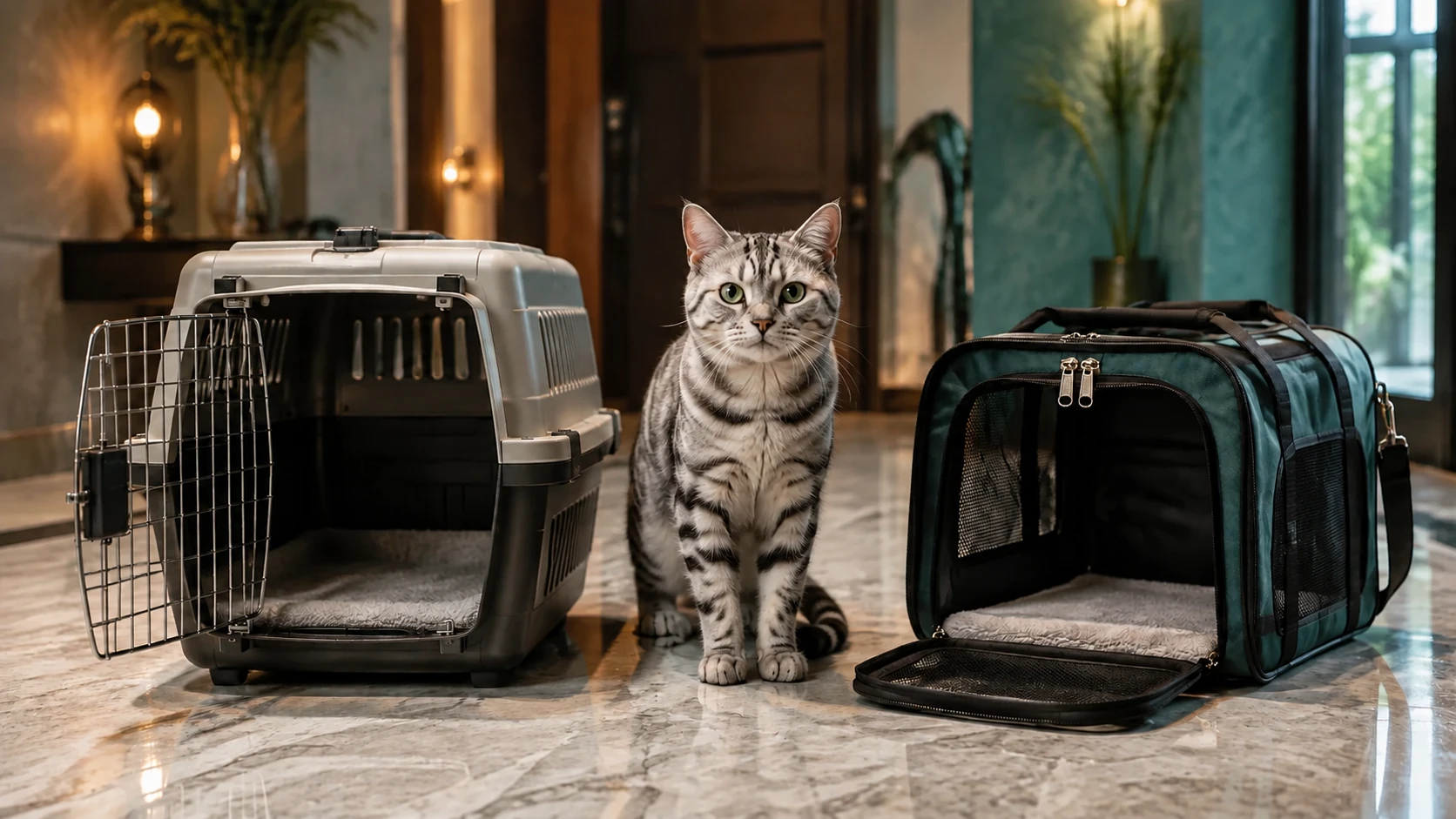
Start with hard-sided for most veterinary visits, a cat that works zips or mesh, likely accidents, or when removable-top access could prevent a forced extraction.
Start with structured soft-sided when a long carry or a confirmed in-cabin route makes low weight and limited flexibility decisive, provided the base, frame, mesh and zips stay secure.
Buy neither until the cat fits inside. For a car or aircraft, the exact model and route must pass; “hard”, “soft” and “airline-ready” are not certificates.
Run the decision planner ↓The most important correction is category versus model. Center for Pet Safety says vehicle carriers can be soft- or hard-sided and tests the actual product in its specified connection. IATA sets container requirements but says it does not certify or endorse commercial carriers. A shell can narrow the shortlist; it cannot finish the safety decision.
Four-failure audit · reviewed 4 September 2026
Clear four gates before choosing the shell
A carrier must fit the cat, stay secure at openings, tolerate realistic cleaning and work on the actual route. No material label can answer all four questions by itself.
The shell becomes the safety verdict
Rigid plastic may feel safer and soft fabric may feel easier, but neither category can prove how an exact carrier performs when attached in a vehicle.
Airline-ready is treated as a product feature
Under-seat fit depends on the airline, aircraft, occupied carrier and ventilation. IATA publishes requirements but does not certify or endorse commercial carriers.
One carrier faces four failure tests
We separate fit, low-force extraction, escape and transport restraint. The planner can return hard, soft, two-carrier or no-buy instead of forcing a universal winner.
The four gates
A carrier has four different ways to fail
Pass them in order. A lightweight bag that fails containment is not convenient; a rigid box that cannot fit the cat or the vehicle is not safer.
Can the occupied interior work?
The cat should stand, sit, turn and lie naturally on the pad. Check interior dimensions and floor sag, not just a weight label.
Can the cat leave without force?
Front, top or removable-shell access should let a veterinary team work without dragging or dumping a fearful or painful cat.
Which component opens first?
Test gate pins, clips and cracks on hard shells; test zipper pulls, tracks, stitching, mesh and corners on soft carriers.
Is this exact model valid here?
Vehicle attachment and aircraft acceptance belong to the exact carrier, route and instructions, not to the material category.
Whole-carrier comparison
Hard-sided vs soft-sided, without shortcuts
These are design tendencies. An excellent structured soft carrier can outperform a poor hard shell on several rows, and vice versa.
| Decision point | Hard-sided | Soft-sided | What to test |
|---|---|---|---|
| Shape under load | A rigid shell and base keep their geometry when lifted or placed beside luggage | Quality varies from collapsible fabric to a structured frame with a firm base | Load the carrier with the cat’s weight and check floor sag, door distortion and occupied ventilation. |
| Veterinary access | Front-and-top models with a removable upper half can leave a fearful or painful cat in the base | A wide top plus one or two end openings can work; narrow collapsing doors make removal harder | Prefer access that does not require pulling, shaking or chasing the cat through one small door. |
| Escape points | Inspect gate pins, latches, shell clips, cracks and the seam between halves | Inspect mesh, stitching, zipper tracks, zipper pulls and every flexible corner | Close every opening, lift from underneath and apply firm hand pressure from inside before the cat enters. |
| Cleaning | A smooth removable shell is usually straightforward to wipe and inspect | Removable pads may wash easily, but seams, foam, mesh and stiffeners can retain liquid | Time a realistic accident clean-up and verify that every damp layer can dry fully. |
| Human carrying | Bulk and rigid handles can become tiring; support underneath rather than relying on one handle | Lower empty weight and shoulder straps can help on long walking routes | Test the combined cat-plus-carrier weight for the full route, not for ten seconds in a shop. |
| Vehicle restraint | Rigid does not mean independently crash-tested | Soft does not mean uncertifiable; some exact soft models appear on certified lists | Check the exact model and use the tested attachment method. Do not transfer a result across a product family. |
| Aircraft cabin | A fixed height may not fit under a particular seat even when the cat fits inside | Limited compression can help only if it does not reduce occupied space or block ventilation | Confirm current airline and aircraft limits directly before purchase and again before departure. |
| Emergency readiness | Sturdy, wipeable construction suits repeated storage and rapid inspection | Compact storage and easier carrying can help if the frame, floor and closures remain dependable | Keep one labelled, accessible carrier per cat and rehearse loading before an emergency. |
Interactive decision planner
Let the route change the answer
Choose the primary job, the cat’s predictable failure mode and the evidence you have actually checked. The result can deliberately stop before recommending a shell.
Two rules retail pages blur
Car restraint and cabin fit are separate claims
Do not let the phrase “travel carrier” collapse two different standards.
Look up the exact model
Center for Pet Safety tests travel carriers on a rear-seat test bench using the manufacturer’s stated connection. Its FAQ explicitly says certified pet crash-protection carriers can be soft or hard.
Check the current CPS certified-products list Read the carrier test distinctionConfirm airline, aircraft and occupied space
IATA requires appropriate construction, ventilation, escape resistance, a leak-proof base and enough room for natural positions. It also states that airlines can impose additional rules and that IATA does not approve commercial carriers.
Open IATA’s traveller guidance Read the in-cabin container checklistBefore the first necessary trip
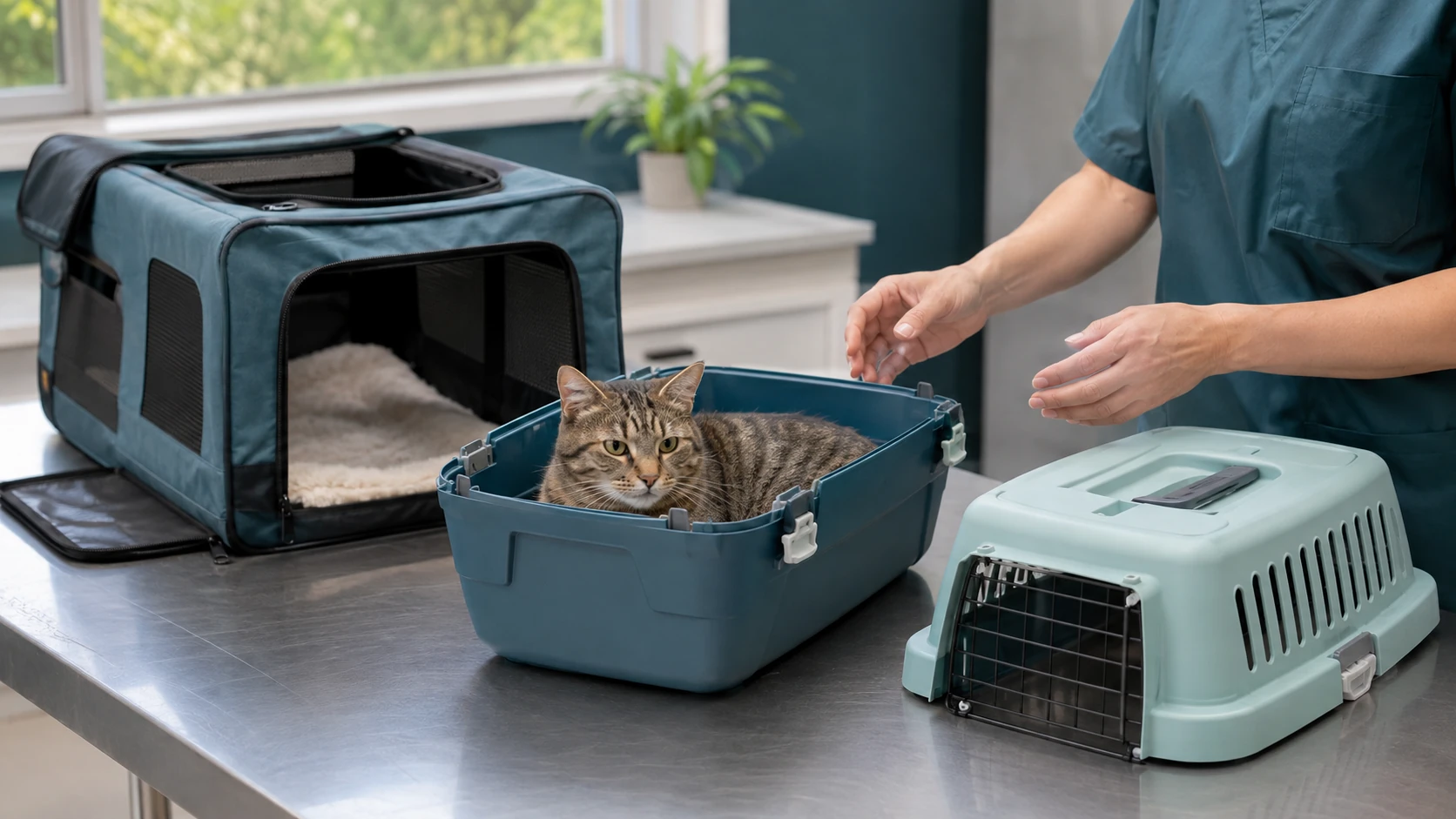
The 30-minute no-force carrier drill
Run the hardware checks without the cat, then use calm voluntary exposure. Stop if the animal shows escalating distress.
For a return trip after surgery, ask the clinic how the carrier and prescribed protection should work together. Our recovery suit versus cone comparison helps prepare those coverage and aftercare questions; it does not authorise removing a device for transport.
- 01
Fit with the cat inside
Measure the usable interior, add the normal pad and observe the cat standing, sitting, turning and lying naturally. Reject a candidate that passes only by a seller’s weight limit.
- 02
Open without a contest
With the carrier on a stable surface, rehearse front, top and removable-shell access. The preferred route should not collapse, pinch or require the cat to be pulled through a narrow opening.
- 03
Press every escape point
Before the cat enters, close all latches or zipper pulls. Push outward at doors, corners and mesh, then lift the loaded carrier from underneath and check that nothing separates.
- 04
Rehearse the real route
Walk the stairs, place the carrier where it will travel and time removal and cleaning. For a car or flight, stop until the exact attachment or airline rule is verified.
For a US preventive-care visit, bring the current product, last application date and measured weight. Our Revolution Plus vs Bravecto Plus comparison turns the current labels into questions for the veterinarian.
If handling resistance appears during coat care rather than travel, use our FURminator vs Oneisall LM2 comparison to separate deShedding, detangling and clipper tolerance.
Direct answers
Hard vs soft cat carrier FAQ
Is a hard or soft carrier better for a cat?
For routine veterinary visits, a secure hard carrier with front and top access and a removable upper half is a strong starting point. A structured soft carrier can be better for a long walking route or a confirmed in-cabin flight. Fit, openings, closure integrity and the exact transport rule matter more than the category name.
Are hard cat carriers safer in a car?
Hard-sided is not a crash certification. Center for Pet Safety states that travel carriers can be soft or hard and tests the exact product with its specified connection. Check the current certified-products list and follow the model’s tested attachment instructions.
Can a soft cat carrier be used on an airplane?
Potentially, but the airline and aircraft decide acceptance. IATA says in-cabin containers need suitable size, ventilation, escape resistance and a leak-proof base; it does not certify or endorse commercial carriers. Compression must not reduce the cat’s usable space or block ventilation.
What size cat carrier should I buy?
Use interior dimensions, not only the exterior size or weight label. With normal bedding installed, the cat should be able to stand and sit naturally, turn around and lie down. Air travel can impose a smaller under-seat envelope, so both animal fit and airline fit must pass.
Why is a removable top useful at the veterinarian?
Cat Friendly guidance explains that a fearful, anxious or painful cat may remain in the bottom half while the top is removed for an examination. This can avoid pulling or dumping the cat through a small front opening.
How do I stop a cat opening a soft carrier?
Choose a structured model with intact mesh, strong stitching and zipper pulls that can be secured together, then inspect every track and corner before each trip. A cat that repeatedly claws mesh or works zippers may need a more rigid containment plan.
Should two cats share one carrier?
Cat Friendly guidance recommends a separate carrier for each cat because travel stress can change how even familiar cats behave. Ready.gov also advises a travelling bag, crate or sturdy carrier for each pet in an emergency kit.
Where can I compare current hard and soft cat carriers?
Félinscope provides labelled Amazon category searches for France, Belgium, the United States, Canada, the United Kingdom and Ireland. These are not exact-product recommendations; verify interior dimensions, construction, seller, returns and transport compatibility.
Primary evidence and limits
Every safety boundary is traceable
These sources support carrier access, fit, restraint, air-travel and emergency-preparedness claims. They do not establish a universal hard-versus-soft winner.
- Cat Friendly Homes: Choosing the Perfect Cat Carrier · removable-top access, stability, cleanability and the exact-model crash-test boundary.
- AAFP/ISFM Cat-to-Vet handout · front-and-top openings, removable shells and examination in the carrier base.
- Center for Pet Safety: current certified products · model-specific independent certification list.
- Center for Pet Safety: crate and carrier FAQ · carrier test placement, connection and the explicit soft-or-hard distinction.
- IATA: Travelling with Pets · natural-position fit and the need to confirm airline-specific requirements.
- IATA: guidance for dogs and cats in the cabin · construction, ventilation, leak-proofing, escape prevention and the non-endorsement of commercial carriers.
- Ready.gov: Prepare Your Pets for Disasters · one travelling bag, crate or sturdy carrier for each pet.
Source review completed 4 September 2026. No hands-on crash, airline-acceptance or long-duration carrier test was performed. Rules, certifications and retailer results can change; verify them for the exact journey.