The answer in 30 seconds
Choose the protection with your vet, not by softness alone.
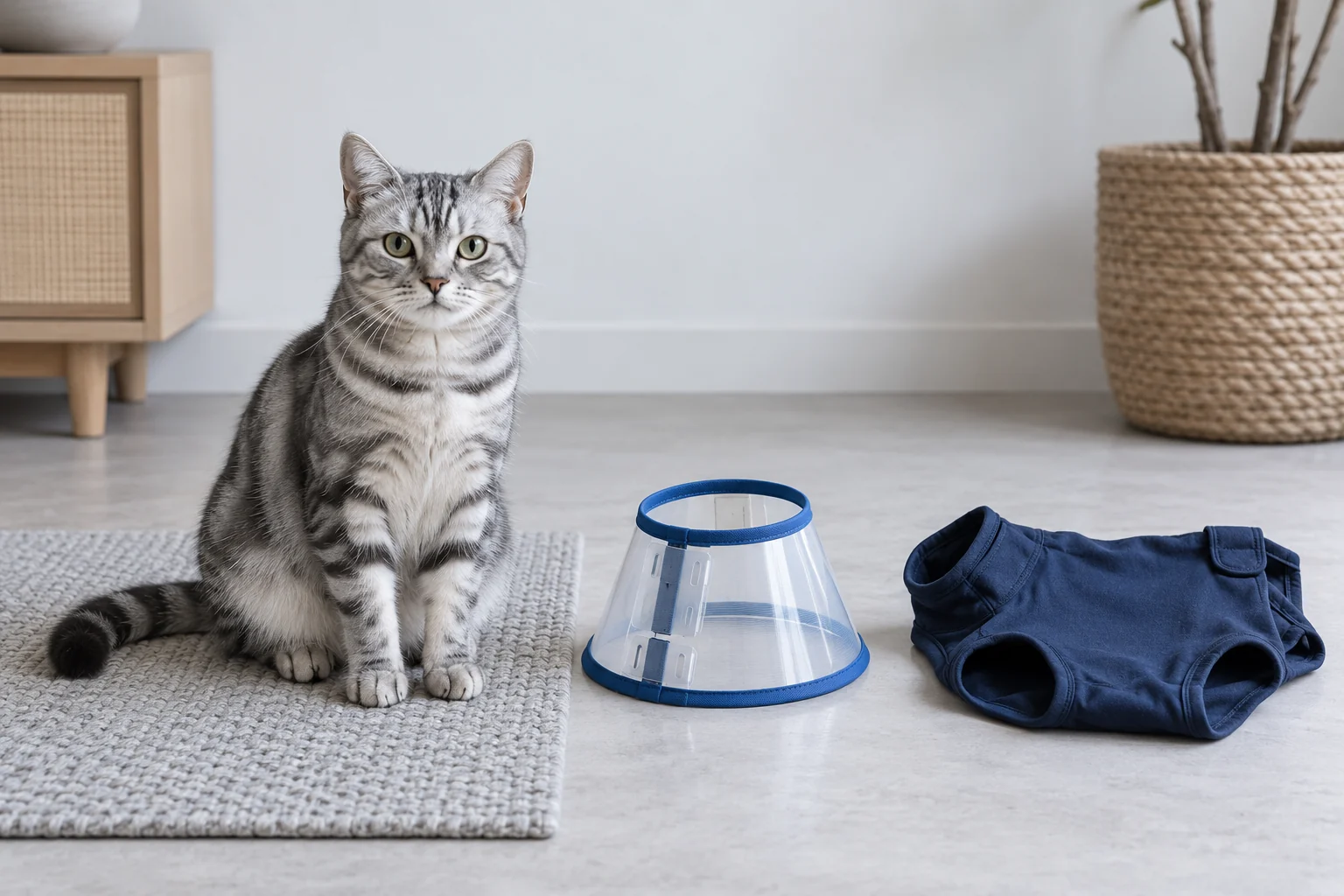
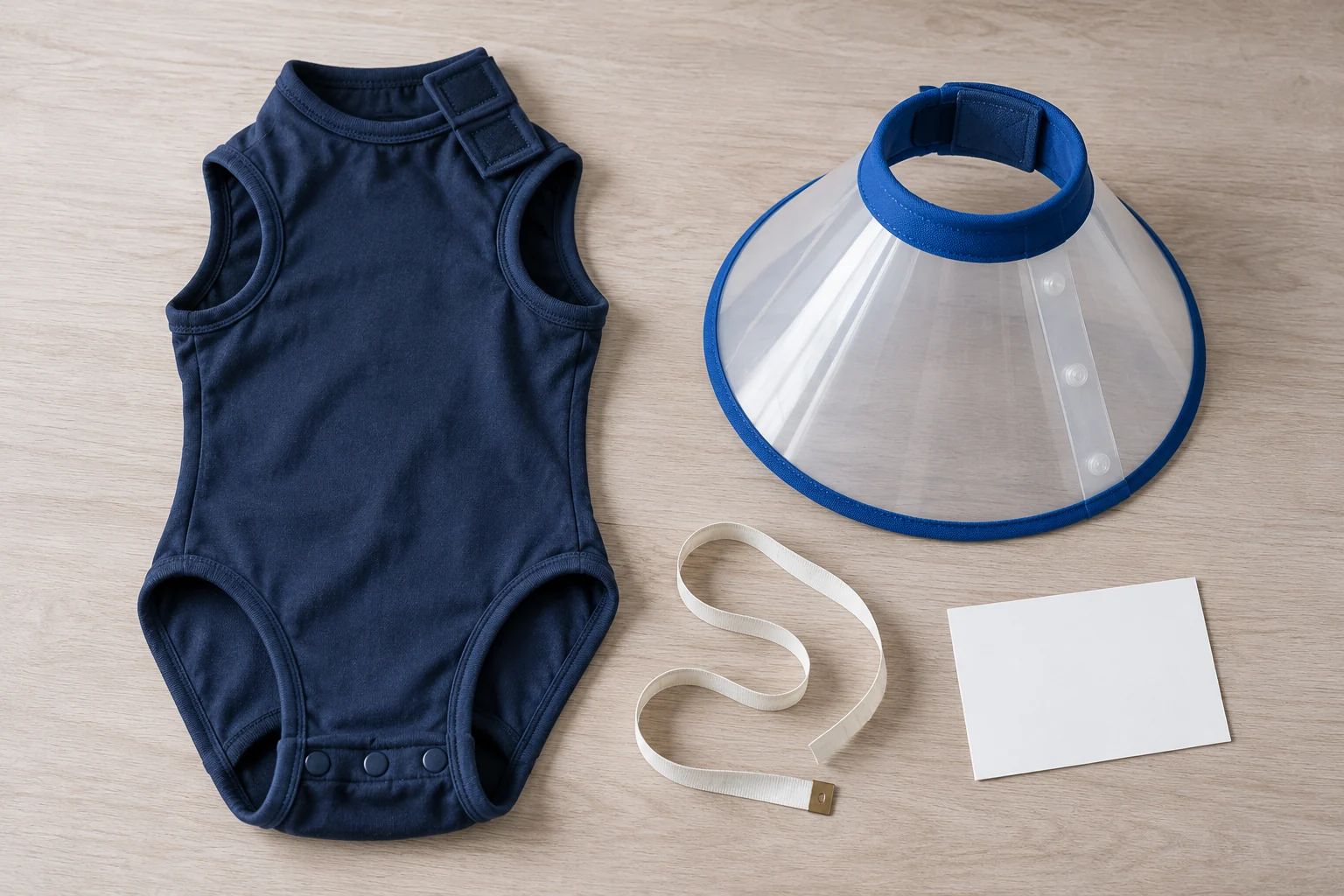
A recovery suit can cover a suitable torso incision. An Elizabethan collar, often called a cone or e-collar, works by limiting access rather than covering the wound. The appropriate choice depends on the site, the device and the individual cat.
Do not replace prescribed protection simply because a suit looks more comfortable. Confirm the exact model, coverage and care plan with the clinic first. PDSA aftercare guidance includes both options; VCA explains the role of a cone.
One important exception: the Suitical Recovery Suit Cat leaves the male castration site unprotected. Its litter-box opening is useful for toileting, but that same opening limits what it covers.
Prepare your vet questionsWhat changes between a suit and a cone?
Think of two different jobs: covering a selected area and stopping the cat reaching an area. The table is a question guide, not permission to select a device without the clinic.
| Decision | Recovery suit | Cone |
|---|---|---|
| How protection works | Fabric covers parts of the torso. Openings, movement and fit determine the actual coverage. | The collar limits reaching or scratching. The clinic needs to check its fit and whether the target area remains accessible. |
| What to ask about the site | Is the whole area inside the garment, including when the cat moves? | Does this shape prevent the action we need to stop, including pawing at the head if relevant? |
| Daily care question | How do we inspect the skin and manage a wet, dirty, slipped or damaged garment? | How will the cat reach food, water and the litter tray with the prescribed collar on? |
| The missing interval | What protects the site while it is changed or cleaned? | If removal is allowed, who supervises and exactly when must it go back on? |
| What not to assume | A quiet cat and a covered-looking body do not prove that the incision is protected. | A softer, inflatable or shorter alternative is not interchangeable merely because it is sold as a cone substitute. |
This combines VCA's collar guidance with the manufacturer's garment precautions. These are different mechanisms, not universally equivalent products. Everyday identification is a separate topic in our breakaway collar comparison.
The useful opening can also be the unprotected area
“For cats”, “post-surgery” and “allows toilet use” answer different questions. A garment can meet all three descriptions and still miss the precise place your veterinarian needs protected. Ask the team to identify that place before matching a product to it.
Abdominal or flank incision
A cat's spay incision may be on the midline or flank, as Cats Protection explains. “Covers the belly” is therefore not a complete specification. Have the clinic check the incision against the garment's edge and openings.
Male castration site
Suitical explicitly excludes its Recovery Suit Cat for protecting this site after castration. This is an exact-model limitation, not a claim that every male cat needs a cone or every garment has the same opening. Read the manufacturer's explanation.
Head or another uncovered site
A torso garment leaves the head uncovered. Ask the clinic which barrier can prevent the particular action that threatens the site.
Read the safety manual as well as the sales page
On 5 October 2026, we found a detail worth taking to the clinic. Suitical's product FAQ describes all-day wear with adult supervision and checks. Its linked February 2025 safety manual says not to exceed eight consecutive hours unless the veterinarian prescribes otherwise.
That is not an invitation to remove protection at eight hours and leave the site accessible. Ask the clinic to reconcile the exact product instructions with a continuous protection plan. Do not transfer this model's interval to other suits.
The manual also requires responsible-adult supervision, discourages use for cats that chew material, and instructs removal and veterinary contact if unusual behaviour occurs. A damaged device or a distressed cat needs individual advice, not a promise to “get used to it”. Compare the product FAQ and complete safety manual (PDF); both are ordinary source links, not affiliate links.
Save the exact instructions
Keep the brand, model, size and instruction version with the discharge sheet. “The website said it was fine” is hard for a second carer to act on. A named product, a specific uncertainty and the clinic's answer are much more useful.
Comfort evidence is not proof of better wound healing
Randomised trial · 2025
26 cats, one operation, 96 hours
Isil and Yanmaz compared a wound-protection corset with an Elizabethan collar in 26 healthy female cats after midline ovariohysterectomy, with 13 cats per group. During hospital observation, head shaking or removal attempts were reported in 10 collar cats and no corset cats.
Pain measures, rescue analgesia and cortisol did not show statistically significant group differences. That does not establish equivalence. The study did not report a comparative wound-healing, infection or wound-opening endpoint. It cannot establish that any retail suit is safer for any operation, including male castration.
Owner survey · 2020
434 owners, not 434 identified cats
In Shenoda and colleagues' survey, 77.4% reported poorer quality of life while their dog or cat wore a collar. The survey did not require species identification. It was retrospective and self-selected, with underlying illness and recall as possible influences.
This supports taking daily difficulties seriously. It is not a cat-only percentage, a suit-versus-cone trial or evidence that removing protection improves recovery.
Our interpretation: comfort problems are a reason to improve the care plan with the clinic. They are not proof that a different-looking device protects the same site. We do not award a numerical safety score or a universal winner.
Original practical resource · Version 1.0
Turn uncertainty into a short conversation with your vet
Select what is unclear and keep the resulting questions with your discharge instructions. This does not diagnose a problem or recommend a device. It works without an account and does not send your selections anywhere.
The core question stays in your list. Select any additional concerns; no personal or medical details are requested.
This tool neither saves nor transmits your selections. Reloading clears them. A downloaded file stays on your device.
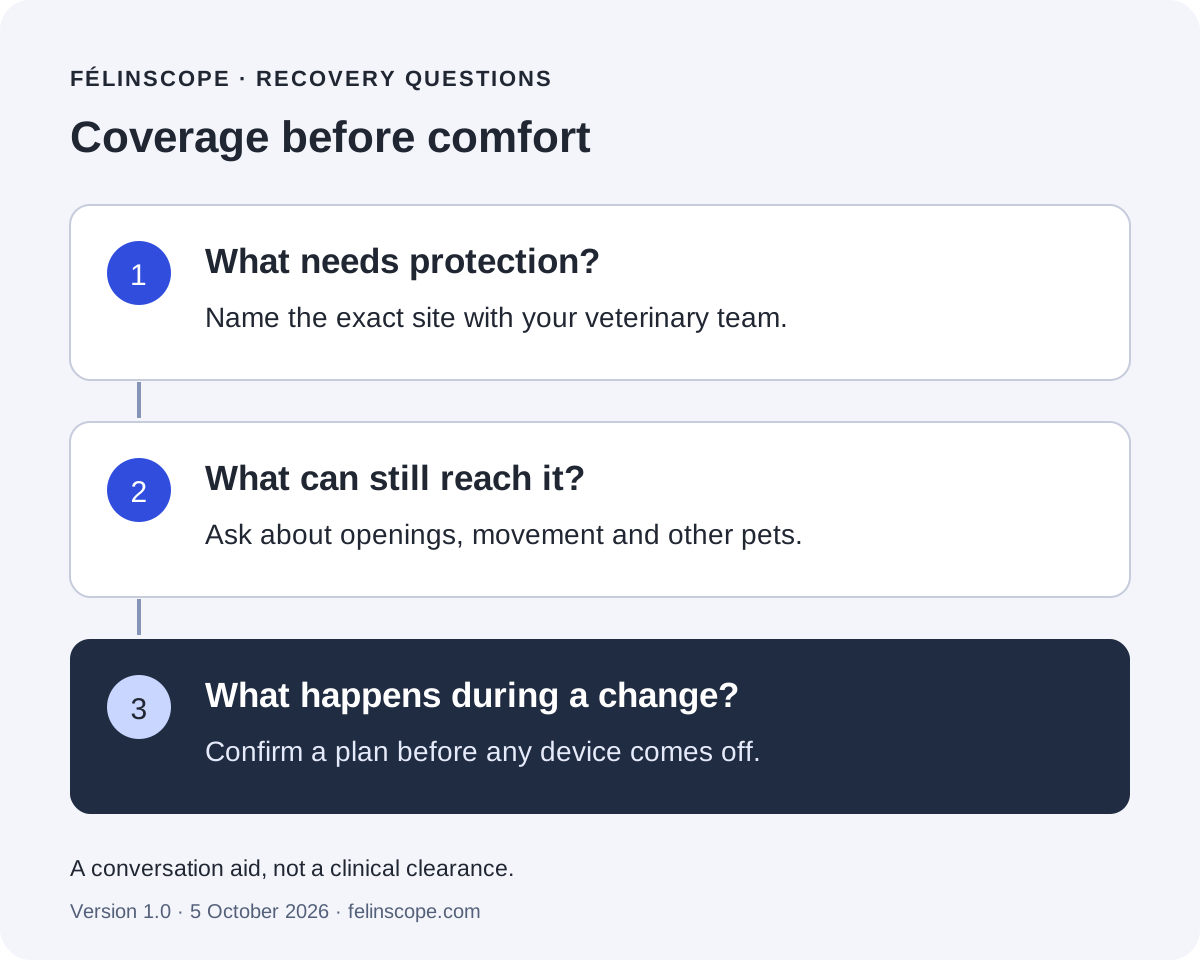
For shelters, carers and resource editors: you can link directly to this question builder or download the source-linked question set (JSON). To cite it: André Ribeiro, Félinscope, Recovery protection questions, version 1.0, 5 October 2026. No purchase, registration or backlink is required to use it.
The protection plan has to work at home, too
Cats Protection recommends a quiet recovery space with essential resources available. Ask how to arrange the room within your cat's prescribed activity limits. Neither a suit nor a cone cancels those restrictions, and a cat appearing comfortable is not permission to resume climbing.
Food, water and toilet access
Watch whether the actual setup is usable. If the collar interferes with meals, call the clinic about an adjustment or its supervised-removal plan. Do not cut the cone shorter yourself. A different bowl may be unnecessary; establish the problem before buying one.
A second cat changes the question
The wearer's cone does not stop a housemate approaching the wound. Cats Protection specifically warns that other pets may lick it. Ask whether separation or another arrangement is needed, and who will check when you are away.
Make the handover explicit
Write who checks the site, how to contact the clinic, what the prescribed protection is and what the team has authorised. Our cat-sitter care sheet can hold that wider routine. Keep medical records and contact details private.
When returning for a check, transport is another decision. Our hard versus soft carrier comparison covers access and usable space, but ask the clinic how to transport a cat wearing its prescribed protection.
Only shop once the clinic has defined the requirement
The clinic may already have supplied an appropriate device. There is no automatic need to buy a suit as an upgrade, or both products as a bundle. If another item is needed, confirm the exact model, size, intended site and care instructions before ordering.
The country-labelled links below open category searches, not tested picks or a veterinary-approved list. Results may contain unsuitable items. We have not verified stock, price or availability of a specific product. The named manufacturer above is an instruction example, not our recommended winner.
As an Amazon Associate I earn from qualifying purchases. These country-labelled searches are not recommendations: verify the exact model, seller, price, delivery and return terms.
See our affiliate disclosure. Referral commission does not determine the care decision.
Common questions
Is a recovery suit better than a cone after spaying?
It may be an option when the clinic confirms that the exact suit protects the incision and is suitable for the cat. The small trial above supports a narrower comfort finding, not a universal improvement in healing or complications.
Can a male cat wear a recovery suit after neutering?
Do not infer suitability from the word “cat” on the packaging. Ask about the actual site and openings. Suitical explicitly says its Recovery Suit Cat does not protect the castration site; other models need their own assessment.
Can I leave a suit on overnight?
Ask the clinic how overnight supervision and wear instructions will be met. Do not treat a comfortable appearance or a product headline as overnight clearance. Resolve the manual and discharge plan together.
Can my cat use a soft cone or inflatable collar instead?
Ask the vet whether that exact alternative prevents access to the site. Softness alone does not establish suitability.
How many days is protection needed?
Use the clinic's endpoint and recheck instructions. Healing and procedures differ. This article deliberately does not supply a universal removal date or a timer that declares a wound healed.
Does a suit replace pain relief?
No. Follow the discharge medication plan and contact the clinic if pain seems inadequately controlled. A clothing comparison cannot select, stop or adjust medication.
Sources, method and limits
André Ribeiro prepared this research-led comparison from seven primary sources, checked on 5 October 2026. We reviewed two research papers, veterinary aftercare guidance and the product page alongside its linked safety manual. We have not fitted these devices to cats, run a clinical trial, tested retail products or obtained veterinary review of this article.
The question set and diagram are our editorial synthesis. They are not validated medical instruments. Source dates and contexts matter: a manufacturer describes one model, a small trial examines a specific population, and an owner survey records reported experience. None alone answers every reader's case.
- PDSA: how to care for your cat after surgery. Aftercare, wound protection and reasons to seek help.
- VCA: Elizabethan collars in cats. Purpose, fit, monitoring and alternatives to discuss with the clinic.
- Cats Protection: caring for your cat after an operation. Home arrangements, incision location and other pets.
- Suitical: Recovery Suit Cat. Model-specific openings, castration exclusion and product FAQ.
- Suitical: Recovery Suit Cat safety and warranty manual, February 2025, version 01. Supervision and wear-time instructions, English section on PDF page 2.
- Isil and Yanmaz, 2025, Veterinary Medicine and Science 11:e70180. Randomised comparison in 26 female cats; DOI 10.1002/vms3.70180.
- Shenoda et al., 2020, Animals 10:333. Owner survey of collar-related quality of life; DOI 10.3390/ani10020333.
Read our review method and transparency policy. If your current product instructions differ, ask the clinic and use our contact page to suggest a source correction.