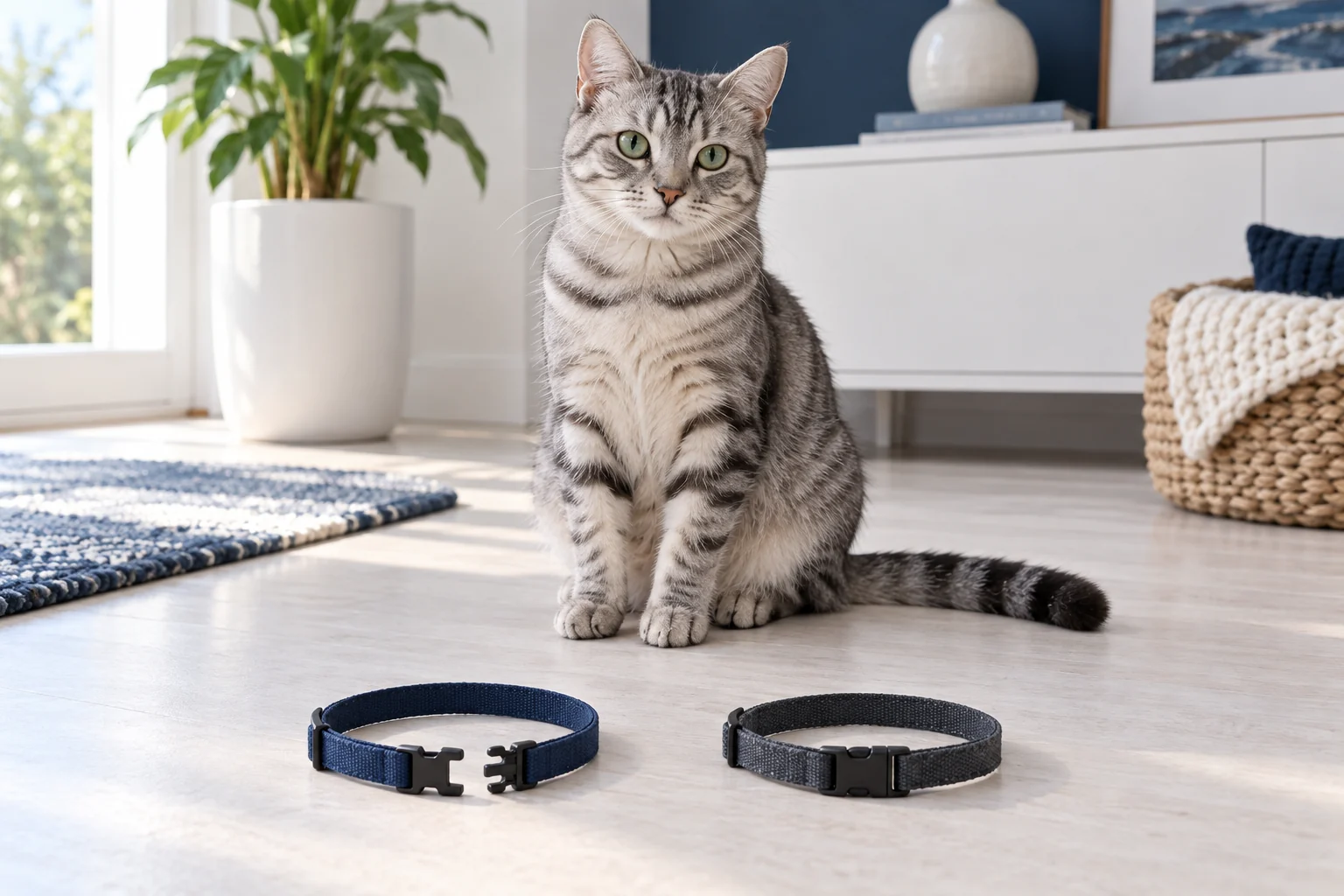
The answer in 30 seconds
For everyday wear, choose a release route, not maximum retention.
If you choose to put a collar on your cat, prefer a cat-specific breakaway clasp designed to separate under tension. A non-breakaway buckle is designed to stay fastened. RSPCA guidance recommends a pressure-opening safety buckle, rather than relying on a fixed or elasticated collar.
A lost collar is inconvenient, but keeping it on at all costs is the wrong target. The useful comparison is between an appropriate release mechanism, a workable fit and an identification plan that does not depend on one wearable object.
Decode the clasp ↓A label is not a mechanism
“Quick-release” can mean two different things.
Imagine two listings with the same phrase. One means the owner can squeeze the sides and remove the collar. The other means the clip separates when the closed collar is pulled. A photo of a plastic buckle cannot settle that question.
Manual side-release
You press the clasp to undo it. That action says nothing about whether it releases automatically when snagged.
Breakaway release
The clasp is intended to separate without a person pressing it. Ask for the exact model's fitting and checking instructions.
Made By Cleo's manufacturer explanation describes near-identical-looking options with different behaviour. That is useful evidence about ambiguous shopping labels, not proof that a particular collar will release in every entanglement.
Ask the seller: “Does this exact clasp open automatically under pulling force, without pressing it, and where are the instructions for checking it off the cat?”
Also ask which cat size or weight range the maker specifies, whether the setting is adjustable, and which attachments are compatible. An unanswered question stays unanswered; neither a star rating nor the word “safety” fills it in.
Compare the closing system
Breakaway, fixed and elastic are not interchangeable.
Scroll the table sideways on a small screen.
| Closure | Intended behaviour | The important limit | Our everyday-wear position |
|---|---|---|---|
| Breakaway | Separates under sufficient tension. | Release depends on the actual mechanism, condition and circumstances. It is not a guarantee. | Preferred starting point when a collar is chosen and the exact product suits the cat. |
| Non-breakaway | Stays fastened until deliberately opened. | Holding identification more firmly does not provide an automatic release route. | Not our solution to repeated collar loss, including for an indoor cat. |
| Elasticated | A section stretches rather than necessarily opening. | Stretching is not the same event as a clasp separating. | Do not treat an elastic section as an equivalent substitute for a breakaway clasp. |
Cats Protection advises against elasticated collars, including the risk of a paw becoming caught. A bell, reflective strip or personalised print is a separate feature; none tells you how the closure works.
This guide is about ordinary identification collars. It does not compare flea treatments, recovery cones, tracking accuracy or harness models. Use our AirTag versus GPS comparison for location technology and our microchip versus magnetic flap comparison for door access.
Retention is not the same outcome as rescue
What the 538-cat study can tell us.
Lord and colleagues' 2010 randomised study assigned 538 cats to plastic-buckle, breakaway-plastic or elastic-stretch collars. Its principal question was whether cats still wore collars and had functional microchips after six months.
Wore the collar for the study period
That was 72.7% of the enrolled cats. Reapplication and owners' initial expectations were associated with success.
Had a reported catching event
A forelimb, mouth or object was involved. The 3.3% figure describes catching events, not a demonstrated rate of serious injury.
Of 478 microchips scanned at the end, 477 functioned. These findings support planning beyond a collar. They do not certify today's buckles, provide a universal opening force or establish how every clasp behaves in a rare severe entanglement.
Our interpretation: a retention study and a welfare recommendation answer different questions. We use the study for realistic expectations and the current RSPCA guidance for choosing a release mechanism. We have not converted either into a numerical safety score.
Inspect first, fit second
Do the mechanical check away from the cat.
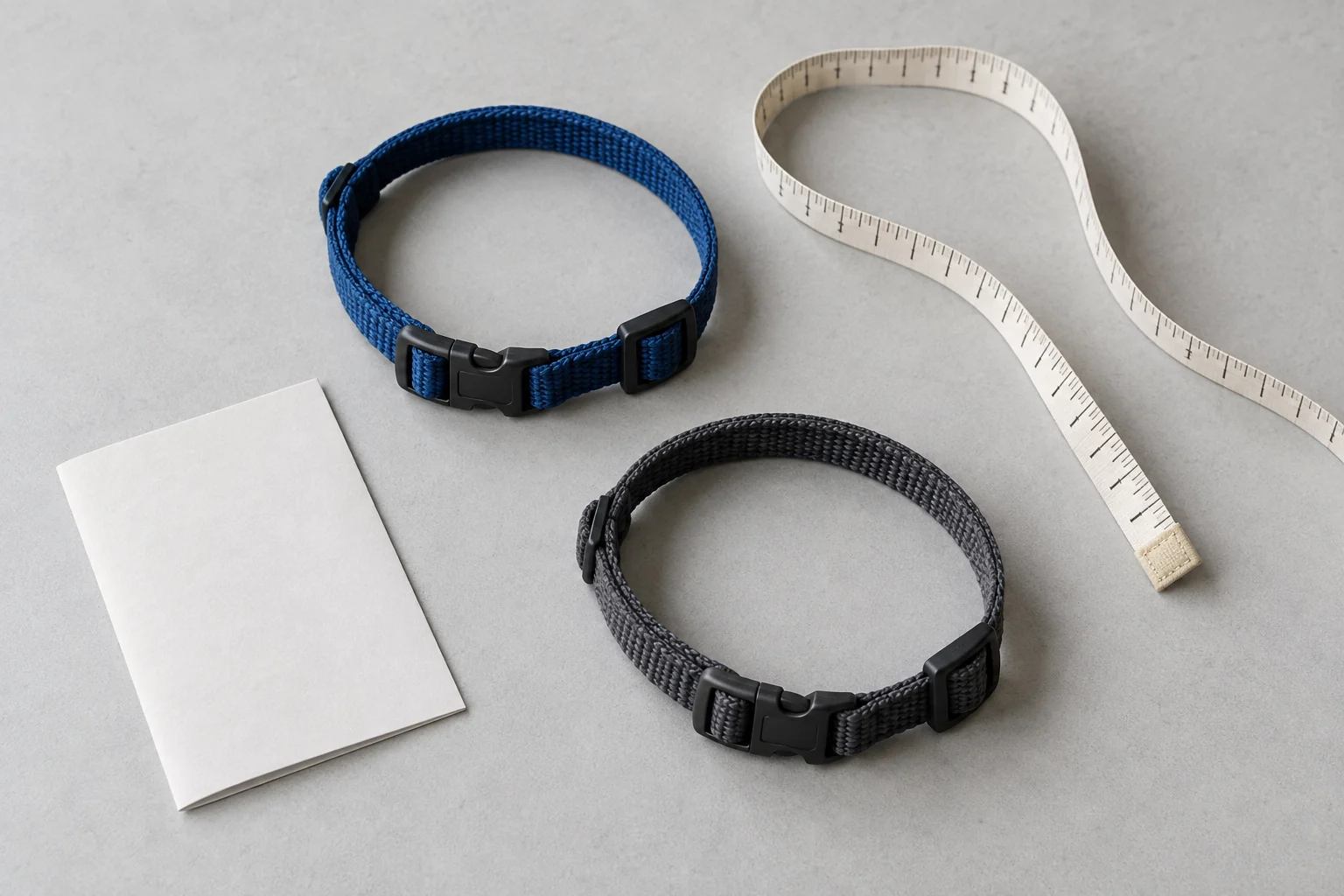
Keep the collar off your cat while you read its instructions and check its condition. If the maker describes an off-cat release check, follow that method. Do not improvise a hanging-weight test, pull against the cat's neck, or decide that “harder to open” means “safer”.
Before first use
Record the maker, model and size. Check for damaged webbing, a cracked clip or an altered setting. If it will not open as described, do not put it on while you investigate.
When it is fitted
Cats Protection's fitting guidance allows two fingers comfortably underneath and calls for a recheck after the cat has settled. An excessively loose collar is not a safer compromise.
When something changes
International Cat Care emphasises adjusting fit as a kitten grows. Reassess after a size change, a new attachment or a damaged component, rather than assuming yesterday's fit still applies.
Follow the exact maker's instructions alongside welfare guidance. If they conflict or the cat falls outside the stated range, ask the manufacturer or your vet rather than inventing an adjustment. Our checklist is an editorial workflow, not a test standard.
The useful question after a loss
Find the cause before buying a stronger clasp.
A collar lying by the sofa could have released after snagging, slipped because the fit changed, or failed because a component wore out. The location alone does not tell you which happened. Use this short event record to make the next conversation with the maker or vet more useful.
- Write down the circumstances. Where was it found? Was the clasp open, the strap broken, or the loop still closed? Record what you saw, without inferring a cause.
- Compare with the instructions. Check sizing, wear and permitted accessories. Take photographs of the item off the cat if the manufacturer needs them.
- Do not defeat the release. Tape, glue, improvised locks and an extra strap across the clasp change the system you selected. Replacing it with a fixed buckle is not our default response.
- Keep identification independent. Confirm the microchip record is current. If unexplained losses continue, pause and obtain individual advice instead of escalating through stronger hardware.
There is no honest “maximum acceptable losses per month” in this guide. One unexplained event can reveal a defect; several events need investigation, not a fabricated pass mark.
Choose the next action
Collar Decision Check
This short check sorts the questions in a useful order. It cannot certify the clasp, diagnose an injury or decide that your cat must wear a collar.
Answers stay in this page only. They are not saved or sent.
Your next action
Start with the cat, then the clasp
Choose an answer for each question. Unknowns remain open questions, not a product approval.
Never test release force while the collar is on your cat.
The day the collar is absent
Keep the identification plan working without it.
A readable contact detail can help a finder while a collar is present. A registered microchip provides a different route after scanning. International Cat Care explains why a collar is not permanent identification; the RSPCA checklist reminds owners to update registration details after a move or phone-number change.
Our practical handover note is simple: where is the chip registration held, are the contact details current, and who will help if the collar disappears while someone else is caring for the cat? Use the cat-sitter care sheet for the wider care instructions. Do not publish your phone number or microchip number in a public comment.
If the collar also carries a tracker or an access key, avoid solving every problem here. Read the specific tracker attachment limits or cat-flap key fallback. Adding equipment changes the setup; it does not make a stronger closure the answer.
Only after the unresolved questions
Shop for a documented mechanism, not a safety slogan.
Start with the cat's measurements and the maker's instructions. If an existing appropriate breakaway collar is intact, fits and works as specified, another purchase may add nothing.
We do not provide a shopping button for fixed collars as a way to prevent loss. Look for a documented cat-specific breakaway design, a suitable adjustment range and a clear explanation of the identification feature. A personalised strap does not prove release performance.
These are country-labelled Amazon category searches, not tested products or approved results. Both searches target breakaway collars; marketplace results may still include unsuitable items. Check the exact mechanism, seller, instructions and return terms before buying.
As an Amazon Associate I earn from qualifying purchases. These country-labelled searches are not recommendations: verify the exact model, seller, price, delivery and return terms.
See the affiliate directory for our commercial-link policy. No purchase is required to use the decision check.
Useful follow-up questions
Cat collar clasps: FAQ
Are breakaway collars better than non-breakaway collars for cats?
For everyday collar wear, a cat-specific breakaway design provides a release route that a fixed buckle does not. RSPCA guidance favours a safety buckle that opens under pressure. Correct fitting and inspection still matter, and no collar can promise to release in every situation.
Is a quick-release buckle always a breakaway buckle?
No. Quick-release can describe a buckle a person opens by squeezing it. Ask whether the exact clasp separates under pulling force without anyone pressing it, and obtain the maker's instructions. Appearance and wording alone do not confirm the mechanism.
What if my cat keeps losing a breakaway collar?
Treat each loss as something to investigate, not proof that a fixed buckle is needed. Check fit, wear, attachments and the maker's suitability instructions. Do not glue, tape or lock the release shut. Repeated unexplained loss is a reason to seek product or veterinary advice before trying another setup.
Can I attach a lead to a cat collar?
Do not use a breakaway collar as a lead restraint, or substitute a fixed collar just to hold the lead. Cats Protection advises a suitable cat harness rather than a collar if lead use is chosen. Many cats find harness outings stressful; an outing is not obligatory.
What force should make a cat collar open?
This guide does not set a universal force threshold. A number without the exact design, size, test method and manufacturer instructions is not a safety certificate. Never measure release force on the cat or use hanging weights for a home test.
Does a microchip make an identification collar unnecessary?
They work differently: a readable collar can provide visible contact information, while a registered microchip provides identification after scanning if the collar is absent. International Cat Care notes that collars are not permanent identification. Discuss the individual collar decision with your vet and keep registration details current.
Sources checked 20 September 2026
Sources and evidence limits
We compared publicly available welfare guidance, a research abstract and a manufacturer's mechanism explanation. We did not test a named collar, measure snag loads or assess individual cats. The decision check and loss-event record are our practical synthesis, not validated clinical or engineering instruments.
- Cats Protection: choosing a cat collarWelfare guidance on release mechanisms, fitting, damage and accessories. Not a certification of a named collar.
- RSPCA: getting ready for your rescue catPage 7 explains the pressure-opening safety buckle; page 2 covers updating microchip contact details.
- Lord et al., 2010: collars and microchips for identifying pet catsRandomised six-month study of 538 cats. We use its published abstract for the outcomes discussed here, not a new product ranking.
- International Cat Care: caring for your new kittenPage 24: snap-open collars, changing fit during growth and permanent identification.
- Cats Protection: harnesses and leadsDistinguishes a suitable harness from a collar for lead attachment; also explains why walking is unsuitable for many cats.
- Made By Cleo: breakaway and non-breakaway bucklesPrimary manufacturer explanation of its hardware. We do not adopt its fixed-collar or lead-use suggestions as feline welfare guidance.
Read how we review and our transparency policy. A source correction or manufacturer clarification can be sent through our contact page.