The answer in 30 seconds
Choose the chain that still works when one link fails.
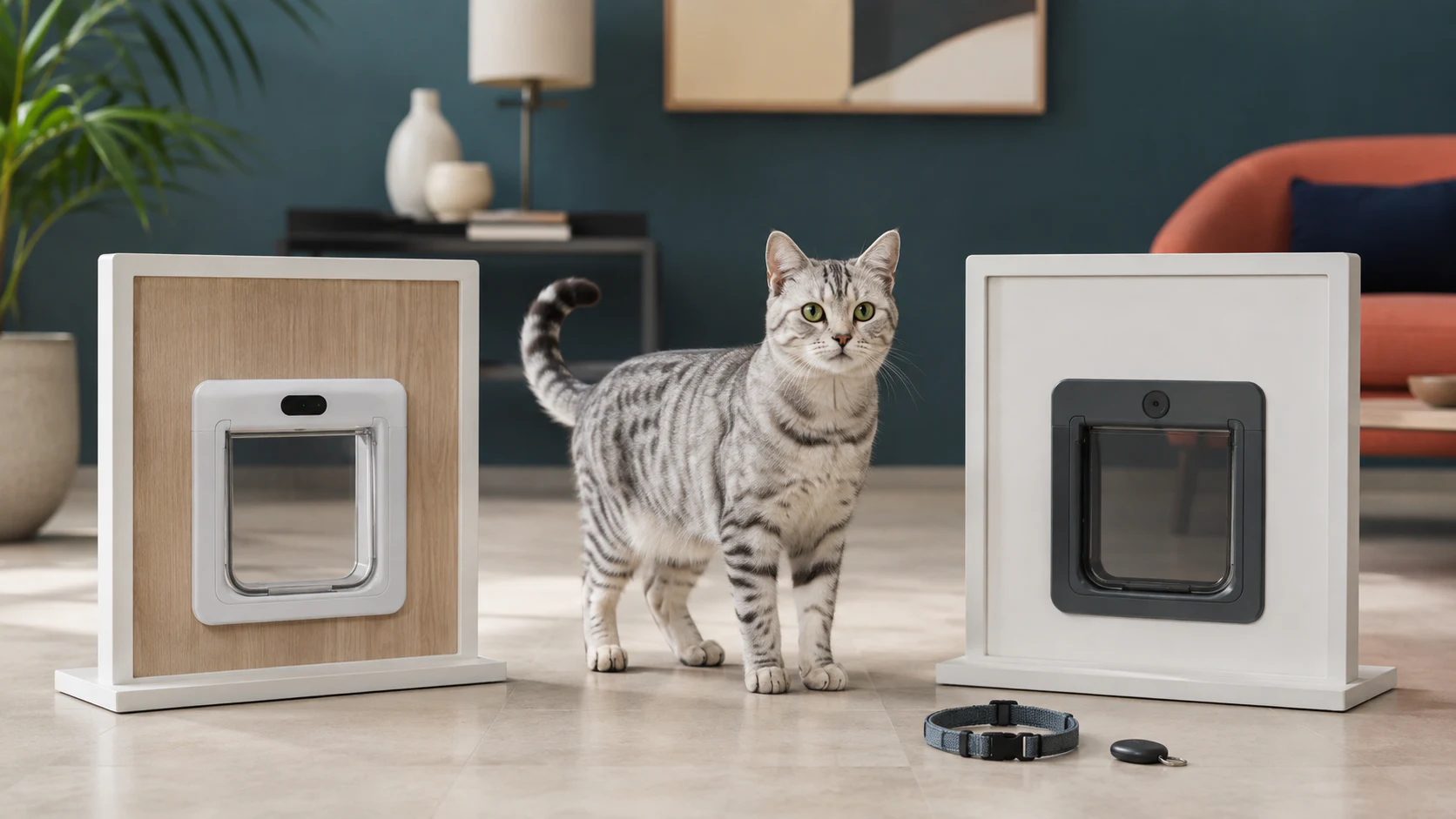
Start with a compatible implanted microchip when the main job is selective entry. The credential stays with the cat, so access does not vanish when a quick-release collar safely comes off.
A magnetic collar key can still make sense when the exact flap accepts it reliably, the cat tolerates a correctly fitted quick-release collar and the household has a plan for a lost key.
Neither category earns a permanent cut by name alone. Verify the controlled direction, usable opening, cat acceptance, ten calm reads, reclose, relock, battery or key failure and the complete installation route first.
Run the no-cut planner ↓This page owns the access-control decision. A microchip is not a GPS tracker, and a cat flap does not locate a missing cat. For recovery technology, use our separate AirTag 2 vs GPS tracker comparison. Selective feeding remains a different job covered by SureFeed vs PETLIBRO One RFID.
Three labels that should not be merged
Decode the credential before comparing prices
Retail listings often place unlike mechanisms under the same words. The correct question is what the exact unit reads and what happens after that read.
Permanent identity credential
A compatible flap reads the unique identifier under the cat’s skin. The chip does not power the door and does not provide GPS.
Removable access credential
A special key on the collar releases a compatible catch. The cat loses that route when a safety collar releases.
Not automatically magnetic
Proprietary collar tags can use other sensing methods. Match the exact tag and reader instead of treating every collar key as interchangeable.
The complete access chain
Seven gates stand between a product claim and a usable route
The sensor can work perfectly while the system fails somewhere else. Test every link in the order the cat experiences it.
Credential
The implanted chip or collar key must be present, readable and supported by the exact reader.
Direction
The model must control the side that matters. Selective entry does not automatically mean selective exit.
Passage
The cat must fit and cross voluntarily without being pushed, trapped or startled by the latch.
Release
The mechanism must unlock early enough for the cat’s natural approach angle, not only in a staged hand test.
Relock
The flap must close and return to the intended state after the whole cat and tail have passed.
Failure
Low batteries, a lost key and a manual lock setting need a safe, visible household response.
Installation
Flap opening, cutout, tunnel depth, adapter, material and reversibility must all fit the real opening.
The permission trap
Selective entry is not selective exit
The original SureFlap Microchip Cat Door documents selective entry with any animal able to exit. PetSafe’s microchip model likewise describes selective entry and a manual four-way lock. Those facts are useful examples, not a rule for every product.
If one resident must stay indoors while another can leave, look for explicit individual exit permissions in the exact manual. Do not infer them from microchip, smart or four-way.
- Selective entry
- Registered credential can enter; unregistered visitor remains outside.
- Manual in-only mode
- The whole flap is set so animals can enter but not leave.
- Individual exit control
- Permission differs by registered animal and must be expressly documented.
Whole-system comparison
The sensor changes one risk; the home supplies the rest
These are category tendencies and decision boundaries. Dimensions, batteries, memory, lock modes and adapters must come from the current exact-model documentation.
| Decision | Microchip cat flap | Magnetic cat flap |
|---|---|---|
| What identifies the cat | An implanted identification microchip read by a compatible flap; some models also accept proprietary collar tags. | A special magnetic key attached to a collar. This is not the ordinary magnet that holds many flaps shut. |
| What stays with the cat | The implanted credential does not depend on a collar remaining attached. | Access disappears when the breakaway collar releases or the key is removed, lost or damaged. |
| Reader and power | The flap’s electronic reader needs its specified power source. Battery life and warnings belong to the exact model. | The key itself is passive, but never infer the complete mechanism or failure state from the category name alone. |
| Entry and exit | Many models authenticate entry only; individual exit control requires an explicitly documented design. | A four-way manual lock can mean open, closed, in-only or out-only. That is not necessarily individual exit control. |
| Cat-welfare trade-off | No access collar is required when the chip is compatible, but the cat must still accept the flap, sound and resistance. | The key route adds a collar. Cats Protection advises a correctly fitted quick-release or snap-opening cat collar. |
| Installation risk | Metal, glass and wall installations can need an adapter, tunnel pieces or professional work. | Cutout, frame, tunnel limit and material compatibility are still model-specific; lower purchase price does not make a wrong cut cheap. |
Documented examples: SureFlap Microchip Cat Door , PetSafe Microchip Cat Flap and PetSafe Staywell magnetic model . Manufacturer pages establish their own features only; they do not prove that one category fits every cat.
Interactive pre-installation decision
Let one failed link stop the cut
Enter what the assembled system has actually proved. The planner keeps installation closed until credential, direction, passage, relock, failure and geometry all pass.
Record whether traffic, escape, conflict, weather and the return path are appropriate for this cat. The access chain cannot qualify while this household gate remains unchecked.
- Current verdict
- No permanent installation yet
- Credential
- Not selected
- Direction
- Not defined
A reversible seven-stage bench test
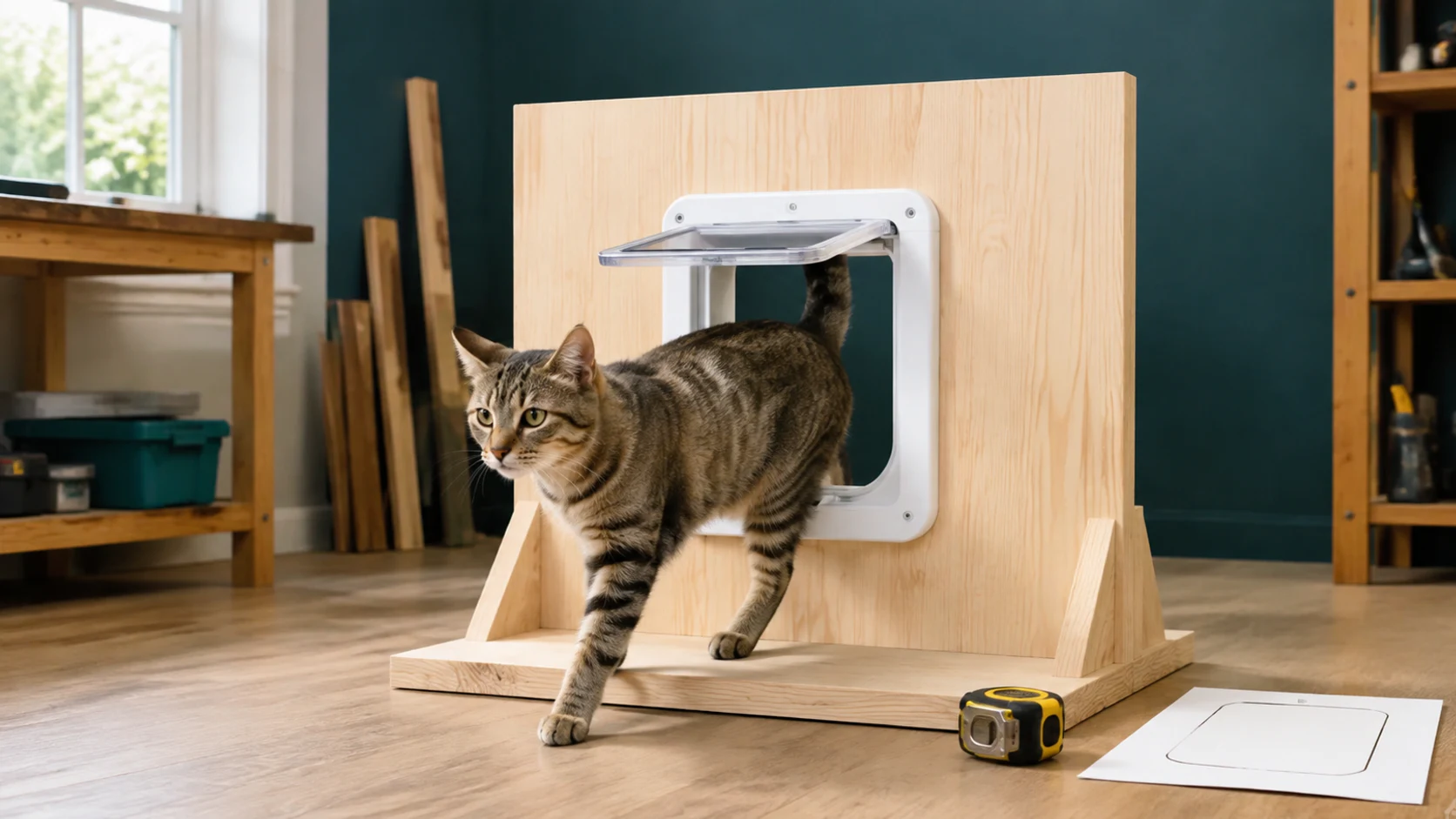
Build confidence on a panel you can remove
Sure Petcare advises introducing and programming a microchip door before installation. We extend that reversible principle across the full access chain so a failed test costs time without costing a door.
- 01
Define the controlled direction
Write the job in one sentence: block unregistered entry, manage one resident’s exit, or control an interior room. If the product manual does not describe that exact job, stop.
- 02
Verify the credential
Use the manufacturer’s compatibility checker or written specification for the exact implanted chip or key. Do not rely on the words universal, RFID or smart.
- 03
Measure cat and opening
Measure the narrowest usable flap opening and compare it with the cat’s comfortable posture. Then verify the cutout, outer frame, tunnel and any adapter independently.
- 04
Build a reversible practice panel
Mount the complete unit at the intended belly height in a stable temporary panel. Programme it before installation so another animal is not enrolled accidentally.
- 05
Teach the passage first
Secure the flap fully open. Let the cat inspect and cross both ways voluntarily; gradually introduce flap weight and latch sound only after relaxed passage.
- 06
Run ten calm approaches
With normal battery and lock settings, record unlock, direction, hesitation, full passage, reclose and relock. One miss stays visible rather than being averaged away.
- 07
Rehearse failure and only then cut
Check the low-battery signal, manual lock, spare-key route and safe return plan under supervision. Install permanently only when every required link passes.
Identity and collar safety
The safer collar is designed to come off
Cats Protection advises quick-release or snap-opening cat collars and a fit that allows two fingers underneath. That safety feature creates a predictable access failure for a magnetic key: the key may leave with the released collar.
An implanted microchip avoids that particular dependency, but it is not fail-safe. AAHA notes different microchip frequencies and imperfect scanner detection. For a door decision, verify the exact reader; for lost-pet identification, keep registry details current and have the chip scanned as advised by a veterinarian.
Before choosing a collar-carried key, read our breakaway versus non-breakaway collar comparison. Losing a key is not a reason to defeat the collar release.
Failure-first comparison
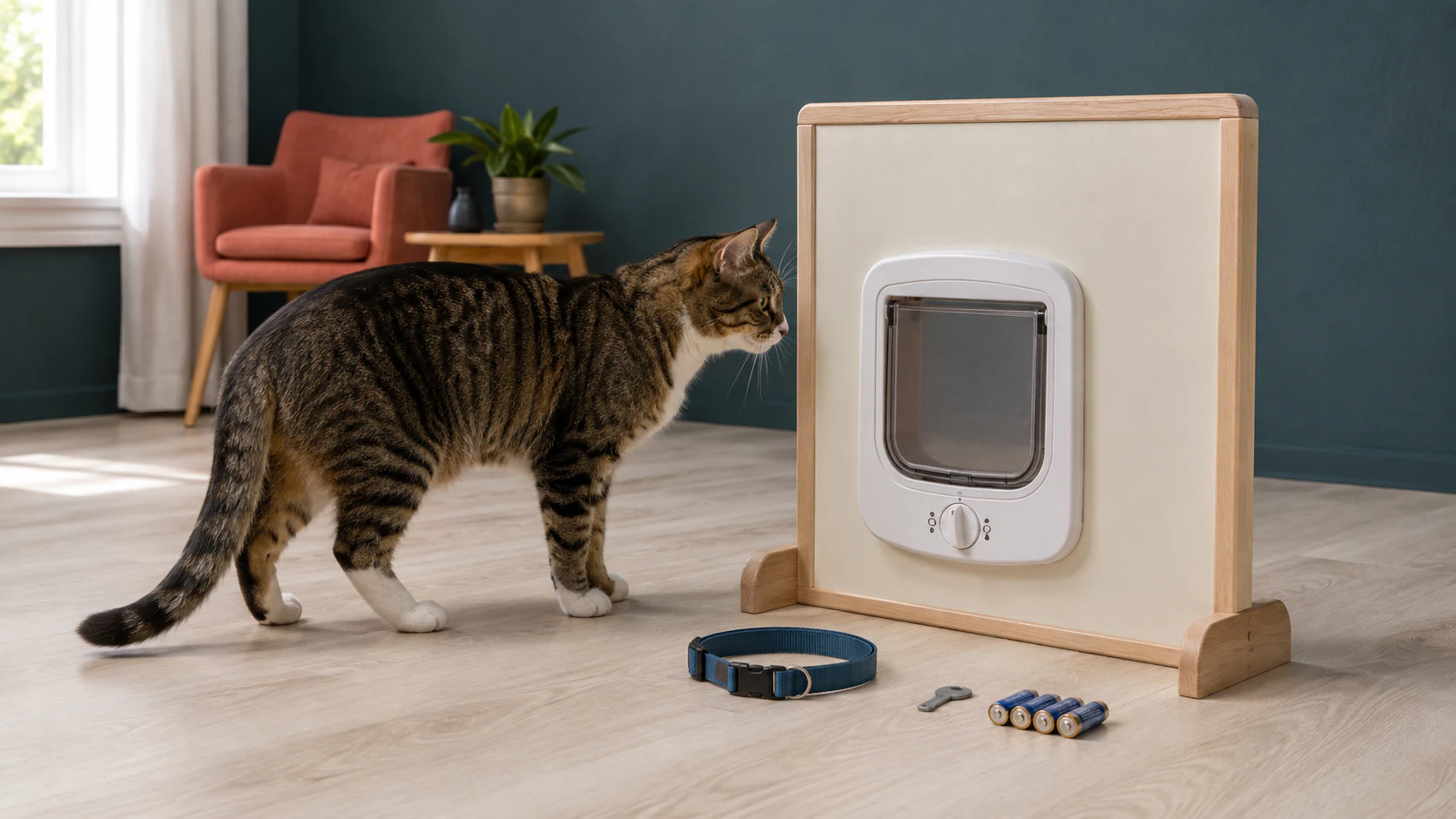
Write the response before the cat needs the route
No category name tells you whether a unit fails locked, unlocked or intermittently. Use the manual and supervised observations from the exact system.
A selective door does not secure the space beyond it. Our catio versus physical cat-proof fencing comparison covers garden boundaries, human gates and indoor return.
Implanted chip is not read
- Visible clue
- No release or inconsistent release at the cat’s normal approach
- Household response
- Stop. Confirm the chip number/type, reader compatibility, batteries, mounting material and manufacturer troubleshooting before installation.
Magnetic key or collar is lost
- Visible clue
- The cat returns without the credential
- Household response
- Use the supervised manual return plan. Replace only with the exact compatible key and a correctly fitted quick-release cat collar.
Battery reaches warning state
- Visible clue
- Indicator or latch behaviour changes
- Household response
- Follow the exact manual, replace with the specified batteries and retest. Never assume the unlocked or locked fail state.
Wrong direction remains open
- Visible clue
- A resident exits when only entry should be allowed, or cannot return
- Household response
- Recheck the model’s per-direction logic. A manual four-way dial and individual permissions are different functions.
Another animal follows closely
- Visible clue
- A second animal reaches the opening before it fully relocks
- Household response
- Treat this as an observed household limit. Change supervision or access design; do not claim a capability the manual does not document.
Cat freezes at click or flap
- Visible clue
- Crouching, retreat, pawing or refusal
- Household response
- Return to the open-flap stage and lower the difficulty. Do not force the cat through or create outdoor urgency.
Geometry before brand
Measure four rectangles, not one pet weight
A weight limit cannot prove passage. Record the narrowest flap opening, required cutout, complete outer frame and tunnel depth separately, then add every adapter or extension the mounting material needs.
- Cat: shoulder width, belly height, comfortable crouch and mobility.
- Flap: narrowest clear opening after seals and latch hardware.
- Structure: cutout, edges, panels, reinforcing bars, glass type and available depth.
- Finish: outer frame clearance, weather seal, tunnel pieces and a reversible repair route.
Passage before electronics
Teach the hole, then the flap, then the click
Cats Protection recommends starting with the door held open, encouraging progress and practising both directions. Sure Petcare similarly advises introducing the unit before installation and propping the flap open.
Inspect
Complete unit present, no crossing required.
Open passage
Flap secured; voluntary travel both ways.
Light contact
Gradually add flap weight without restraint.
Latch sound
Normal credential and release at cat height.
Independent route
Calm approach, pass, close and relock.
Direct answers
Microchip vs magnetic cat flap FAQ
Is a microchip cat flap better than a magnetic cat flap?
Usually when the cat already has a compatible implanted microchip and the main job is selective entry: access does not depend on a collar key remaining attached. A magnetic model can still be rational when the exact key works reliably, the cat accepts a correctly fitted quick-release collar and the household accepts key-loss risk.
What does magnetic cat flap mean?
In this comparison it means a flap released by a special magnetic collar key. It does not mean a basic flap whose ordinary closure magnet simply holds the door against draughts.
Will every microchip work with every cat flap?
No. Frequencies, formats, reader design and installation conditions vary. Check the exact microchip number or type with the exact manufacturer’s compatibility information, then prove repeat reads on the assembled unit before cutting.
Does a microchip cat flap track my cat?
Not by default. A microchip is an identification credential, not GPS. Some connected doors can log events, but tracking, remote control and selective access are separate functions that must be documented for the exact model.
Can a microchip cat flap stop one cat going out?
Only if the exact model documents individual exit permissions. Many common microchip flaps provide selective entry while allowing any animal to exit; a four-way manual lock does not automatically create per-cat exit control.
Does a microchip cat flap need batteries?
The implanted chip is passive, but the flap reader needs the power source specified by its manufacturer. Battery number, expected life, warning and fail state vary, so read the exact manual and test the warning routine.
Is a collar key safe for a cat?
Any collar adds a welfare trade-off. Cats Protection recommends a quick-release or snap-opening cat collar, correctly fitted so two fingers fit comfortably underneath. The access plan must expect that a safety collar may release and take the key with it.
How do I train a cat to use a selective flap?
Introduce the complete unit before permanent installation, secure the flap open, reward voluntary approaches and practise both directions. Gradually reintroduce flap weight and latch sound. Stop if the cat freezes or avoids the route; never push the cat through.
Can I install a cat flap in glass, metal or a wall?
Sometimes, but the adapter, cutout, tunnel extension and professional requirements are model-specific. Check the installation guide before purchase and before any cut; a door that fits timber directly may need extra parts elsewhere.
Can a selective cat flap guarantee home security?
No. It can restrict the animals that operate the flap under documented conditions, but it cannot guarantee building security, prevent every close follower, or make an outdoor route safe. Assess the opening, surroundings and household separately.
Source ledger
What supports each conclusion
Welfare and veterinary sources carry collar, identification, training and outdoor-context guidance. Manufacturer pages carry only their exact model behaviour, dimensions and installation claims. Accessed 7 September 2026.
- Sure Petcare: Microchip Cat Door Selective-entry boundary, compatible credentials, batteries, manual lock, memory and five separate installation dimensions.
- PetSafe: Staywell Magnetic 4-Way Locking Classic Cat Flap Special magnetic collar key, manual modes, included template, material fit and exact geometry.
- PetSafe: Microchip Cat Flap FDX-B compatibility, selective-entry wording, memory, low-battery indicator and adapter requirements.
- Sure Petcare: training a cat to use a cat door Pre-installation introduction and programming, belly-height placement and open-flap progression.
- Cats Protection: choosing a cat collar Quick-release design, two-finger fit, loss and snag risks, and microchip identity context.
- Cats Protection: cat flaps and training Open-flap start, gradual force, both-direction practice and the role of selective access.
- AAHA: animal identification and microchipping Permanent identification, ISO context, registry upkeep, annual scanning and non-fail-safe limits.
- VCA Canada: pet doors with microchip sensors Credential comparison, direction, size, template, installation, noise and outdoor-safety context.