The answer in 30 seconds
Choose the boundary you can manage completely.
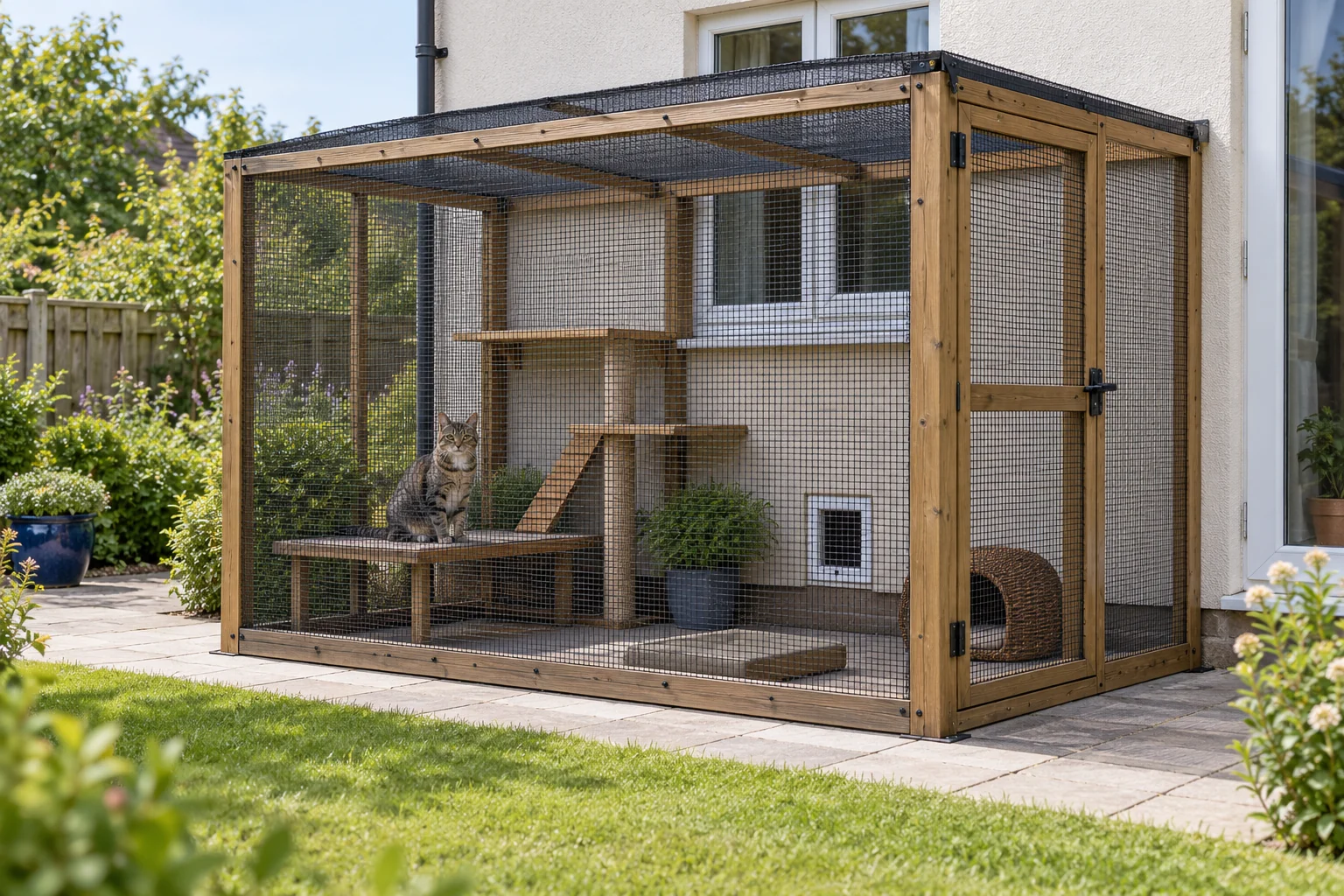
A catio encloses a defined outdoor space, including overhead. Physical cat-proof fencing modifies or builds a garden boundary while usually leaving the sky open. A catio limits the area to resolve; fencing can offer more of the garden, but every gate, join and route around the perimeter matters.
Our decision rule: shortlist a house-connected catio when a whole-garden problem remains outside your control. Consider fencing when the complete boundary and its daily use can be addressed. Neither choice is ready merely because the shopping list is complete.
This comparison excludes electronic or invisible fences and shock-collar systems. It does not rate a particular kit as escape-proof. Cats Protection explains the two physical options.
Make your opening registerA room outside or a garden boundary?
Catio: a contained footprint
Here, “catio” means an enclosed space with walls and a containment ceiling, connected to the home. The ceiling may be mesh or solid; weather shelter is a separate requirement. A loose shade cloth is not automatically a containment roof.
Fencing: a continuous perimeter
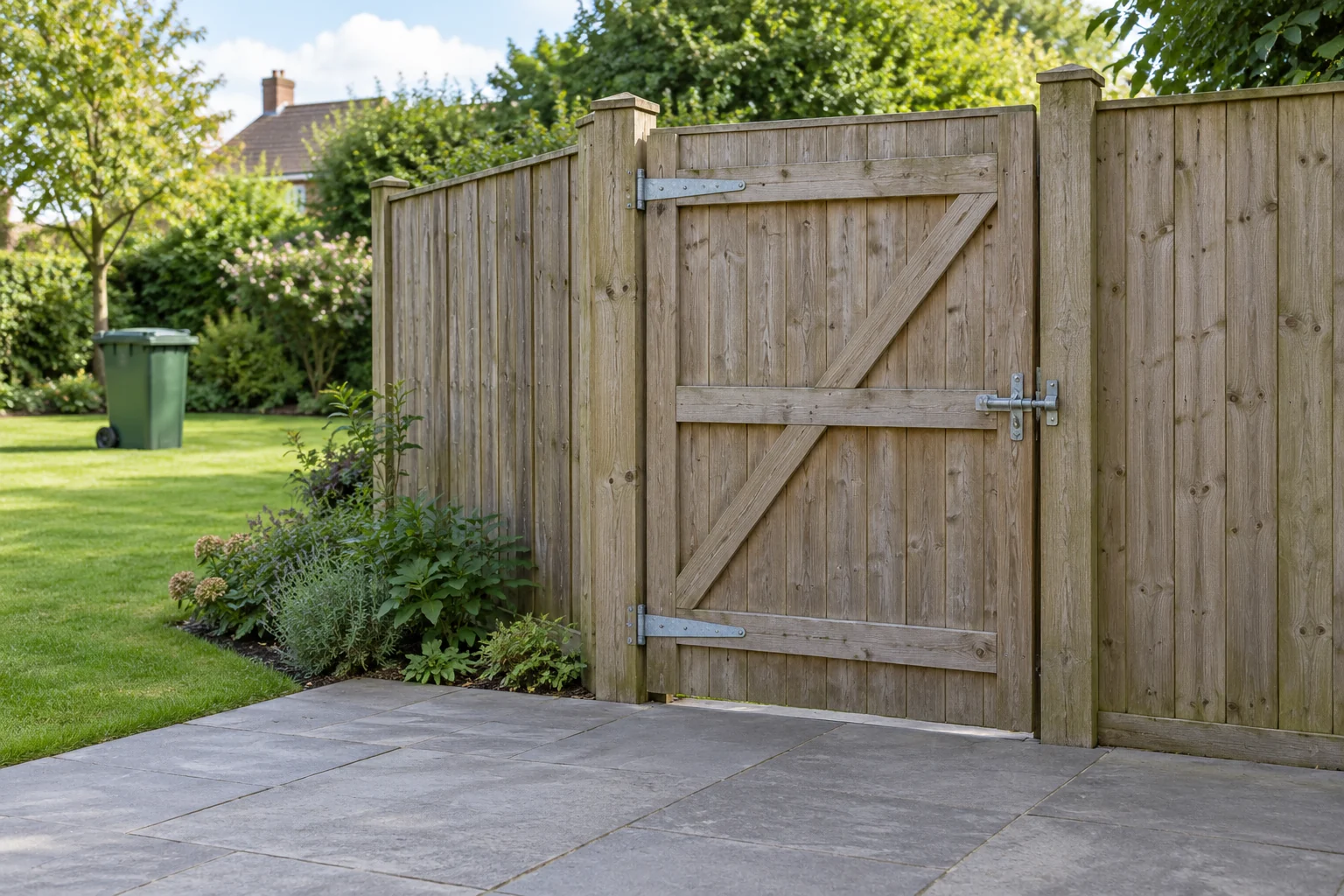
Here, “fencing” means a physical barrier such as a compatible fence-top system or a purpose-built roofless enclosure. An ordinary garden fence is not equivalent simply because it is tall. The chosen system has its own installation requirements.
| Question | Connected catio | Physical cat-proof fencing |
|---|---|---|
| What is the boundary? | The enclosure panels, ceiling, base, service door and house connection. | The entire chosen perimeter, including gates, buildings and changes in ground level. |
| What space becomes available? | The selected footprint and usable furnishings inside it. | The garden area inside the completed system, which may be much larger. |
| What does ordinary use change? | Opening a service door, cleaning panels or moving interior furniture. | Bin collections, deliveries, gardening, new structures and access shared with others. |
| What might rule it out? | No workable home connection or no suitable place for a useful, comfortable enclosure. | A boundary you cannot alter, a gate routine you cannot manage or an unresolved bypass route. |
| What is not proved? | That any size suits every cat, or that the enclosure stays cool and comfortable. | That a topper excludes visiting animals or fixes openings below it. |
The table is our planning synthesis, not a product specification. For example, Purrfect Fence's conversion instructions distinguish gate arrangements, corners and attachments to different fence materials. Straight-line length alone does not describe that work.
Worked example · Hypothetical, not a field test
The same garden can produce two very different proposals.
Imagine a home with a patio beside the back door, a timber garden boundary, a shared side gate used for bins and a shed near one corner. The owner likes the idea of the cat using the whole garden. A smaller connected enclosure could also fit beside the house.
| Observed feature | Fencing proposal | Catio proposal |
|---|---|---|
| Shared bin gate | Needs an answer. Who controls access when the gate is open? Ask about a separated entrance arrangement. | Different boundary. A patio enclosure could leave the shared gate outside it. Its own service door still needs an opening routine. |
| Shed beside the fence | Installer assessment. Record the complete climb route and ask how the design addresses it. | Check the actual plan. The shed may be outside the catio, but the ceiling and house junction must be resolved. |
| Back-door connection | Needs a household plan. Can the cat return when this door is shut? | Needs a design answer. Confirm a suitable opening and every connection to the enclosure. |
| Two initial quotes | Incomplete. A price for fence toppers only does not settle the gate or shed questions. | Incomplete. A panel-kit price does not settle the base, doorway or installation. |
Our interpretation: in this fictional case, the catio is worth exploring first because it may avoid the shared gate, not because catios always outperform fencing. If a feasible gate arrangement and shed treatment are later confirmed, the fencing proposal deserves another look. The record can change without inventing a winner.
Original practical resource · Version 1.0
Keep a record of the openings, not a safety score.
A tick without an observation is hard for another person to act on. Use this register to record the unanswered question, who will deal with it and the next check. Add measurements or photograph references if useful, but obtain product-specific answers rather than guessing permitted gaps.
Your notes stay in this open page only. Download or copy before leaving; refreshing clears them. Do not include an address, alarm code or other sensitive details.
“Answer recorded” is not a safety pass. Notes can identify an unresolved problem; they cannot prove that an installation contains a cat.
Reopen the question when something changes
A new bin position, replacement gate latch, growing branch or damaged panel can invalidate an old note. Record the change and the action taken. Keep the cat away from a suspected escape route or damaged structure until the problem is resolved. Regular checks are part of the RSPCA's containment guidance; this register does not prescribe an inspection interval for every product.
For carers and resource editors: link to this opening register or download the blank, source-linked worksheet (JSON). Suggested citation: André Ribeiro, Félinscope, Outdoor opening register, version 1.0, 7 October 2026. It is free to use without a purchase, account or required backlink.
The route back inside belongs in the design.
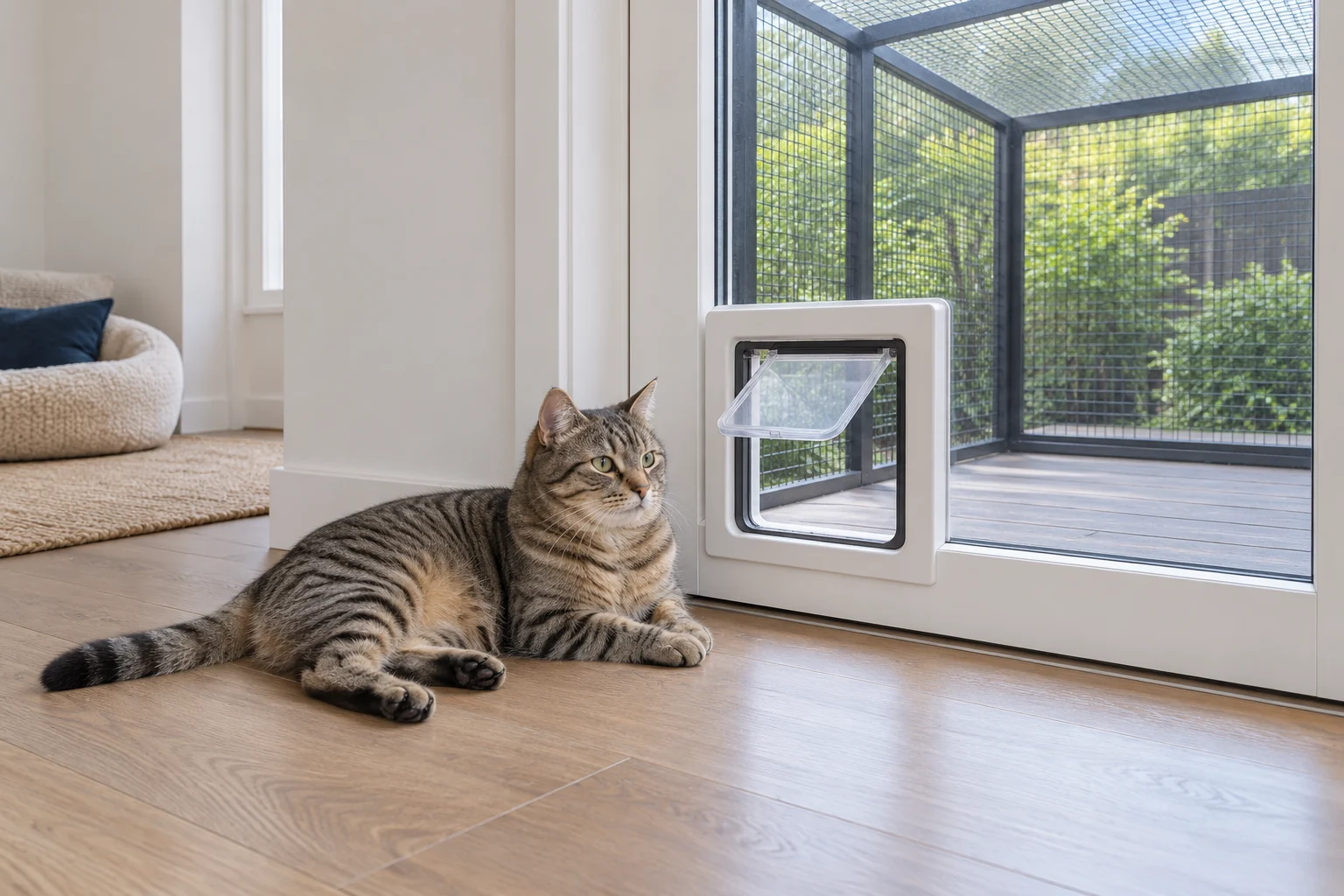
Cats Protection recommends free indoor return and discourages isolated pens where a cat has to be carried in and confined. A house connection should support the cat's choice, not turn the outdoor space into a place it cannot leave.
A connected cat flap is a separate equipment decision. Our microchip versus magnetic flap comparison deals with direction, credentials and passage; a selective flap does not contain the garden beyond it.
Human doors need a routine, too
RSPCA Australia describes a double-door or gate arrangement: close the first barrier, check the cat has not followed, then open the next. Ask how that would work at the actual entrance, with everyone who uses it. Inward-facing fence modifications may keep a resident cat in without keeping visiting cats out. Wildlife and other hazards can still enter a contained space.
Space the cat can actually enjoy
PDSA recommends places to rest, hide, climb and scratch, with an easy way home. Introduce the space gradually, supervise early visits and never force entry. There is no guarantee the cat will want to use it. For furnishing choices, see our cat tree versus wall shelves comparison, then check outdoor suitability separately.
A planned garden system is also different from taking a cat out on a lead. That decision belongs in our harness versus collar guide.
Ask for two complete quotes, not two kit prices.
Give each supplier the same brief and request a written list of inclusions and exclusions. Our suggested headings are: the boundary being created, existing repairs, ground preparation, house connection, entrance arrangements, materials and fixings, labour, delivery, weather shelter, handover instructions and ongoing replacement parts. Ask which questions remain unanswered after the visit.
The Purrfect Fence freestanding-system instructions address slopes, structure connections and a lower chew/dig barrier as separate installation details. This is one manufacturer's system, not a universal recipe. A photograph of a finished top edge cannot establish that every lower edge is complete.
For a conversion, ask the installer to identify the exact fence material and gate swing. For a catio, ask which surface closes the top, what protects against weather and how the base meets the site. Record whose work is required before installation can start.
“Neither yet” can be the useful result
If the landlord's permission, shared access, boundary condition or indoor connection is unresolved, keep planning rather than buying a kit to force a decision. Ask the relevant owner and local authority which permissions apply; this guide does not determine local building or tenancy requirements.
Promising welfare evidence is not a containment guarantee.
De Assis and Mills' study, published in January 2021, surveyed customers of ProtectaPet. It received 446 responses and reported owner-perceived improvements associated with installing controlled outdoor access. It was a retrospective survey without a control group, not a head-to-head escape test.
The work was partly funded by ProtectaPet and the Manufacturing Growth Programme; the paper describes the company's role in circulating the questionnaire. These findings cannot establish a universal success rate, prove that one category is safer or certify a retail kit.
The welfare guidance is not identical
PDSA and Cats Protection are cautious about restricting cats already accustomed to roaming. RSPCA Australia promotes containment that meets cats' needs and recognises that some cats need individual help adapting. The sensible shared question is whether the arrangement works for this cat, not whether all cats should accept the same footprint.
If a cat is persistently distressed or its behaviour changes, seek veterinary advice instead of treating a bigger kit as the automatic fix. Our register covers household planning; it is not a veterinary or structural assessment.
Optional equipment, after the plan makes sense
You can start with a sketch, photographs and a measuring tape you already own. The links below are country-labelled Amazon category searches for enclosures or a basic measuring tool, not selected installations or tested recommendations. Search results can include detached pens and unsuitable products; apply the home-connection and installation checks above.
Affiliate disclosure: as an Amazon Associate, Félinscope earns from qualifying purchases. We have not verified current stock, prices or the suitability of individual search results. There is no commission-based winner, and no purchase is required to use the register.
As an Amazon Associate I earn from qualifying purchases. These country-labelled searches are not recommendations: verify the exact model, seller, price, delivery and return terms.
Manufacturer manuals in this guide are ordinary source links. Read how our affiliate links work.
Common questions
Is a catio better than cat-proof fencing?
Not in every home. A catio can narrow the boundary you need to resolve. Fencing can offer a larger outdoor area when the entire perimeter and its everyday use are manageable. Your cat's needs, the site and the finished installation determine the useful choice.
Does a catio need a roof?
For the enclosed catio discussed here, yes: an overhead containment surface is part of the boundary. It can be mesh rather than a solid rain roof. Shelter from weather remains a separate design question.
Can a cat escape over a normal garden fence?
Do not treat ordinary fencing as a containment system. Height alone leaves other questions unanswered. Ask about the exact barrier, every opening and any nearby route that could bypass it.
Will cat-proof fencing keep other cats out?
Not necessarily. A system designed to interrupt climbing from one side may not prevent entry from the other. Ask the supplier about both directions and the actual garden layout.
Which option is cheaper?
Compare completed proposals for the same goal. A small panel kit and a whole-garden installation are different scopes. Repairs, entrances and the home connection can change the project enough to make a headline price misleading.
Can I leave my cat in a detached outdoor pen?
Do not use a detached pen as a substitute for the connected space described here. Resolve indoor retreat, comfort and supervision with welfare guidance, rather than assuming that a lockable door makes confinement suitable.
Sources, method and limits
André Ribeiro prepared this comparison from six primary sources, checked on 7 October 2026. We compared welfare guidance, one owner survey and two system-specific instruction documents. We have not installed or tested the products, measured escape resistance or obtained veterinary or engineering review of this article.
The example is fictional. The register is Félinscope's editorial planning aid, not a validated safety tool. The three images are AI-generated illustrations, not photographs from a field test. Dimensions, fixings and suitability require the current instructions for the actual system and site.
- Cats Protection: Are catios good for cats? Definitions, indoor retreat and individual suitability.
- RSPCA Australia: Safe and Happy Cats. Containment, double-door routines, boundary checks and residual risks.
- PDSA: Should you build a catio for your cat? Enrichment, limitations and voluntary introduction.
- De Assis and Mills, Frontiers in Veterinary Science, 11 January 2021. Owner survey; DOI 10.3389/fvets.2020.599284. Funding and study limitations are discussed above.
- Purrfect Fence: Existing Fence Conversion System instructions (PDF). System-specific attachments, gates and junctions.
- Purrfect Fence: Freestanding Cat Fence System instructions (PDF). System-specific terrain, structure connections and lower-edge treatment.
If a PDF does not open, use the manufacturer's installation-information page to find the named system's current instructions.
Read our review method and transparency policy. Use our contact page to suggest a correction or a newer source.