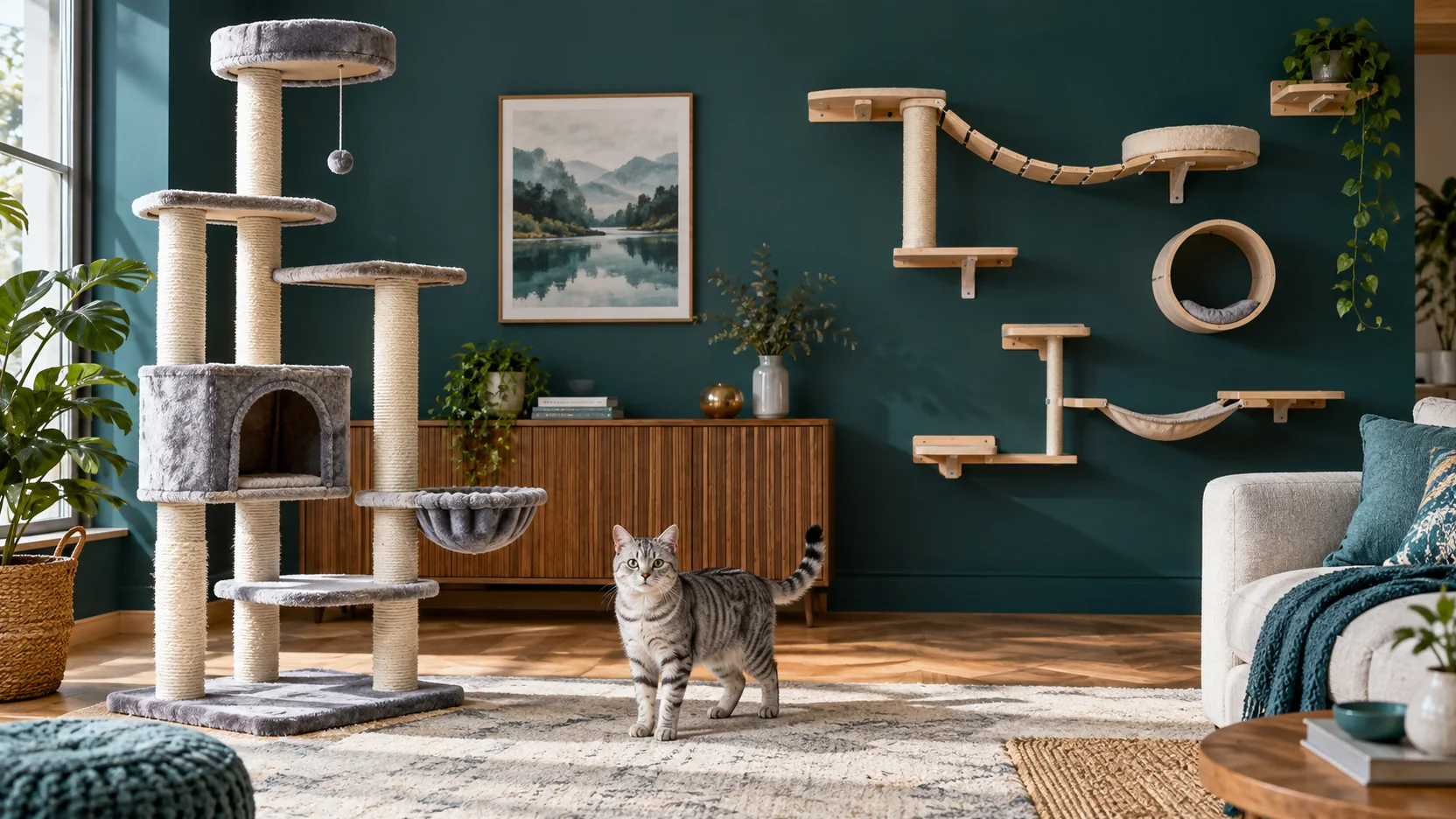
The answer in 40 seconds
Choose the route that closes every gate—not the furniture that reaches highest
Start with a cat tree when a complete base and approach fit the room, permanent drilling is unavailable, and the exact tree provides accessible levels, useful resting space, a practical return and every required restraint.
Consider purpose-built wall shelves when the wall, permission, exact hardware and installation are verified—and when the system forms a complete two-way route rather than isolated high steps.
Choose a modest hybrid or neither when distributed spaces solve a real household problem, or when structural, mobility, social-flow or location gates remain open. A new movement change pauses the shopping decision.
Run the Vertical Route Audit ↓This page owns one narrow English intent: choosing between a complete freestanding cat tree and a purpose-built wall-mounted shelf system. It does not answer platform spacing alone, review a named brand, certify DIY construction or compare a window perch, catio, human bookcase or scratching orientation.
Freestanding cat tree
A complete floor-supported structure with levels, resting surfaces and often scratching or hiding functions. Some models still require wall restraint, a tension fit or a particular placement.
Purpose-built wall system
A set of cat shelves, steps, beds or bridges installed as one route under the exact product and wall instructions. This guide does not treat an ordinary decorative floating shelf as equivalent.
Usable route
The whole sequence from a place the cat already uses through approach, ascent, landing, rest or turn and a practical return. Product height alone does not describe it.
Structural pass
The named product, support, hardware, installation and ongoing inspection are all resolved. A load claim copied from another product or wall is not a pass.
Need the scratching question instead? Use our vertical vs horizontal scratcher comparison. Looking for warmth rather than height? Keep that intent in the cat-bed guide.
The missing comparison
Footprint, style and price do not reveal whether the cat can get back down
Leading English comparison pages reviewed on 11 September 2026 cover familiar trade-offs: floor space, drilling, portability, appearance, built-in scratching and broad price bands. Those are useful filters, but they compare objects before proving the route.
Félinscope makes the unit of comparison one complete round trip. Structure, first access, usable landing, turn, rest, return, mobility and social flow can each reject a candidate. The audit can finish with a tree, shelves, a hybrid, an installation review or no purchase.
Name the missing job before the object.
Use comfortable movement repeated in ordinary life.
Map each cat, every approach and every exit.
Verify the exact structure before drilling or buying.
One object, six observable stages
The useful product begins before the first platform and ends after the descent
Trace the route in both directions. A wall system and a tree can each fail at a different stage, even when their published dimensions look generous.
Approach
Can the cat reach the first level without an improvised launch or blocked floor?
Ascent
Are the transitions already comfortable for this cat in this direction?
Landing
Can all four paws arrive on a clear, grippy and structurally verified surface?
Rest or turn
Is there usable body space after edges, posts, beds and objects are subtracted?
Return
Can the cat descend or take another route without a forced leap or reversal?
Reuse
Does the cat return voluntarily after novelty, at ordinary times and without luring?
Eight gates before checkout
Make both categories prove the same complete job
Every unknown stays open. A lifestyle photo, “heavy duty” badge or maximum-height claim cannot silently close a structural or feline gate.
Enrichment—not diagnosis
Use this comparison to add optional space. A new change in jumping, landing, gait, grooming or willingness to climb belongs with the veterinary team before a shopping decision.
A location the cat values
Map rooms, windows, people, noise, heat, doors and existing resting choices. An elegant route in an unused corridor can lose to a modest tree beside a familiar window.
First access and return
Draw the route from floor to destination and back. Maximum height is irrelevant if the first step, landing, turn or descent fails.
Usable surface
Subtract posts, holes, bolsters, toys and narrow edges. A platform dimension is not the same as a surface where the cat can land, orient and rest.
Exact structural instructions
Identify the complete model, wall type, support, hardware, restraint and installation limits. Never transfer one manufacturer’s weight or spacing claim to another system.
Mobility in both directions
Observe familiar voluntary movement without provoking a jump. The route must fit the harder direction and remain adaptable if access needs change.
More than one social path
For multiple cats, count approaches, exits, visual barriers and separate resting places. Extra levels on one guardable ladder are not distributed resources.
Inspection and reversibility
Price fixing, restraint, replacement coverings, cleaning, joint checks and wall repair. Prefer the option whose failures can be detected and corrected before the cat pays the cost.
Category tendencies, not guarantees
Cat tree versus wall shelves: compare the dependencies
The table describes questions that commonly differ. The exact model, room, wall and cat can reverse any broad category advantage.
| Decision factor | Freestanding cat tree | Purpose-built wall shelves | What to verify |
|---|---|---|---|
| Primary strength | Combines several functions in one movable or semi-movable footprint. | Distributes a route across otherwise unused vertical wall area. | Which useful job is missing in the cat’s current territory? |
| Floor and wall demand | Uses its base plus approach, landing and restraint clearance. | Uses wall area but still needs safe floor approaches, clear landings and exits. | Measure the complete operating zone, not only the product footprint. |
| Installation dependency | Assembly, level floor, joints and any exact anti-tip or tension requirement. | Compatible structure, permitted drilling, exact hardware, layout and competent installation. | Read the complete current instructions for the named product before purchase. |
| Route shape | Levels and paths are largely fixed by the design. | Potentially configurable around the cat and room, within structural limits. | Trace approach, ascent, landing, turn, rest and return in both directions. |
| Rest and hiding | May include broad beds, hammocks or enclosed spaces; actual dimensions vary. | Simple steps may create transit but not a complete resting or hiding place. | Subtract edges and hardware; confirm the body can settle without blocking the path. |
| Scratching | Often included, but height, stability and material may not match the cat. | May be absent or located where the route does not invite scratching. | Treat scratching as a separate surface-and-location question. |
| Mobility adaptation | A low-entry, broad-level design may work; steep fixed designs may not. | Can sometimes use gradual steps, but every transition and the return must remain accessible. | Base the route on easy observed movement, not age labels or maximum jump ability. |
| Multi-cat flow | Several platforms can still share one guardable approach. | Distributed routes can help, but a narrow linear run can also create a bottleneck. | Count independent ways in and out plus separate destinations. |
| Portability | Often easier to relocate, although large, tensioned or restrained units are not instant moves. | Usually fixed; changes can mean new holes, hardware and structural review. | Include moving, repair and reconfiguration in the ownership plan. |
| Useful verdict | Best when one verified structure closes the route and housing gates. | Best when a verified wall route solves real location or floor constraints. | Tree, shelves, a modest hybrid or neither can all be correct. |
Evidence with its limits attached
Vertical space is supported; a universal retail winner is not
Veterinary guidance supports elevated safe places, choice and separated resources. Biomechanics shows that landing is a real physical event. Product documents govern named structures. None of those sources turns a category into a blanket safety verdict.
| Evidence source | What it supports | What it does not prove |
|---|---|---|
| AAFP/ISFM environmental-needs guidance | Elevated safe places, separated resources, feline choice and locations with practical access. | It does not rank cat trees against wall shelves or give one universal domestic layout. |
| 2024 AAFP intercat-tension guidelines | Different heights, safe places, alternative entry and exit, and attention to blocking in multi-cat homes. | It does not certify a retail system or prove that more platforms resolve every relationship. |
| Feline enrichment review | Shelves, perches and trees can add vantage points, active behaviour, rest and retreat; single routes can be blocked. | A general welfare mechanism does not establish the best product for one home. |
| iCatCare home-modification guide | Steps, ramps, ground-level alternatives and easier access for cats with pain or reduced mobility. | It is support for adaptation, not a remote diagnosis or a fixed shelf-spacing prescription. |
| Two feline landing studies | Jumping and landing produce measurable forces, and landing height changes kinetics in small samples. | They did not compare household furniture, specify safe shelf gaps or validate a consumer load rating. |
| Exact manufacturer instructions | Named wall products can require particular supports, stud positions, hardware and installation sequences. | One product’s instructions and test claims cannot be transferred to another product or wall. |
Original interactive decision aid
Which complete vertical route belongs on the shortlist?
The audit keeps health, permission, structure, movement, floor space and multi-cat flow separate. It stores nothing and never calculates a universal spacing or load limit.
Map the cat, room, household and exact products before comparing price or height. Unknown is a valid result and should remain visible rather than becoming an assumed pass.
Close every structural, movement and return gate first- Wall structure
- Open
- Tree structure
- Open
- Wall route
- Open
- Tree route
- Open
Audit incomplete. Close every structural, movement and return gate first
Structure before geometry
A weight number without its test conditions is not an installation plan
Catastrophic Creations’ current instructions specify studs, concrete or brick for its own system and provide product-specific planning. Its FAQ explicitly warns against treating drywall anchors as primary support for that furniture. The Lotus Branch instructions name a different exact mounting arrangement. IKEA’s general anchoring guidance changes hardware by wall type.
Together, these sources support one rule: follow the complete instructions for the named product and the actual support. They do not create a universal screw, stud spacing, shelf gap or safe load for every wall. If the support is uncertain, use a qualified installer rather than an online estimate.
The cat changes the verdict
Design for the least easy direction and the quietest social signal
Mobility: iCatCare recommends home adaptations such as steps, ramps and easier access for cats with joint pain or reduced mobility. The two landing studies show why “cats can jump” is too crude: forces differ from walking and change with landing height. Those studies do not prescribe shelf gaps.
Multiple cats: the 2024 AAFP guidelines describe staring, blocking and competition for vertical space, and recommend safe places with alternative entry and exit paths. Watch who waits, turns away or stops using the route—not only who reaches the top.
Room-first, irreversible work last
A seven-step comparison that never asks the cat to test a sketch
Use the method before checkout, then keep a seven-day observation window after the final installation. It can produce a no-buy result.
- 01
Write the missing job
Choose one: observation, retreat, climbing, resting, scratching, separation or access to an existing resource. If several are missing, list them instead of pretending one platform solves all of them.
- 02
Map current voluntary routes
For three ordinary days, note where the cat already climbs, rests, turns back or waits. Do not lure, lift or provoke a maximum jump.
- 03
Draw both candidates at full size
Use removable tape on the wall and paper footprints on the floor. Include the entire tree base, approach, shelf depth, route direction, door swings and furniture beneath it.
- 04
Read the exact documents
Resolve complete dimensions, usable surfaces, assembly, wall or restraint requirements, replacement parts, cleaning, warranty, delivery and return conditions before ordering.
- 05
Fail the route on paper
Trace the first access, each landing, the resting position, turn, descent and an alternative exit. Mark any unverified structure, single-exit bottleneck or forced leap as open—not acceptable.
- 06
Get structural uncertainty reviewed
If wall material, hidden support, hardware or installation is uncertain, ask a qualified installer. Do not test a provisional elevated assembly with the cat.
- 07
Observe after final installation
Once the exact product is fully assembled and secured, allow voluntary discovery. Log approach, complete route, rest, return, avoidance, slips, wobble and social blocking for seven days.
Date · time · voluntary approach · highest stage completed · rest duration · route down · slip/wobble · another cat present · blocking/waiting · maintenance needed.
“Loved it” is not observable. A partial climb, quiet wait or abandoned descent can be the more useful result.
Real-use cost
Price the usable destinations, not the number of platforms
A cheap tall tree can offer one cramped destination. A premium wall can contain several transit steps but no place to settle. Keep structural work and the cat’s actual use visible.
Inspection minutes
Joints, coverings, fasteners, tension, wobble, wear and obstacles remain part of ownership.
Route function
Transit, scratching, hiding and prolonged rest are different outcomes, even on the same product.
A happiness score
Voluntary use is observable. A numerical welfare promise from one household log is not.
Direct answers
Cat tree and wall-shelf FAQ
Is a cat tree or wall shelves better for cats?
Neither category wins universally. A cat tree is often the simpler shortlist when floor and approach space exist, drilling is unavailable and one complete structure provides accessible levels. Purpose-built wall shelves can be the stronger option when a compatible wall, exact installation, usable landings and a two-way route are all verified. The decision belongs to the complete route, not the highest perch.
Are cat wall shelves safer than a cat tree?
No category label proves safety. Wall shelves depend on the exact product, structural support, wall, hardware, installation and layout. A tree depends on its base, joints, surface, placement and any restraint or tension instructions. Reject either candidate when those conditions cannot be verified.
Do cats prefer wall shelves or cat trees?
Preference varies by cat, location, route, surface, height, familiarity and household. Veterinary guidance supports access to elevated safe places; it does not establish one universal furniture preference. Observe voluntary use after the structure is complete and keep a no-buy or return outcome available.
How far apart should cat wall shelves be?
There is no single evidence-based spacing that fits every cat, direction, shelf and room. Measure vertical change and horizontal gap separately, preserve a broad usable landing, design the return route and start from movement the individual cat already performs easily on a stable familiar surface. Follow the exact product instructions and obtain installation advice when needed.
Can renters install cat wall shelves?
Only when the rental agreement and owner permit the required permanent fixings and the wall can support the exact system as instructed. Adhesive-only or improvised no-drill substitutions should not be assumed equivalent. A verified freestanding or tensioned product may be more reversible, but its complete instructions still govern.
What is better for a senior cat?
A low first access, smaller comfortable transitions, broad grippy landings, easy return and ground-level alternatives matter more than the category name. International Cat Care recommends environmental adaptations for cats with mobility problems. A recent movement change needs veterinary assessment before furniture changes.
What should a multi-cat vertical route include?
Provide separate elevated safe places and, where cats may meet, more than one approach or exit. Watch for staring, waiting, blocking, chasing and one cat abandoning the route. A tall structure with one narrow ladder can concentrate conflict rather than distribute space.
Does a cat tree need to be anchored to the wall?
Use the exact model’s instructions. Some trees require wall restraint, tension to the ceiling or a defined placement; others have different requirements. Height, apparent weight and a wide-looking base are not substitutes for the named assembly and restraint directions.
Can ordinary floating shelves be used as cat shelves?
Do not assume decorative shelving is designed for a cat landing dynamically. A purpose-built system still needs exact structural installation, and an ordinary shelf needs competent assessment of the complete shelf, brackets, fasteners, wall and intended dynamic use. A marketplace load number alone is insufficient.
Can I combine a cat tree with wall shelves?
Yes, a modest hybrid can distribute useful spaces or provide a lower approach, but only when each element is independently safe and the transition between them forms a complete route. A tree must not become an unverified launch platform for an incomplete wall installation.
Source ledger
What supports each part of the decision
Veterinary and independent sources support environmental needs, mobility and carefully bounded biomechanics. Manufacturer documents establish only named-product requirements. Leading comparison pages were used to map coverage gaps, not to create universal safety claims. Sources accessed 11 September 2026.
- AAFP/ISFM — Environmental Needs GuidelinesFive-pillar framework for safe places, separated resources, play, predictable interaction and sensory needs; no category winner.
- AAFP — 2024 Intercat Tension GuidelinesVertical places, different heights, safe places, blocking signals and alternative entry/exit paths in multi-cat homes.
- Ellis — Environmental Enrichment: Practical Strategies for Improving Feline WelfareReview of vertical space, shelves, perches, trees, vantage points, rest, retreat and the risk of single routes being blocked.
- International Cat Care — Home modifications for cats with pain or mobility problemsCaregiver guidance on easier access, steps, ramps, ground-level alternatives and environmental adaptation.
- Lascelles et al. — Kinetic evaluation of normal walking and jumping in catsPressure-walkway study in client-owned cats; jumping down differed from walking, without testing household shelves or trees.
- Wang et al. — Kinetic analysis of felines landing from different heightsSeven healthy cats landing from controlled heights; forces increased with height, with limited transfer to voluntary home routes.
- Catastrophic Creations — installation guideCurrent instructions for the manufacturer’s own modular system, including compatible supports and planning.
- Catastrophic Creations — installation FAQManufacturer-specific warning on primary support and its own suggested layout; not a universal rule.
- The Refined Feline — Lotus Branch instructionsExact-product example showing why the named mounting sequence and support arrangement matter.
- IKEA — general wall-anchoring guideGeneral explanation that hardware changes with wall type; not cat-furniture certification.
- Pawerah — cat tree vs cat wall shelvesLeading comparison result reviewed for coverage of floor space, installation, cost and broad household fit.
- Catastrophic Creations — shelves vs trees vs towersLeading manufacturer comparison reviewed for category definitions and common trade-offs.
- FurryFable — wall-mounted shelves vs floor treeLeading comparison result reviewed for structural, behavioural and practical framing.