The answer in 30 seconds
Keep the useful box. Add a tunnel only for a job it does not do.
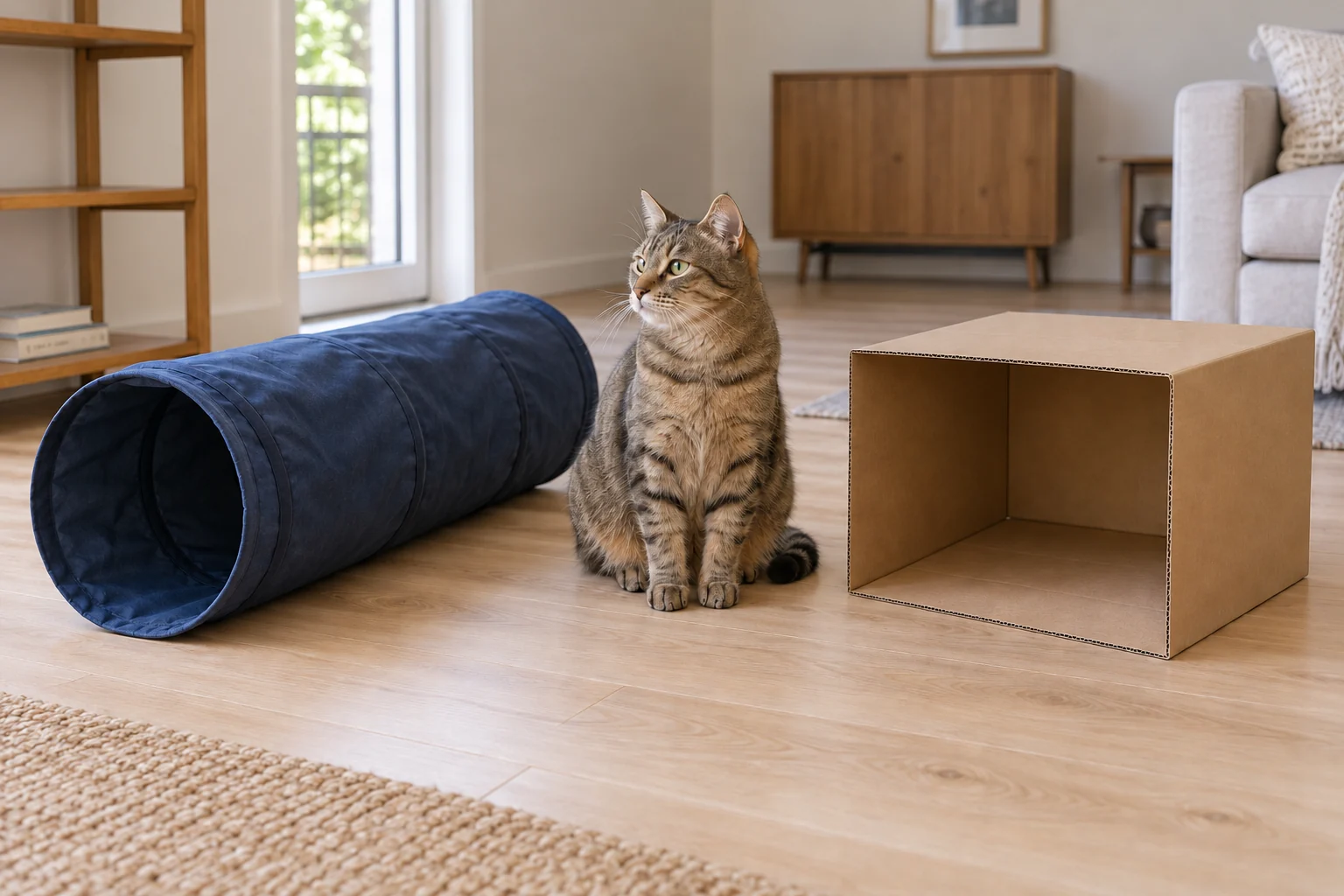
A cat tunnel offers a covered route through a space. A cardboard box offers an enclosure you can arrange as a resting place, hiding spot or play area. Both can support play and retreat; neither label tells you which role your cat will choose.
Our practical recommendation: keep a safe, accepted refuge undisturbed. Consider a tunnel if you want a separate play route and the exact model fits your cat, room and cleaning routine. You do not need to replace a working box to provide worthwhile enrichment.
The AAFP/ISFM environmental guidelines treat safe places and opportunities for play as distinct needs. They do not rank a commercial tunnel above a cardboard box.
Make a play-and-retreat noteA shape, a material and a purpose are three different things.
“Tunnel” describes a form, while “cardboard” describes a material. A tunnel can itself be made from cardboard. Here we compare a typical collapsible fabric play tunnel with an ordinary dry cardboard box. A tunnel bed, paper tube or rigid hideaway may behave differently.
| Question | Fabric play tunnel | Ordinary cardboard box |
|---|---|---|
| What does the shape offer? | A covered route, with entrances defined by the model. | An enclosed area; orientation and openings change how it is used. |
| What should you check for play? | Room at both ends, movement on the floor and loose attachments. | Stability, clear openings and accessible packaging remnants. |
| What should you check for rest? | Whether it stays quiet, holds its shape and is left alone. | Whether it stays dry, comfortable and out of passing traffic. |
| Can it be cleaned? | Read the exact care label. Fabric does not automatically mean machine-washable. | It is generally a replaceable enclosure, not a washable one. |
| What happens between uses? | A collapsible model may store compactly; folding it removes access. | It takes up its full footprint unless folded or discarded. |
| When might you spend nothing? | If an existing play setup already gives the cat something it enjoys. | If a suitable box you already have is safe and voluntarily used. |
One practical trap is buying a folding tunnel for convenience, then discovering that the cat sleeps there while you want it packed away. Decide where a permanent refuge can remain before making storage convenience the deciding feature.
If your real question is who controls the moving toy, see automatic toys versus wand toys. This guide deals with the space around play, not with replacing interaction.
Research without the retail leap
The hiding-box study did not compare boxes with tunnels.
In a 2019 randomised trial by van der Leij and colleagues, newly admitted cats at a Dutch shelter received either a hiding box or no hiding box. The box group's behavioural stress scores declined faster. The study found no significant difference in weight loss, adoption rate or length of stay between groups.
That supports providing hiding opportunities in the setting studied. It does not establish a percentage reduction in anxiety for household cats, prove that any retail hideaway is therapeutic, or show that cardboard beats fabric. A single shelter and a small sample are also not a universal buying rule.
A better question for a product page
When a listing says “calming”, ask what was measured, in which cats and with which exact item. Evidence for access to a hiding place is not evidence for a particular colour, lining, noise or brand. We found no head-to-head tunnel-versus-box trial in the primary sources reviewed for this article.
Let the resting place be a resting place.
RSPCA Education distinguishes a lasting resting space from a quick place to retreat. It emphasises easy access, privacy, familiar scent and freedom to enter and leave. That distinction is more useful than assuming that every covered object is interchangeable.
Our room-planning interpretation is simple: do not make the only quiet hideout the centre of a chase game. If your cat already settles in a box by the bedroom chair, leave that arrangement available. A tunnel can sit in a different play area without replacing it.
Two cats need more than a longer tunnel
The AAFP/ISFM guidelines recommend separated safe places, at least as many as there are cats, with more than one entry in multi-cat homes so another cat cannot readily block access. A long tube shared by both cats is not equivalent to two private refuges. Notice who can approach, who waits and whether either exit is being guarded.
If access is difficult, a low, easy-to-enter refuge may be more useful than a dramatic elevated setup. For a separate discussion of vertical space and installation, see cat trees versus wall shelves.
When hiding is a reason to ask for help
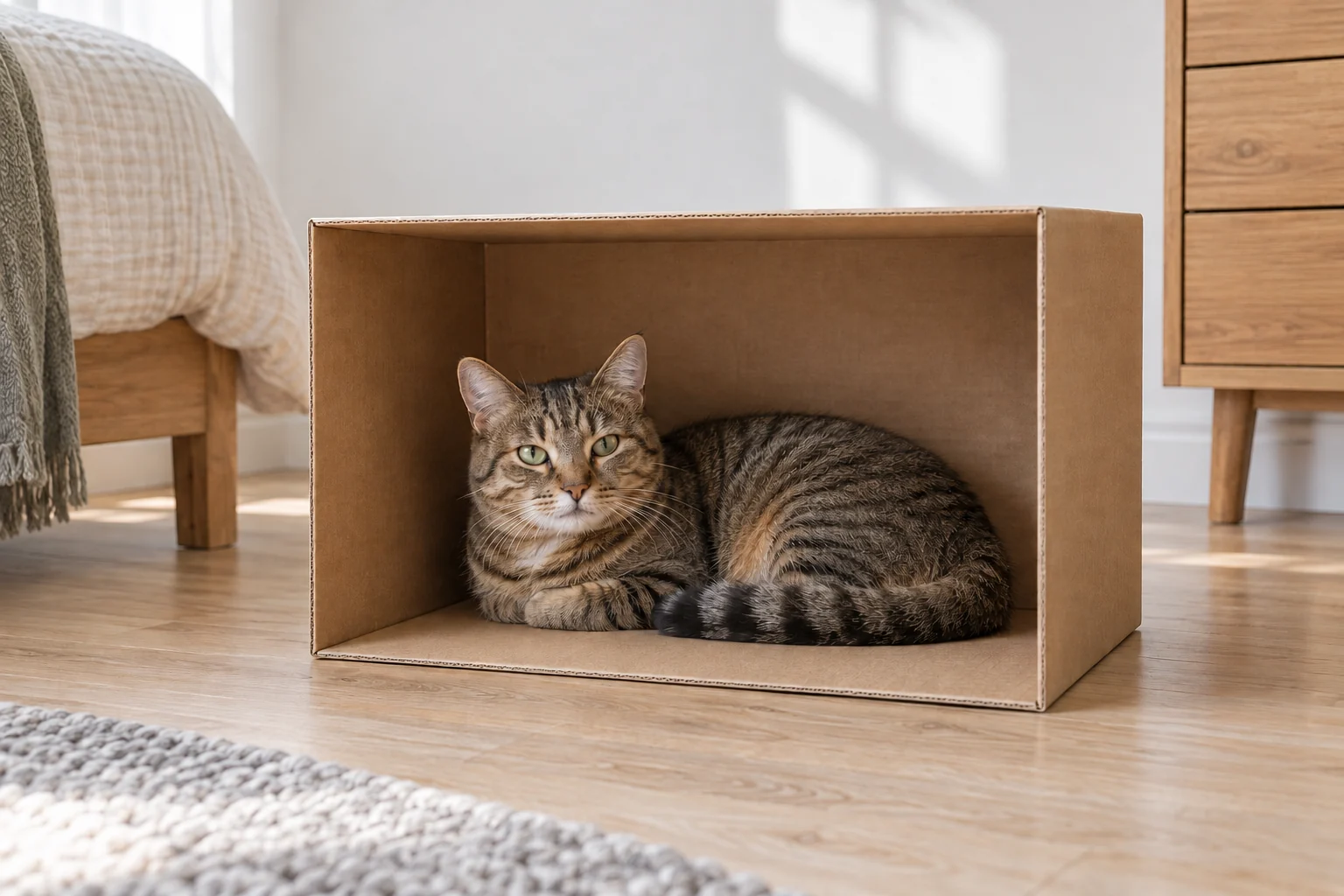
Cats Protection advises a veterinary check when hiding increases, because illness as well as stress can change this behaviour. Concerns about eating, drinking or toileting also need veterinary advice. Do not spend days comparing toys while a new health concern goes unchecked.
Normal retreat is not a failed enrichment session. Equally, simply counting time spent inside does not distinguish relaxed rest from withdrawal. The note below records context without diagnosing either.
Before the cat goes in, look at the actual object.
For the box
Use a clean, dry box with a known, harmless previous use. Our practical inspection list is: remove accessible tape, staples, ties and loose packaging; check the edges and all openings; make sure it cannot topple or close on the cat. Replace it if it becomes wet, contaminated or structurally damaged. A box being swallowed is not a suitable enrichment item.
For the tunnel
Check the actual internal opening, not just the advertised length. Follow the care and supervision instructions. Look for torn seams, exposed supports and loose cords or attachments. Open a sprung or folding tunnel away from the cat. Retire a damaged item rather than covering a defect with tape the cat can reach.
These are inspection prompts, not a safety certification or a universal size formula. PDSA's cardboard-play guidance stresses stable, secure construction; Cats Protection warns against leaving cats alone with toys they could swallow or become tangled in. Supervise introduction and stop if the item is being chewed apart or the cat struggles to leave.
Do not turn the trial into a lure contest
First allow voluntary exploration without putting the cat inside. If you add food to one object or move a toy through only one, record that difference. An entry prompted by a toy is not evidence that the cat prefers that object as a bed.
For interactive games, Cats Protection recommends short sessions and opportunities to catch the toy. Put risky attachments away afterwards. Keep the quiet refuge available rather than repeatedly moving it to make the new tunnel seem more attractive.
Original practical resource · Version 1.0
Record what happened, not which item “won”.
This small observation note is our editorial tool for an ordinary home, not a validated preference test. Keep the cat's established refuge. Observe an optional play item separately, at a calm time, without chasing, trapping or withholding access to essentials. There is no required timetable or target number of entries.
A note you can share with a carer
Fields stay in this page's memory and disappear on reload. We do not save or send these entries. Copy or download before leaving. Avoid personal details.
No winner is calculated. Not observed is not the same as rejected. A prompted entry is not proof of a resting preference.
Use the printable blank worksheet if you prefer paper. It includes the same prompts and source links. For carers and editors, the observation-note section is a stable reference once this article is published. Suggested citation: André Ribeiro, Félinscope, Play-and-retreat observation note, version 1.0, 9 October 2026. Free to use without an account, purchase or required backlink.
Do not remove a favourite box just to create a fair comparison. Changing an established refuge tests a different situation and may tell you little about the new item itself.
Three observations can explain why both objects stay.
Hypothetical example, not a home trial: a cat rests in a cardboard box behind a chair. Its owner adds a plain tunnel in the living room. Here is how the note could prevent an unnecessary replacement.
| What happened? | What is known? | Reasonable next step |
|---|---|---|
| The cat sleeps in the box after breakfast. | The box is being used for rest at that time. | Keep it accessible and undisturbed. |
| The cat runs through the tunnel during a wand game. | The tunnel is used during prompted play. | Record the toy prompt; do not call this a sleeping preference. |
| The tunnel is ignored when visitors arrive. | No use was observed in that context. | Do not push the cat inside or remove its other refuge. |
The practical result is not “tunnel wins” or “box wins”. Each has a role. If the tunnel never gains a useful role, returning it under the retailer's actual policy, passing it on safely or simply not buying another is a legitimate outcome. Three observations here are storytelling, not a recommended test sample.
If a purchase still solves a real problem
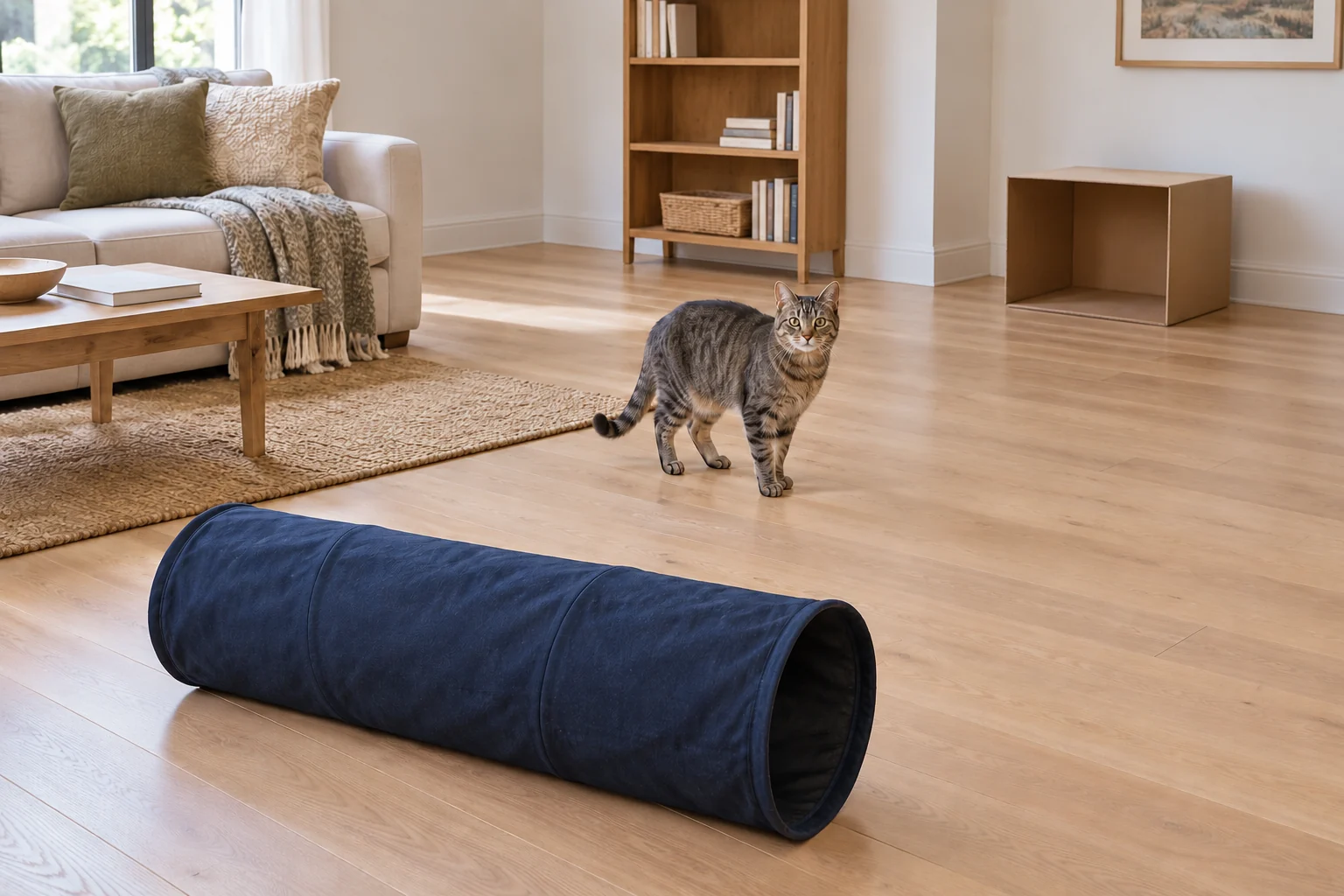
Write a short brief first: the role you want, usable opening dimensions, available floor area, storage needs and care instructions you can follow. Ask about unfamiliar crinkle sounds, exposed fasteners and removable attachments. A washable hideaway may be worth exploring when disposable cardboard does not suit your cleaning needs, but check the exact washing instructions before buying.
The country-labelled links below are Amazon category searches, not tested picks. Search results may include hanging toys, unsuitable sizes or items with different care requirements. The search wording does not verify those features.
Affiliate disclosure: as an Amazon Associate, Félinscope earns from qualifying purchases. We have not verified current prices, stock or the suitability of each listing. Keeping a safe box you already own remains a valid choice.
As an Amazon Associate I earn from qualifying purchases. These country-labelled searches are not recommendations: verify the exact model, seller, price, delivery and return terms.
All welfare and research references above are ordinary, non-affiliate links. Read how our affiliate links work.
Common questions
Is a cat tunnel better than a cardboard box?
Not automatically. A tunnel may offer a useful covered play route and compact storage. A suitable box may already provide a quiet refuge or play space. Compare the role the cat uses, the actual construction and upkeep, not the price alone.
Can a tunnel replace a hiding box?
Only consider that after looking at how the cat uses both. A busy play tube is not automatically an undisturbed resting place. Keep an established refuge available while introducing something new.
Do boxes reduce cat anxiety?
A small shelter trial found a faster decline in behavioural stress scores when cats had a hiding box. It did not establish a home-cat anxiety percentage, a treatment or a winner over tunnels. See the study and its limits above.
What if my cat ignores the tunnel?
Leave the cat free to decline. Record the context and inspect the item rather than forcing entry. One ignored session does not establish a permanent dislike. There is also no obligation for the cat to justify the purchase.
Can I make a tunnel out of boxes?
PDSA describes joined cardboard boxes as a play option, provided the structure is stable and secure. Inspect the completed arrangement and openings; an improvised build is not safe merely because its materials are free.
Should I add catnip to make the comparison fair?
Adding scent changes the comparison. If you use it, record where and what you added rather than crediting the object alone. Our catnip versus silvervine comparison covers the separate scent-enrichment question.
Sources, method and limits
André Ribeiro prepared this comparison from six primary sources, checked on 9 October 2026. We distinguished veterinary environmental guidance, a shelter experiment and practical welfare advice. We have not tested a tunnel, run a household preference trial or obtained veterinary review of this article.
The comparison table, fictional example and observation note are Félinscope's editorial synthesis. They are not clinical assessments or validated research instruments. The three images are AI-generated illustrations, not product photographs or evidence from testing.
- Ellis and colleagues: AAFP/ISFM Feline Environmental Needs Guidelines (2013). DOI 10.1177/1098612X13477537. Safe places, separated resources and play opportunities.
- van der Leij and colleagues: hiding boxes in Dutch shelter cats (2019). PLOS ONE 14(10): e0223492. Randomised trial; no tunnel group. Funding was disclosed and the authors declared no competing interests.
- Cats Protection: Cats hiding. Normal retreat, individual safe places and veterinary advice for increased hiding.
- Cats Protection: Cats and play. Interactive play and ingestion or entanglement hazards.
- RSPCA Education: Create a safe space for cats. Distinguishing resting places from quick retreats; privacy and access.
- PDSA: Homemade toys for cats (17 April 2023). Cardboard boxes and stable, secure DIY play spaces.
Read our review method and transparency policy. Send corrections or newer evidence through our contact page.