The short answer
Silvervine is a reasonable alternative to try, not an upgrade every cat needs.
If your cat enjoys an appropriate catnip toy, you do not need to replace it. If catnip gets little interest, silvervine offers a different scent option. Published studies support that possibility, but do not establish that every silvervine stick, powder or blend is better than every catnip product.
Check the ingredient and plant part, inspect the whole toy, and let the cat approach or ignore it. The useful outcome is an acceptable enrichment option, not the most dramatic reaction you can obtain. The 2017 comparison and the 2026 free-choice study answer related but different questions.
Two plants, several products, different questions
Catnip is Nepeta cataria; silvervine, also written silver vine or called matatabi, is Actinidia polygama. Both can elicit scent-directed behaviours such as rubbing and rolling. The names identify plants, not a standardised toy, dose or effect.
That distinction matters at checkout. “Silvervine” may describe wood, dried plant material, powder or one ingredient in a mixture. “Catnip toy” tells you even less about its filling, seams and removable parts. Ask two questions separately: which scent is being offered, and is the delivery object suitable?
Response
Did the cat show the behaviour being recorded when a material was offered?
Choice
What happened when the cat could approach different stimuli or leave?
Benefit
Did a study measure a lasting welfare or health improvement? Do not substitute the first two answers for this one.
This comparison concerns optional scent enrichment. For chasing and catching a moving target, see our automatic cat toy versus wand toy guide. The purchase decisions are not interchangeable.
What the research actually put in front of cats
A response rate makes more sense beside the sample and material than on its own in a product headline. Read these studies as evidence about specific conditions, not a league table for items in your basket.
| Study | Material and setting | Useful finding | Limit at checkout |
|---|---|---|---|
| Bol et al., 2017 | 100 domestic cats enrolled, with some missing observations; plant materials included catnip and silvervine dried fruit-gall powder. | About 80% responded to silvervine and about two thirds to catnip. That response-rate difference was not statistically significant. Many catnip non-responders responded to silvervine. | Those figures are not a success guarantee for a particular retail stick or toy. |
| Uenoyama et al., 2026 | Outdoor observations involving six cats, plus an indoor group of 22 cats offered paired leaf extracts; separate laboratory assays. | Silvervine elicited rubbing and rolling more reliably under the studied free-choice conditions. | Limited plant sources, unblinded scoring and group-setting effects restrict generalisation. Retail toys were not compared. |
| Uenoyama et al., 2023 | Separate assays assessed exposure behaviour, immediate cortisol and glucose, and liver and kidney markers in cats with recorded plant-iridoid exposure histories. | No adverse effects were detected in these measured endpoints under the study conditions. | A study of plant exposure does not certify every added ingredient, chewable object or use pattern. |
The newer work is interesting because it asks what happens when cats can engage voluntarily. It does not turn “contains more active compound” into a reliable buying rule. Nor does it provide a household timetable for how long a toy should work. Read the authors' methods and limitations.
Our interpretation is deliberately narrower than “silvervine wins”: it is worth considering as an alternative, while the individual cat and exact product remain unresolved. A bag carrying a research percentage has not itself become a tested product.
Read the format before paying for the name
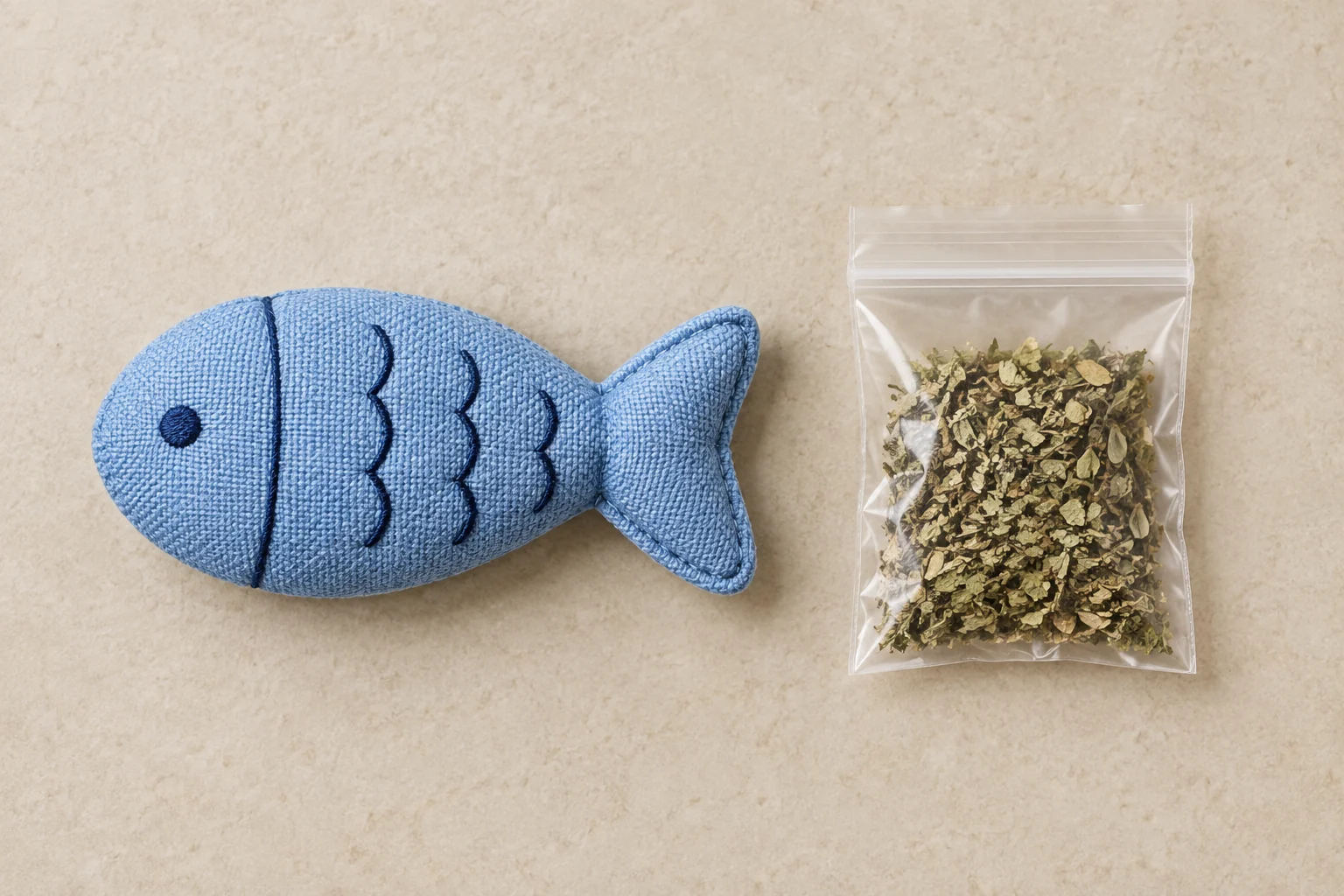
A blend cannot tell you which ingredient your cat responded to. For example, Catit separately lists dried catnip and a catnip-and-silvervine mix. That is a useful label distinction, not evidence that the mix will outperform either plant for your cat. See the manufacturer's product descriptions.
| Format | What to establish | What not to assume |
|---|---|---|
| Dried plant or powder | Named plant, plant part, full ingredients and intended use. | All powders contain the same material used in a study. |
| Stick or chewable item | Actual material, size, instructions and condition during use. | Plant-response research proves dental cleaning or makes the object risk-free. |
| Filled fabric toy | Filling, stitching, attachments and whether its opening closes securely. | A desirable scent compensates for a damaged toy. |
| Catnip-and-silvervine blend | Both ingredients are declared; other additions are listed. | A response reveals a preference for one plant. |
| Spray or liquid | Complete formulation and label instructions for cats. | A liquid is equivalent to a dry ingredient, or a laboratory extract recipe is suitable to copy. |
This is a buying checklist, not a safety certification. If the seller cannot identify the contents, leave the purchase unresolved. Avoid selecting an unlabelled item because its photograph resembles a research specimen. Do not prepare solvent extracts at home or substitute concentrated oils for a cat product.
Check the toy as well as the plant
Stop if the experience becomes a problem
Remove access safely if a toy is breaking apart, the cat is swallowing pieces, or the interaction becomes distressed or difficult to manage. Vomiting, diarrhoea or other signs of illness are a reason to seek veterinary advice, not to increase the amount or try a stronger mixture.
The ASPCA lists vomiting and diarrhoea as possible effects of catnip. That is a reason to reject “natural means harmless” marketing. The silvervine safety paper addresses particular study conditions, not every cat's medical history or unlimited ingestion. If your cat has a health condition or you are uncertain about a product, show its full label to your veterinary team before use.
Cats Protection advises checking toys for wear and avoiding unsupervised access to items that can be shredded, eaten or cause entanglement. Apply that inspection to a scented toy too. Replace or remove damaged items, including ones the cat still likes.
A silvervine stick is not a substitute for an oral-care plan. We have not established a dental benefit for retail sticks here. Our dental treats versus brushing comparison explains why the exact health claim and evidence matter. Similarly, scent enrichment is not a replacement for veterinary parasite prevention or treatment for anxiety.
Let the cat give you an answer, including “not interested”
You do not need to stage a dramatic side-by-side challenge. Start with one labelled, suitable product used as directed in a familiar place where your cat can leave. Do not hold it against the face, sprinkle it onto the cat or lure the cat into handling it already dislikes.
For a household note, describe what happened without scoring a winner:
- What was offered?
- Plant, plant part if listed, single ingredient or blend, and the actual toy or container.
- What did the cat do?
- Approached, sniffed, rubbed, played, walked away or did not investigate. Record observations rather than assuming “calm” or “happy”.
- What else changed?
- Different room, new toy shape, another cat nearby or unfamiliar handling?
- What happens next?
- Keep an acceptable option, leave it alone, or stop and ask for advice if there was a concern.
Example, not a product test: “Catnip fabric mouse, contents labelled catnip. Sniffed and left. Silvervine blend in a different kicker toy on another day: rubbed and kicked.” That records different responses to two experiences. It does not isolate the plant: the filling, shape and day all changed.
If you later explore a second option, keep that uncertainty visible and do not repeat presentations to force a response. Follow the product's instructions. We do not prescribe a universal dose, daily schedule or waiting interval across powders, sticks, sprays and toys.
In a multi-cat home, avoid turning a new item into a contest over access. Keep familiar resting places and ordinary activities available. A cat that ignores both scents still has plenty of enrichment options. VCA's play guidance discusses variety, safety and matching play to the cat.
Before buying more, decide what would count as useful
For this purchase, useful might mean an intact toy the cat chooses to revisit. It need not mean a longer roll, a bigger reaction or a shelf full of increasingly concentrated products. If an existing toy works well, doing nothing is a valid buying decision.
- Compare like with like. A refill, a ready-filled toy and a mixed multipack have different costs. State which one you need before comparing prices.
- Read storage and replacement instructions. Do not invent a shelf-life or a number of sessions from the pack size.
- Separate novelty from the ingredient. A new shape may be interesting even without a different scent.
- Keep ordinary play. Optional scent enrichment should not displace the opportunities to stalk and catch a suitable toy described by Cats Protection.
For a different activity with a food reward, our circuit toy versus food puzzle comparison helps distinguish chasing from foraging. There is no requirement to buy an attractant to make every other item worthwhile.
Optional searches, once the label makes sense
These are retailer searches for further investigation, not a shortlist of tested products. Results may include blends or unrelated items. Open the ingredient information and instructions before choosing; the search phrase does not verify the contents.
Affiliate disclosure: As an Amazon Associate I earn from qualifying purchases. Félinscope may receive a commission from eligible purchases through these links. Choose your local store and check the actual seller, delivery, price and returns. How our affiliate links work.
Optional affiliate searches. Check plant, plant part, formulation and the whole toy. No product-test, health-benefit or acceptance guarantee is implied.
Common questions
Is silvervine the same as catnip?
No. Silvervine is Actinidia polygama; catnip is Nepeta cataria. Matatabi is another name used for silvervine. A product may contain one plant, both, or additional ingredients, so read the full label.
Is silvervine stronger than catnip?
“Stronger” is too vague to be a universal verdict. The studies above measured responses under defined conditions. A greater response rate does not demonstrate better health, longer enjoyment or superiority of every commercial product.
Can silvervine interest a cat that ignores catnip?
Yes, that possibility is supported by the 2017 study. It is not guaranteed for your cat or the item you buy. Lack of interest is not a reason to force contact or keep increasing exposure.
Should I start with a blend?
A clearly labelled blend is a different buying choice from a single-plant product. If you want to understand which plant interests your cat, a mixture cannot answer that question by itself. If an existing suitable blend is already enjoyed, this article is not a reason to replace it.
Do I need to buy both?
No. Keep an appropriate option that already works, try an alternative if there is a reason, or use unscented play. The objective is to offer choices your cat can accept, not to complete a collection.
Sources and limits
Sources checked on 1 October 2026. We reviewed primary research, veterinary and welfare guidance, and a manufacturer's ingredient descriptions. We did not conduct a feeding, toxicity, preference or product trial, and this article was not reviewed by a veterinarian. The label checklist and household note are editorial aids, not validated assessments.
- Bol et al. (2017), BMC Veterinary Research: responsiveness to plant materials in domestic cats (PDF).
- Uenoyama et al. (2026), Journal of Chemical Ecology: voluntary responses to catnip and silvervine.
- Uenoyama et al. (2023), iScience: safety and suitability of silvervine as olfactory enrichment.
- Cats Protection: cats and play: play variety, supervision and toy condition.
- ASPCA: catnip plant information: possible gastrointestinal effects.
- VCA Animal Hospitals: play and play toys: choosing and using toys.
- Catit: catnip range: single-plant and mixed-product descriptions, not independent efficacy evidence.
All three images are AI-generated editorial illustrations. They do not identify botanical specimens, reproduce a named product or document a test. See who writes Félinscope and our transparency policy.