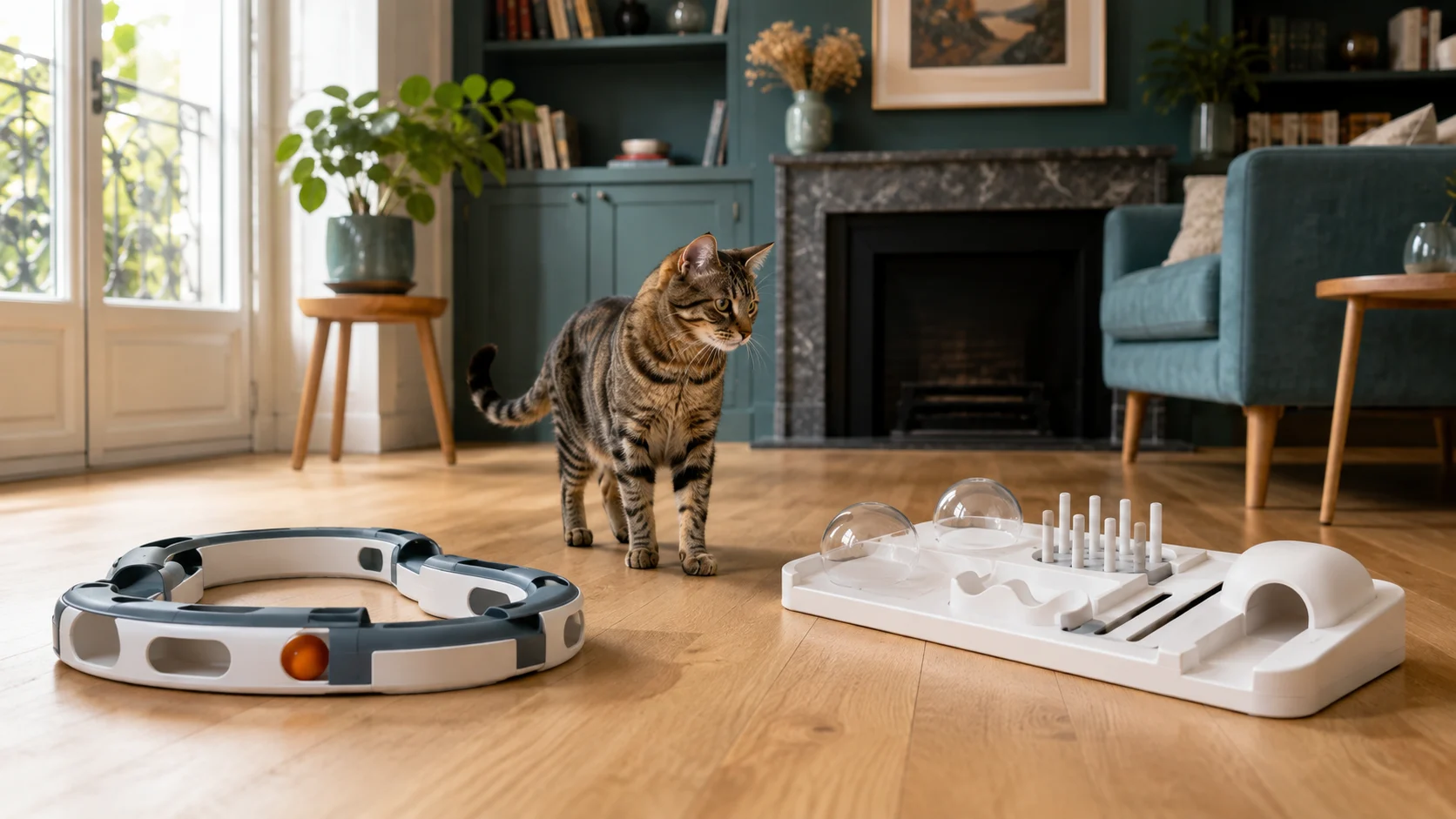
The answer in 30 seconds
Catit is a chase machine. TRIXIE is a food problem. Your cat’s repeated behaviour, rather than the product category, decides the better first test.
Choose Catit Senses 2.0 first when the cat repeatedly stalks, swats and chases partly hidden rolling movement, and track noise does not cause avoidance.
Choose TRIXIE Fun Board first when the cat works calmly for dry food and you can transfer a measured part of the normal ration into an easy starting module.
Choose neither yet when the preference is unknown, food is medically restricted, pain limits access, or one cat controls the only shared resource.
The buying section keeps six country-specific Amazon routes separate. A search result may not be the exact circuit or board; check model, included sections, ball, seller, price and returns.
Quick comparisons usually focus on entertainment claims. That misses the mechanism: a circuit can keep prey-like movement available without an edible payoff; a stationary puzzle can deliver a clear reward but also adds calories, skill demands and competition. This comparison makes those trade-offs observable.
Decision context · reviewed 3 September 2026
The quick comparisons list toys; they do not map reinforcement
Manufacturer pages are useful for identity and specifications. Generic roundups are useful for discovery. Neither replaces a decision model that separates drive, payoff, difficulty and sustained voluntary use.
Product pages describe parts
The manufacturer pages explain the track, ball, five modules and materials. They do not decide which reinforcement loop fits one cat.
Different jobs are easy to confuse
Movement toys and food puzzles are often placed in one list, even though prey-like motion and an edible payoff create different routines.
Sustained use is not a launch-day reaction
The useful comparison tracks voluntary returns after novelty fades, the difficulty needed for success and the calories or human play required to complete the loop.
The mechanism before the model
Three loops, only two products
A self-directed toy can add choice and activity. It cannot reproduce every part of responsive human play.
See → stalk → chase → swat
The Catit circuit makes a moving target visible through openings. It offers repeatable pursuit, but the ball is designed to remain within the track.
Locate → manipulate → obtain → eat
The TRIXIE board converts successful investigation into food. Its five stations can expose different paw-and-nose strategies.
Invite → play → capture → settle
Interactive wand play adds timing, prey-like variation and a catchable ending. Neither self-directed device replaces that relationship.
Exact mechanism comparison
Catit Senses 2.0 vs TRIXIE Fun Board
The table separates documented facts from our household implications. It does not turn manufacturer entertainment claims into measured welfare outcomes.
| Decision point | Catit Senses 2.0 Circuit | TRIXIE Fun Board 4590 | Household implication |
|---|---|---|---|
| Primary trigger | A ball moving inside a partly covered track | Dry food or treats placed in five stationary task types | Choose from observed chase drive or food-working drive, not from the number of pieces. |
| Payoff | The cat can chase and swat, but the enclosed ball normally remains in the circuit | Successful paw or nose work releases an edible reward | A circuit benefits from a separate catchable finish; a board needs a calorie plan. |
| Difficulty control | Rebuild the layout and vary where play starts | Load the easiest station generously, then use harder modules progressively | Novelty and challenge are separate controls. Change only one at a time. |
| Documented construction | BPA-free materials; Senses 2.0 and backwards compatibility; designed for assembly and cleaning | Plastic and rubber; non-slip feet; five modules: globe, peg, alley, tongue and tunnel | Confirm the exact listing and included parts after any retail redirect. |
| Published footprint | Configuration and variant dependent | 30 × 40 cm for item 4590 | Measure the quiet floor area, not only the storage cupboard. |
| Food boundary | No food is required for the circuit’s basic mechanism | Officially presented for treats or daily dry-food feeding | Transfer a weighed portion of the normal ration; do not create an invisible second diet. |
| Likely friction | Track noise, static layout, no terminal capture, pieces separating if assembled poorly | Difficulty, food trapped in harder stations, diet restrictions, competition between cats | The failure mode should determine the first-week setup. |
| Best first hypothesis | Cats that repeatedly stalk, swat and chase partly hidden motion | Food-motivated cats that calmly persist with paw-and-nose problems | Neither is a universal boredom cure or replacement for positive human interaction. |
Official product pages and manuals accessed 3 September 2026. Product availability, included pieces and regional listings can change; verify the exact item after redirection.
Interactive enrichment-fit planner
Turn four observations into a first hypothesis
This tool deliberately returns “profile first” when the evidence is weak. A cautious no-buy result is more useful than a confident guess.
Novelty is not retention
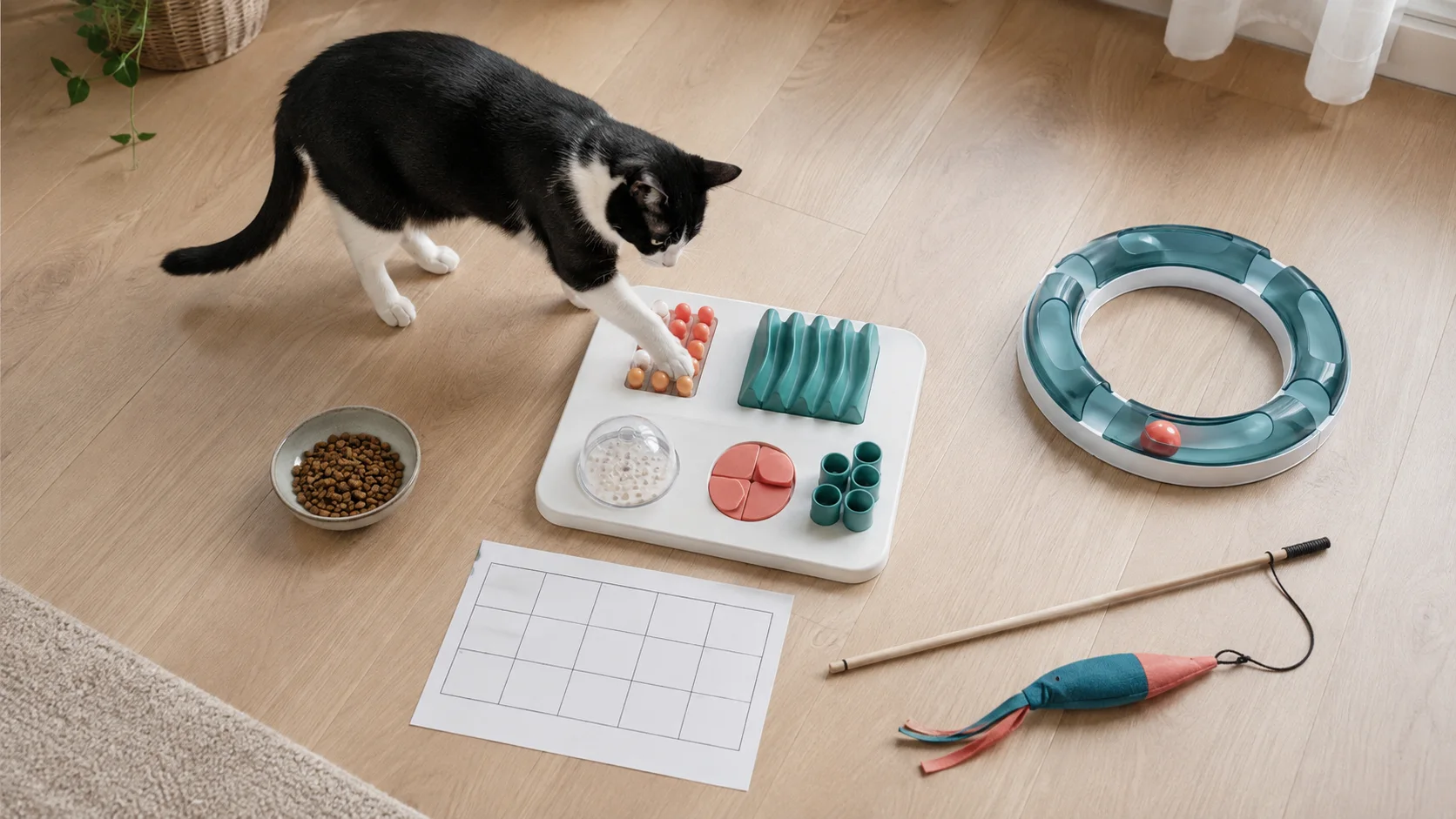
The seven-day engagement audit
Adult cats can habituate quickly to unchanged object characteristics. Record voluntary return and change one variable at a time.
- 01Before day 1
Profile without buying
On separate days, offer safe moving play and an easy food-search task using part of the normal ration. Record approach within two minutes, repeated engagement and any frustration.
- 02Days 1–2
Create an easy first win
Introduce one device in a quiet area. For the board, expose food and load an easy station generously. For the circuit, start the ball once, then let the cat choose whether to continue.
- 03Days 3–4
Measure voluntary return
Count unprompted returns and engaged minutes. Do not repeatedly point, place paws or add treats to rescue a weak response.
- 04Day 5
Change one variable
Reconfigure the circuit or open a different board module without changing novelty and reward value at the same time. A single-variable change keeps the result interpretable.
- 05Day 6
Audit the household cost
Check floor space, night noise, cleaning time, scattered food, body posture and whether another cat blocks access.
- 06Day 7
Keep, rotate or stop
Keep a device that earns calm voluntary reuse. Rotate it if interest returns after a break. Stop if there is persistent frustration, conflict, unsafe use or no meaningful engagement.
Two hidden costs
Food puzzles spend calories; shared toys spend access
A board can support foraging only when the reward and the social setting remain safe and measurable.
Move food, do not duplicate it
Weigh food placed in the board and subtract it from the daily ration. Change the diet only with appropriate veterinary guidance.
Success before challenge
Begin with visible, easy-to-retrieve food. Raise difficulty gradually; walking away is information, not disobedience.
Separate equivalent opportunities
Provide more than one location and watch for blocking, staring, chasing or one cat waiting until another leaves.
Pain changes the comparison
Sudden reluctance to jump, paw, eat or play warrants veterinary assessment. Do not use a toy choice to explain a health change.
Decision questions
Catit Senses 2.0 vs TRIXIE Fun Board FAQ
Is Catit Senses 2.0 better than the TRIXIE Fun Board?
Not universally. Catit is a stronger first hypothesis for repeated chase-and-swat behaviour. TRIXIE is a stronger first hypothesis for food-motivated problem solving when a measured part of the daily ration can be used.
Which toy is better for a bored indoor cat?
Boredom is not one diagnosis. First identify whether the cat lacks movement, foraging, vertical space, scratching options, safe retreat or predictable social play. One device cannot replace a complete environment.
Does the Catit circuit complete the hunting sequence?
It supports stalking, chasing and swatting, but the ball normally remains enclosed. Some sessions should therefore finish with a separate safe lure the cat can physically catch, followed by an appropriate small food payoff if that fits the diet.
Can the TRIXIE Fun Board replace a food bowl?
TRIXIE states that item 4590 can be used for daily dry-food feeding. Introduce it gradually, begin with easy access, monitor actual intake and follow veterinary advice for prescribed diets, illness or weight management.
How do I avoid overfeeding with a puzzle board?
Weigh the puzzle portion and subtract it from the normal daily ration. Treats added on top are easy to forget and can turn enrichment into an untracked calorie source.
Which one is better for a senior or mobility-limited cat?
A stable low board may be easier for some cats, and TRIXIE describes the Fun Board as suitable across ages. Individual pain, posture, vision and reach still matter. Start with the easiest accessible module and ask a veterinarian about any mobility change.
Can two cats share one enrichment toy?
Do not assume shared access is equal access. Provide separated opportunities and observe staring, blocking, chasing, waiting and displacement. Each cat may also prefer a different puzzle type.
Why did my cat stop using the circuit after a few days?
Rapid habituation to unchanged toy characteristics has been observed in adult cats. Reconfiguration and rotation may restore interest, but repeated disinterest is also useful evidence that this mechanism is not a strong fit.
How often should I clean these toys?
Follow each manufacturer’s current instructions. Remove food residue promptly from a puzzle board and inspect every device for damage, loose parts or trapped debris before reuse.
Where can I buy the Catit Senses 2.0 circuit?
Félinscope provides direct tagged Amazon searches for France, Belgium, the United States, Canada, the United Kingdom and Ireland. The exact model, included parts, seller, price, stock and returns must be checked on the country store.
Primary sources and evidence limits
Product identity first; welfare claims kept proportional
Félinscope did not run a long-duration physical product test. Specifications come from the manufacturers; implementation and welfare context come from veterinary guidance and peer-reviewed literature.
- Catit UK: Senses Circuit · ball-and-track mechanism, peek-a-boo cover, compatibility, assembly, cleaning and BPA-free-material claims.
- Catit International: Senses Circuits range · Play, Wave and Super identities and official range context.
- Catit: Senses Circuits manual · assembly, configuration, maintenance and safety instructions.
- TRIXIE US: Fun Board Strategy Game 4590 · five named games, materials, non-slip feet and 30 × 40 cm dimensions.
- TRIXIE Europe: Fun Board 4590 · five-module identity, dry-food use, minimum age and independent welfare-body statement.
- TRIXIE: Instructions 4590 · staged introduction and module-use guidance.
- Journal of Feline Medicine and Surgery, 2016: food puzzles for cats · implementation, difficulty, individual preference, multi-cat provision and evidence limitations.
- Veterinary Clinics of North America, 2020: feeding and behavioural wellbeing · foraging enrichment, choice and multi-cat feeding context.
- Applied Animal Behaviour Science, 2002: object-play habituation · declining response to an unchanged toy and renewed response after sensory change.
- AAFP/ISFM: environmental needs guidelines · five pillars of a healthy feline environment and opportunities for play and predatory behaviour.
- FelineVMA: setting up the environment for success · multiple separated resources and positive, predictable interaction.
- Applied Animal Behaviour Science, 2024: play and cat welfare · associations between play, owner practices and welfare indicators, with observational limits.
A scent refill raises a separate question from chasing or foraging. See our catnip versus silvervine guide for the difference between study materials, product labels and a cat's response.