The answer in 30 seconds
Start with the controller that can complete the play sequence.
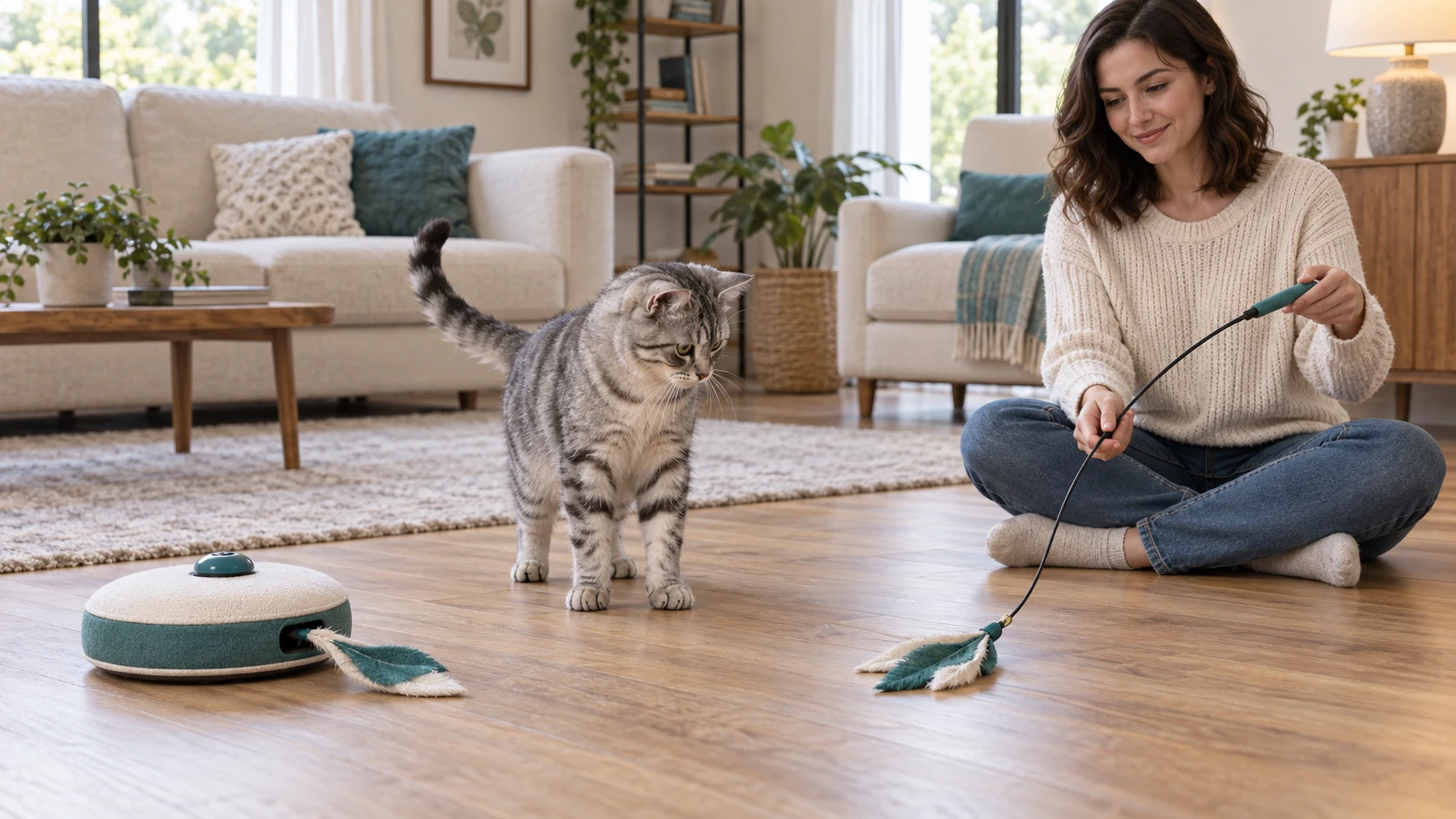
Choose the wand first when you can offer brief, supervised and adaptable play with a physical target the cat can catch. It lets your movement respond to the cat instead of repeating a fixed programme.
Consider an automatic physical toy as a supplement only when the exact model passes its whole-toy inspection and the cat voluntarily returns after the novelty session. Automatic never means universally safe to leave unattended.
Choose both or neither when the eight-session record supports two different jobs or no repeat use at all. This decision can end without a purchase.
Run the Control–Capture Ledger ↓This page owns one narrow intent: motor control versus human control of a physical, catchable cat-play target. It does not compare lasers, food puzzles, cameras, exercise wheels or cat-powered ball circuits. Comparing a rolling chase circuit with a food puzzle instead? Use the separate Catit Senses 2.0 vs TRIXIE Fun Board guide.
Automatic physical toy
A powered device that moves a fabric, feather or other tangible lure without moment-to-moment human control. This guide still treats supervision as an exact-model question.
Wand toy
A rod, connector and physical lure moved by a person who can change speed, direction, hiding, pause and capture timing in response to the cat.
Laser toy
A moving light target. It is excluded from the matched test because it changes target type and physical capture as well as control mode.
Food puzzle or track
A reward-dispensing problem or cat-powered enclosed circuit. Those mechanisms have different outcomes and belong to a separate comparison.
The missing comparison
Hands-free versus bonding is not enough
Broad category pages usually compare convenience with interaction, then recommend using both. That leaves the decisive variables tangled together: control mode, target material, movement plane, capture, first-use novelty, exact-model supervision and the work required to reset the toy.
Félinscope holds the target and play job as steady as a home comparison reasonably can. The ledger can reject an unsafe setup, label a pairing invalid or finish with a wand, automatic supplement, hybrid routine or no purchase.
Eight gates before checkout
Make “automatic” prove a narrow job
Each gate preserves an unknown state. A feature list, video loop or first pounce cannot silently close it.
Play, not a symptom
Use the comparison for optional enrichment. A sudden fall in play, movement, appetite or normal behaviour is health information before it is a shopping brief.
Physical target
Keep light dots out of the matched test. Both candidates need a tangible target the cat can contact and, at least intermittently, capture.
Matched play job
Compare ground chase with ground chase, hidden movement with hidden movement, or aerial lure with aerial lure. Do not let target plane decide a control-mode contest.
Exact-model language
Identify the automatic toy, model or SKU and current instructions. A category word such as smart, automatic or interactive does not define supervision.
Whole-toy integrity
Inspect casing, battery door, charge port, motor gaps, wheels, line, elastic, feathers, connectors and replacement lures before and after every session.
Safe room and storage
Clear stairs, cables, hard corners and trapping gaps. Keep an open exit and store wand lines and detachable lures out of reach after supervised play.
Individual access
One household total cannot reveal who played. In multi-cat homes, observe separately and record blocking, staring, chasing and waiting.
Repeat-use ledger
Alternate order across eight comparable sessions. Record the sequence, capture, re-engagement, avoidance, failures and human work, not just first-session excitement.
Control before product
Automatic toy versus wand: compare the job, not the motor
The table describes category tendencies and inspection questions. It does not transfer one model’s manual, safety language or behaviour to every product.
| Decision factor | Automatic physical toy | Human-controlled wand | What to observe or verify |
|---|---|---|---|
| Control | A motor, timer, sensor or programme determines movement within the exact device’s range. | The person changes movement continuously in response to the cat. | Does the target react to pauses, hesitation and successful contact? |
| Target identity | Varies widely: concealed arm, pop-out feather, rolling body, tail or other physical lure. | Varies by attachment, line and rod; many lures are replaceable. | Match physical target class and dominant movement plane before comparing. |
| Capture | Some targets can be contacted or held; enclosed or retracting designs may limit a complete grab. | The operator can slow, stop and yield the lure for capture. | Count actual contact, secure capture and manipulation rather than gaze alone. |
| Feedback | Limited to its programmed pattern or sensor response. | Human timing can adapt to stalking, hiding, pouncing, rest and disengagement. | Record whether adaptation, not merely speed, restores voluntary pursuit. |
| Supervision | Set by the exact manual, complete construction, room and observed cat; not by the word automatic. | Direct active supervision is inherent while the person holds it; string and elastic still require storage afterwards. | Quote the current instruction and reject any use that contradicts it. |
| Novelty | Sound, motor pattern and self-movement can create a strong first response that may fade. | The person can vary routes and attachments, but the lure can also become familiar. | Separate first exposure from voluntary re-engagement in later sessions. |
| Failure path | Battery depletion, jam, tip-over, trapped hair, open door, detached target, worn drive or inaccessible replacement. | Frayed line, damaged rod, loose connector, detached lure or unsafe storage. | Inspect before and after; stop immediately on damage or ingestion risk. |
| Human work | Setup, charging or batteries, clearing jams, resets, cleaning, retrieval and inspection remain. | Active movement plus inspection and storage; no motor or charging system. | Record active minutes and maintenance minutes separately. |
| Multi-cat use | A device may attract several cats but aggregate activity does not establish equal access. | A person can direct separated sessions, although attention and space still need managing. | Identify the cat, not only the number of activations or toys moved. |
| Useful result | A supervised supplement only when the exact toy passes and repeat use survives novelty. | A responsive shared-play route when the cat engages and the person can sustain it. | Automatic, wand, both and neither are all valid outcomes. |
Evidence boundary: no direct trial comparing these two categories was located in the reviewed sources. The newest standardised wand research supports repeated, individual observation, not a universal wand verdict. Read Chung et al. (2026) .
Evidence with the limits attached
Different sources answer different parts of the decision
Research describes play, individual variation and habituation. Welfare guidance defines useful safeguards. Exact-model documents define only the device they name.
| Evidence source | What it supports | What it does not prove |
|---|---|---|
| Direct head-to-head evidence | No direct automatic-physical-toy-versus-wand trial was located in the scientific and official sources reviewed. | The article cannot declare a universal mechanism winner. The ledger is a household observation protocol, not published comparative efficacy research. |
| Chung et al. · 2026 · 87 cats | Standardised feather-wand responses showed consistent individual variation and a statistically significant trial effect across repeated observations. | Citizen-science videos of wand trials do not evaluate an automatic toy, safety, required play time or welfare benefit. |
| Hall et al. · 2002 | Adult cats habituated to an unchanged object, while a change in sensory characteristics renewed play-related interest. | The study addresses object-play habituation and disinhibition; it does not prove a rotation schedule or automatic-toy disadvantage. |
| Henning et al. · 2023 · 1,591 guardians | Reported play variables were associated with cat quality-of-life and cat–guardian relationship measures. | A cross-sectional guardian survey shows associations, not causation, device effectiveness or a minimum daily duration. |
| Kogan & Grigg · 2021 · 618 responses | Frequency of laser use was associated with several guardian-reported abnormal repetitive behaviours. | The survey is correlational and self-reported. It cannot establish that laser play caused those behaviours or represent physical automatic toys. |
| FelineVMA and AAFP/ISFM guidance | Cats benefit from opportunities for predatory play, intermittent capture, individual choice, toy rotation and separated resources in multi-cat homes. | Guidance does not certify a retail model or show that powered movement substitutes for responsive human play. |
| Cats Protection, iCatCare and RSPCA | Authoritative caregiver guidance supports short cat-led play, physical capture, line-toy supervision, storage and regular wear inspection. | Caregiver guidance is not a controlled product comparison and cannot approve unattended use for every device. |
| RoloRat, Catit and KONG documents | Named-product documents demonstrate why session modes, batteries, replacement parts, inspection and supervision language must be checked on the exact item. | Manufacturer instructions and feature claims transfer only to the named model; they are not independent proof of engagement or category safety. |
Original interactive decision aid
Can the automatic toy earn a supporting role?
The tool checks purpose, target match, exact-product integrity, room, supervision, attribution and repeated use. It stores nothing and never approves unattended use.
Define the purpose, match both physical targets, identify the exact automatic toy, inspect every component, prepare the room, supervise the sessions and make individual access observable.
No control-mode verdict yet- Target match
- Open
- Whole-toy gate
- Open
- Eight sessions
- Open
- Repeat use
- Open
Audit incomplete. No control-mode verdict yet
A sequence, not a stopwatch
Count what the cat can actually do
Motor runtime is a device metric. Play is observed in the cat. Use a small sequence that can be recognised without inventing an emotion score.
Orient
Head, ears or body turn toward the physical target.
Search / stalk
The cat watches, follows or uses cover before approach.
Chase
Voluntary movement follows the target’s route.
Pounce / contact
Paws or mouth reach the target without unsafe collision.
Capture
The target can be held or manipulated at least intermittently.
Re-engage
After a pause, the cat voluntarily returns in a later bout or session.
A session may stop before capture because the cat chooses to leave. That is a valid observation. Never prolong, intensify or block the exit to complete the row.
The whole-toy test
A mode name does not grant unattended use
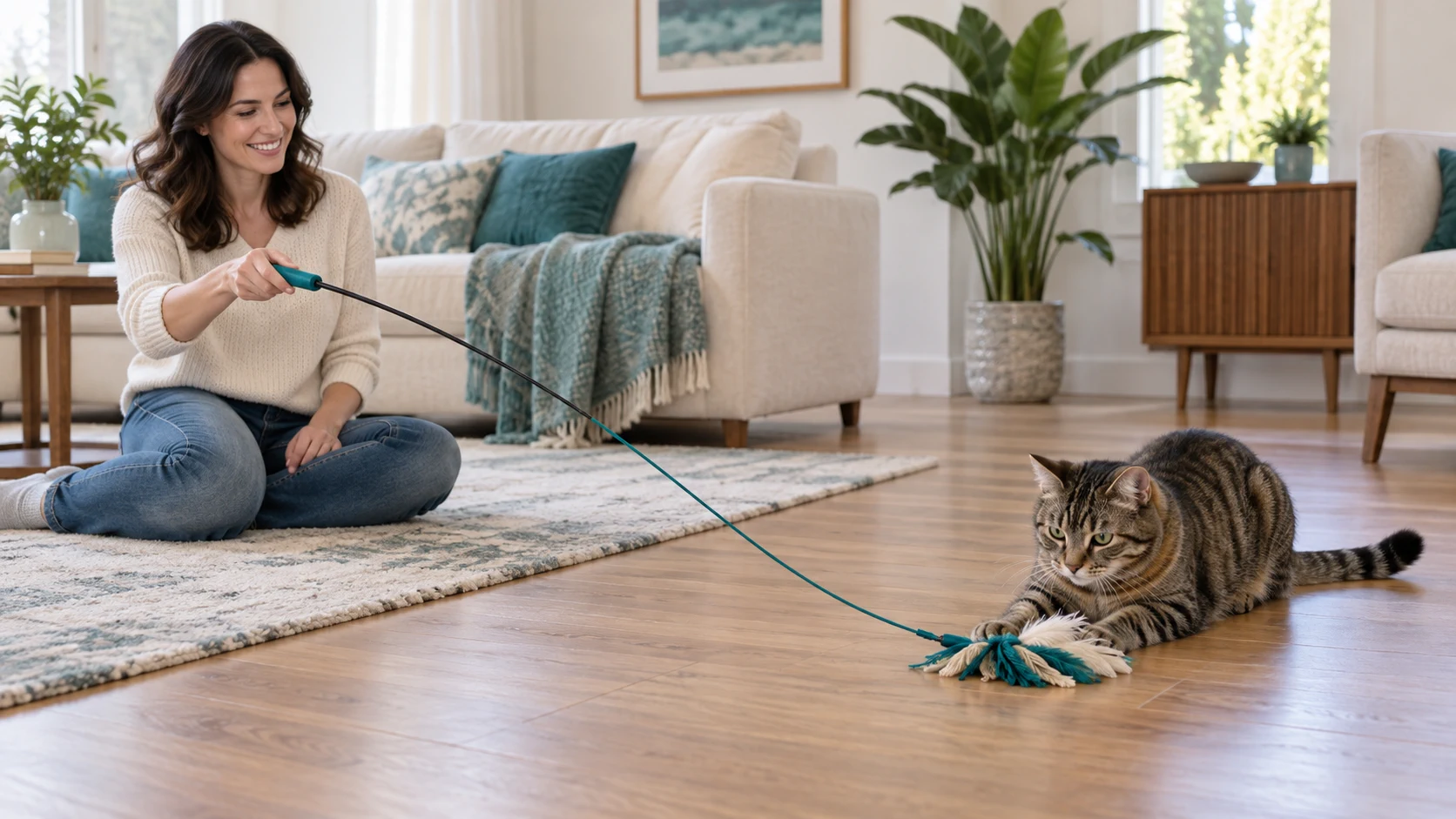
The RoloRat manual illustrates the exact-model rule: it names adult supervision, periodic damage inspection and observation before its own away mode. Catit documents battery, standby and replaceable elements for the named PIXI Spinner. KONG tells users to supervise and discontinue its named wand if damaged.
These documents do not prove that the models are equivalent or suitable for this cat. They show why the complete instructions, rather than a marketplace adjective, must control the use plan.
Original eight-session protocol
Alternate the controller and protect the capture
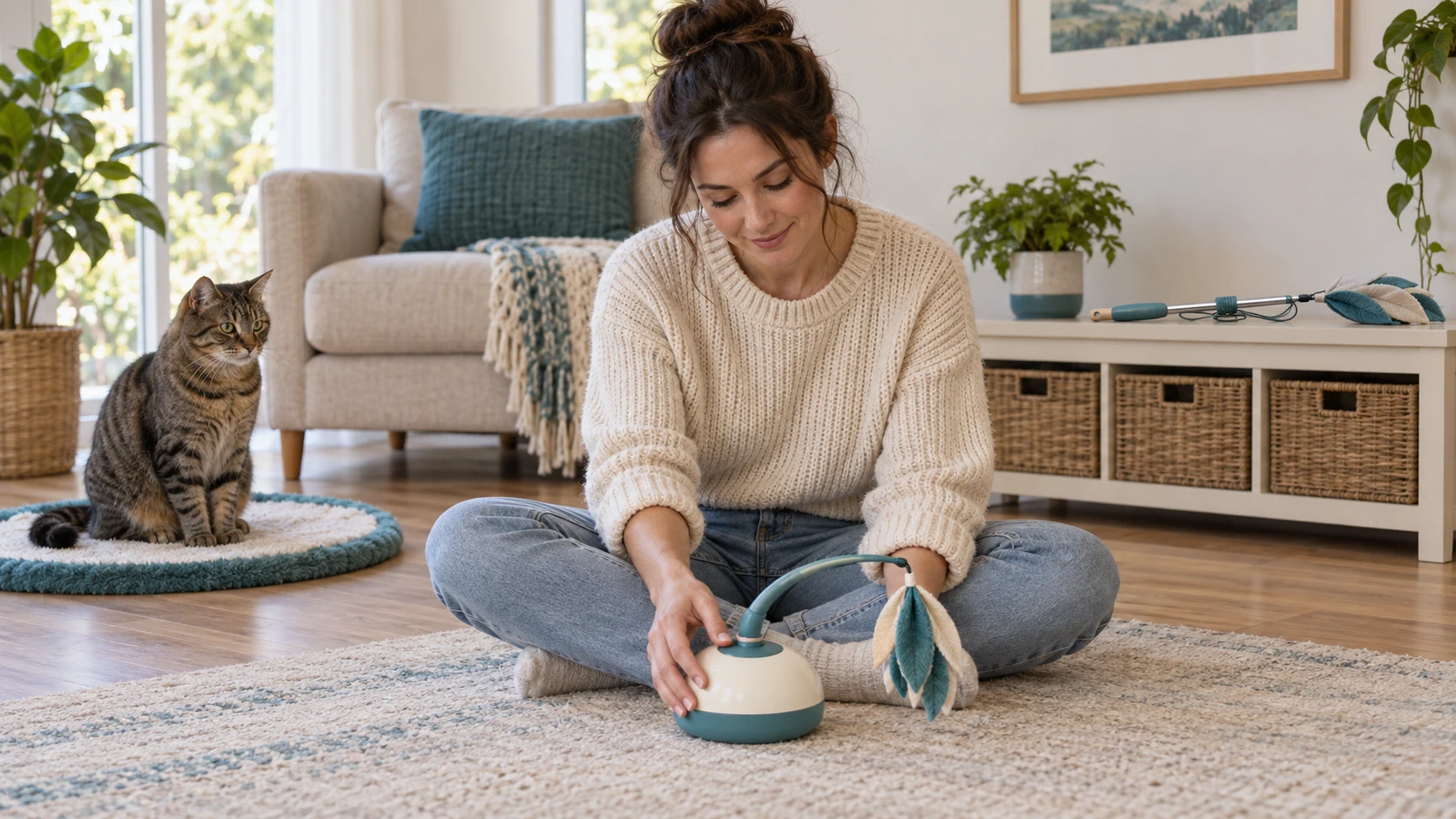
This is a practical household comparison. It keeps every session supervised, preserves the cat’s exit and refuses a result when the targets are not reasonably matched.
- 01
Define one play job
Write ground chase, hidden movement or aerial lure. Select one automatic physical toy and one wand lure that approximate the same target class and plane. Exclude lasers, food, catnip and extra sound unless both sides truly match.
- 02
Identify and inspect both toys
Record the exact automatic model or SKU and current instructions. Check its casing, battery door, moving gaps and lure. Check the wand rod, connector, line, elastic and attachment. Store or reject anything damaged.
- 03
Prepare one repeatable room
Use a familiar space with secure footing, open exits and no route into stairs, cables, fragile objects, furniture gaps or another animal. Keep the approximate activity window and room stable across sessions.
- 04
Create a blank ledger
For each session, leave fields for orient, search or stalk, chase, pounce or contact, capture, manipulation, re-engagement, avoidance, damage, successful device run, active human minutes and reset or maintenance minutes.
- 05
Run A–B–B–A
A is the wand and B is the automatic toy. Supervise every session, follow the cat’s willingness and the exact product limits, and allow a real pause between candidates. Stop rather than imposing a universal duration.
- 06
Run B–A–A–B
Complete the balanced order in comparable later windows. Position and starting order should not quietly favour one mechanism. End immediately on fear, entanglement, attempted ingestion, damage or a battery compartment opening.
- 07
Read sequence and repeat use
Count which stages appeared and whether the cat returned after novelty. Do not score staring as capture, motor runtime as cat activity, or one household’s total as an individual cat’s choice.
- 08
Choose the least stretched result
Keep the wand first, add the automatic toy as a supplement, rotate both for different jobs, or buy neither. Reinspect before use and rerun the comparison only when the cat, room, target or product meaningfully changes.
Novelty is a variable
The first pounce can be the least useful result
Hall and colleagues observed rapid habituation to an unchanged object and renewed interest after its sensory characteristics changed. Chung and colleagues later found individual consistency alongside trial effects in standardised wand responses. Together, they justify repeated observation and caution; they do not prescribe an eight-session retail test.
Our eight-session pattern is an editorial protocol designed to balance starting order and expose fading interest. If a replacement lure, scent, sound or new room is introduced, mark it as a new condition. Do not use the change to rescue the original comparison.
Health and access boundaries
Do not interpret silence or crowd activity as preference
Pause for health context when a cat suddenly stops playing, avoids a familiar movement, appears stiff or painful, hides, loses appetite or shows another persistent behaviour change. Environmental guidance explicitly keeps possible medical causes in the veterinary conversation.
Separate multi-cat observation. One activation can hide unequal access. Provide equivalent, separated opportunities and record which cat approached, waited, blocked, chased or withdrew. FelineVMA’s 2026 caregiver guidance recommends separate resources and individual play in multi-cat homes.
Real-use cost
Price the sessions the cat returned to
Purchase price alone favours the cheaper box; raw runtime favours the motor. Neither measures household value. Keep engagement and human work visible.
Active human minutes
A wand asks for direct time. That time may be the intended social value, not a defect to hide.
Setup and reset minutes
Charging, batteries, jams, retrieval, cleaning and storage remain work even when movement is automatic.
A guessed welfare score
Cost per “happy cat” would convert an unmeasured internal state into false precision.
Direct answers
Automatic and wand cat toy FAQ
Are automatic cat toys better than wand toys?
No, not universally. A wand gives a person moment-to-moment control and can yield a physical target for capture. An automatic toy earns a narrower supporting role only when the exact model passes inspection and the cat voluntarily re-engages after novelty.
Can an automatic cat toy replace playing with my cat?
The sources reviewed do not establish replacement. Treat powered play as a possible supplement. Responsive human play provides timing and interaction that a fixed programme cannot automatically reproduce.
Do cats actually use automatic toys?
Some do and some do not. First-session attention is not the same as repeat use. Observe several matched sessions and record approach, contact, capture, re-engagement, avoidance and device failures for the individual cat.
Do cats get bored of automatic toys?
Cats can habituate to unchanged objects, but the speed and degree vary. A sensory change can renew interest; that does not guarantee a particular powered toy will remain useful. Rotation should preserve safety and exact-product instructions.
Is an automatic cat toy safe to leave on while I am away?
There is no category-wide answer. Follow the complete exact model’s current instructions, inspect its parts and room, and first observe how this cat uses it. A mode name that mentions absence does not authorise every automatic toy or every household.
Should a cat be able to catch the toy?
Authoritative feline guidance recommends that cats can capture the physical prey target at least intermittently. Record real contact and capture instead of treating continuous pursuit or visual attention as the same outcome.
Is an automatic laser toy comparable to a wand toy?
Not for isolating control mode. A light target cannot be physically held, so laser versus fabric changes target identity and capture as well as automation. The 2021 laser survey is correlational and should not be stretched into a verdict on physical automatic toys.
How long should each cat play session be?
Do not impose one universal quota from a comparison page. Use brief, cat-led sessions within the exact toy’s instructions. Stop when the cat disengages or shows fear, fatigue, pain, unsafe intensity or attempted ingestion.
How do I match an automatic toy to my cat’s play style?
Observe the movement plane and target the cat already follows: ground, hidden or aerial. Then shortlist a physical automatic lure in the same broad class. Matching the job makes the controller, rather than a second change, the main variable.
What should I inspect before buying an automatic cat toy?
Confirm the exact model, instructions, supervision language, target attachment, casing, battery or charge door, moving gaps, floor compatibility, replacement parts, cleaning, seller, delivery, warranty and returns.
What changes in a multi-cat household?
Aggregate activation is not individual preference. Offer separated, equivalent opportunities and record which cat approached, waited, blocked, stared, chased another cat or left. If attribution is impossible, the ledger must remain unresolved.
Which option costs less?
Sticker price is incomplete. Add purchase price, batteries or charging, replacement lures and likely replacement units, then divide by sessions with voluntary re-engagement. Keep human active minutes and maintenance minutes visible rather than pretending they are free or equivalent.
Source ledger
What supports each part of the decision
Independent research supports individual variation, repeated observation, habituation and carefully bounded associations. Veterinary and welfare guidance supports feline choice, physical capture, supervision and separated access. Manufacturer documents establish only named-product features and warnings. Sources and competitor pages accessed 10 September 2026.
- Chung et al.: Utilising citizen science to assess consistent individual variation in play behaviour (2026) Standardised repeated feather-wand assay in 87 US cats; individual consistency and trial effects, without an automatic-toy comparison.
- Henning et al.: Cats just want to have fun (2023) International survey of 1,591 guardians; play, quality-of-life and relationship associations, with cross-sectional and self-report limits.
- Hall et al.: Object play in adult domestic cats: habituation and disinhibition (2002) Experimental evidence on declining response to an unchanged object and renewed interest after sensory change.
- Kogan & Grigg: Laser light pointers and guardian-reported repetitive behaviours (2021) Cross-sectional survey of 618 responses; significant associations but no causal proof, kept outside the physical-lure comparison.
- AAFP/ISFM: Environmental Needs Guidelines (2013) Veterinary framework for predatory play, feline control, interactive social contact and a complete home environment.
- FelineVMA and iCatCare: Your Cat’s Environmental Needs (2026) Current caregiver guidance on capture, rotation, individual preference, separated resources and individual play; educational grant disclosed in the document.
- Cats Protection: Cats and play Cat-led short games, periodic capture, rotation, supervision, wear checks and removal of shred, swallow or entanglement risks.
- Cats Protection: Keeping your cat safe in the home Current household guidance on cables, string, swallowed objects, supervision and safe alternatives.
- International Cat Care: Caring for your new kitten (2024) Wand play at a distance from hands and explicit storage/supervision caution for string or elastic attachments.
- RSPCA: Play time with cats (2026) Wand control, changing speed and direction, hiding the target and allowing a successful physical capture.
- Premier Pet: RoloRat Automatic Cat Toy product manual Exact-model example of battery, floor, inspection, supervision, away-mode observation and session-cycle instructions.
- Catit: PIXI Spinner official specifications Exact-model example of paw activation, standby, battery requirements, treat dimensions and replaceable cover or feather parts.
- KONG: Friendship Teaser official product page Exact-model wand materials, dimensions and instruction to supervise, inspect frequently and discontinue use if damaged.
Considering an optional scent rather than a different moving toy? Our catnip versus silvervine comparison separates plant research, retail formats and your cat's voluntary response.
Choosing the space around the game? Our cat tunnel versus cardboard box comparison separates active play routes from an undisturbed refuge, without requiring another purchase.