The answer in 30 seconds
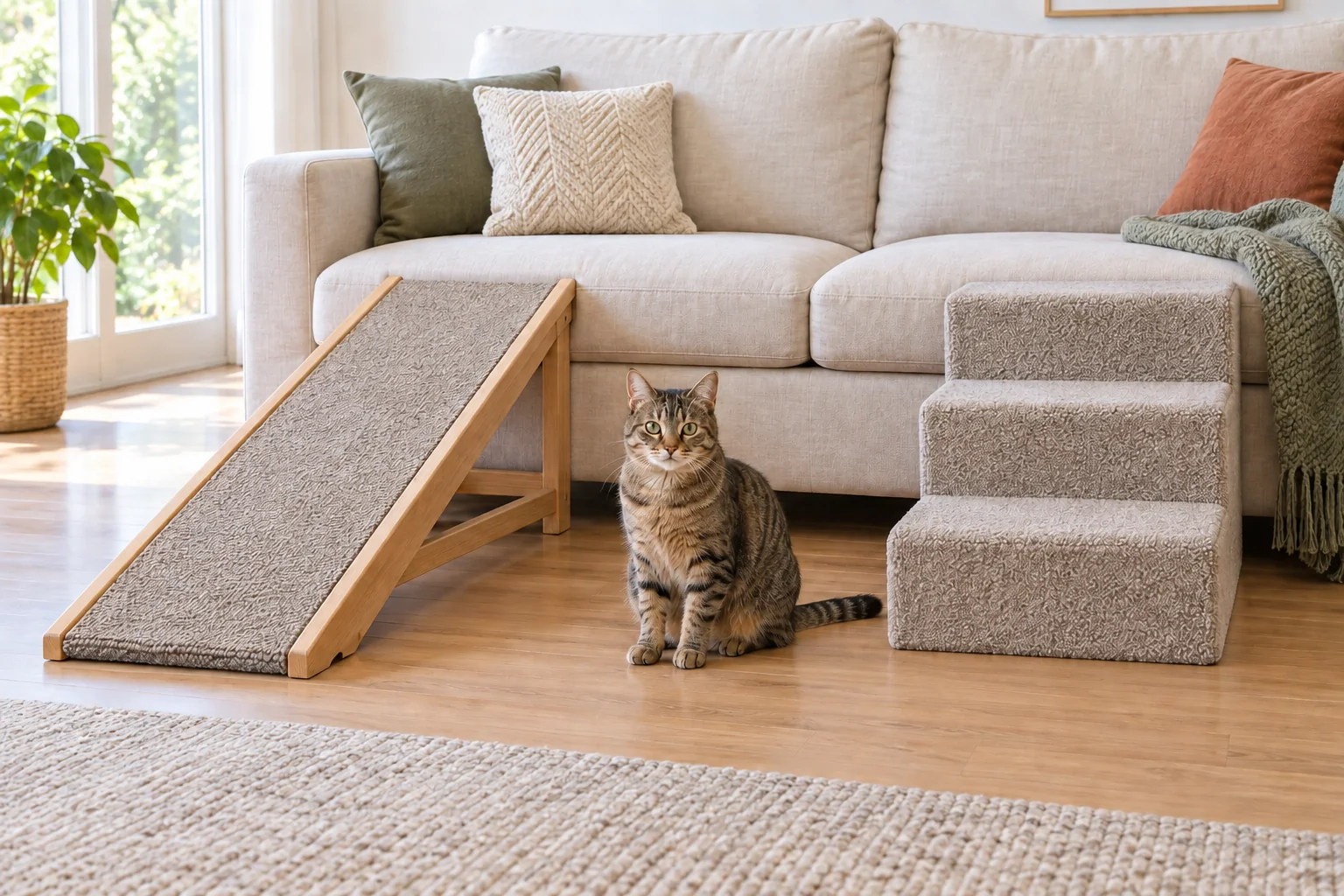
Choose between a cat ramp and pet stairs by checking the destination, floor footprint, footing and return journey. A continuous incline may be worth considering when individual steps are difficult, provided its actual setup suits your cat. Steps may fit the room better, but each rise and tread still needs assessment. Neither category is automatically right because a cat is older.
VCA includes stable intermediate furniture, ramps and carpeted pet stairs among home adaptations for cats with osteoarthritis. It does not establish a universal winner. VCA: Helping Your Cat with Osteoarthritis
If jumping or walking has changed, discuss it with your veterinarian rather than treating an equipment purchase as the diagnosis. If neither route can be installed appropriately, an accessible resting place at floor level is a reasonable alternative to discuss.
Start with the room measurements below. Keep “no purchase yet” available as a result.
What this comparison covers
This guide is about reaching an existing sofa or bed. It is not a ranking of exercise furniture, a rehabilitation plan or advice for a cat recovering from surgery. For a complete climbing installation, use our cat tree vs wall shelves comparison.
We reviewed veterinary welfare guidance and manufacturer instructions, then built a measurement worksheet around that evidence. We have not tested these products with cats. The numerical examples are calculations, not observed comfort scores. Our contribution is a way to identify missing information before buying, not a clinical pass/fail test.
Ramp or stairs: what changes?
| Question | Continuous ramp | Pet stairs |
|---|---|---|
| How is the height crossed? | Along a sloping walking surface. | Through separate rises and treads. |
| What controls the footprint? | Incline geometry plus any platform, supports and approach area. | Actual assembled depth plus space to approach and leave. |
| What measurement is easy to miss? | Whether “length” means the sloping surface or overall product size. | Each riser and usable tread, including the first and last transition. |
| What can invalidate a good-looking setup? | A sliding base, loose cover, abrupt top transition or obstructed approach. | Rocking steps, unsuitable spacing, a moving cover or a final gap. |
| Does going up settle the decision? | No. The cat's voluntary use of the downward route is a separate observation. | No. Reaching the bed does not show that the return route works. |
| What does the weight rating prove? | Only the manufacturer's stated load limit under its conditions. It is not a comfort assessment. | The same limitation applies. |
Inspect the walking surface itself. A product marketed as a ramp may contain distinct steps; rounded foam stairs may behave differently from firm, flat treads. Names are not a substitute for measurements and assembly instructions.
Measure the destination before shopping
Pick one resting place, not “all the furniture in the house”. Write down these five details:
- Destination height. Measure from the floor to the usable arrival surface. A bed frame is not the same height as the top of its mattress.
- Available floor space. Record the clear rectangle beside the furniture, including its width. Doors, drawers, walking routes and the cat's approach still need room.
- Top transition. Note where the aid would meet the surface. A gap, an abrupt extra rise or a narrow turning point can remain even when the catalogue height looks right.
- Surface and support. Identify the floor material, rug movement, attachment requirements and whether furniture can shift. Follow the manufacturer's installation method.
- Way back. Look from the resting place toward the floor. Does the same route remain available, with somewhere unobstructed to step off?
Do these checks without placing the cat on an unfinished setup. Do not improvise a raised plank or unstable stack of furniture as a trial ramp.
Ramp length is not floor footprint
For one straight incline, rise is its vertical change, run is its horizontal projection and sloped length is the distance along its surface. These are three different measurements.
Our geometry helper uses rise and run to calculate the sloped length and angle. It answers “what geometry do these measurements describe?”, not “is this safe for my cat?”. It does not design a load-bearing structure or recommend a slope.
| Illustrative rise | Horizontal run of incline | Calculated sloped length | Calculated angle |
|---|---|---|---|
| 50 cm | 120 cm | 130.0 cm | 22.6° |
| 50 cm | 80 cm | 94.3 cm | 32.0° |
At the same rise, reducing the run makes the incline steeper. Neither angle above is a recommended limit. A flat top platform, support legs or a curved profile may add space beyond this simplified triangle. Check the assembled footprint in the product instructions rather than copying our result into a shopping filter.
For those checking the calculation: sloped length = √(rise² + run²); angle in degrees = arctan(rise ÷ run) × 180 ÷ π. Use the same unit for both inputs.
If a listing only says “120 cm long”, ask what was measured. Do not enter that figure as horizontal run unless the seller confirms it is the projection of the inclined section. Nor does a long ramp automatically provide a suitable top connection or enough usable width.
Straight incline geometry helper
Enter the vertical rise and the horizontal run of one straight inclined section in the same unit. Horizontal run is the floor projection, not the catalogue sloped length.
Geometry only. This does not establish a safe angle, product strength or suitability for your cat. Check the assembled footprint and installation instructions.
With stairs, inspect every transition
Overall height and step count leave important questions unanswered. Ask for the usable depth and width of each tread, the rise between successive surfaces, and the height of the final platform.
Do not divide total height by the advertised number of steps and assume you have verified the individual risers. Some products have unequal sections, curved surfaces or a top platform counted differently. The floor-to-first-step and top-step-to-furniture changes matter too.
A soft cover is not proof that the underlying structure stays steady. Check fastening, seams and movement using the manufacturer's instructions before inviting the cat near it. If dimensions or installation requirements are unclear, keep the item off your shortlist until the seller provides them.
There is no universal tread size or riser height established by the sources reviewed for this comparison. Where mobility is affected, use your veterinary team's advice about the individual cat rather than selecting a model from age or weight alone.
Footing includes the floor, not just the aid
International Cat Care discusses small steps or ramps for reaching resting places and stresses non-slip surfaces. Its guidance also includes rugs or runners on slippery floors. That makes the approach and exit relevant, not merely the carpet shown in a product photograph. International Cat Care: Home modifications, page 7
For the buying checklist, record whether the covering is secured, whether the base can move on your floor, and whether the assembly locks or attachments are accessible for inspection. Read how the cover is cleaned and refitted. A design that only fits when it blocks a doorway is not a workable everyday installation.
Keep the alternative resting place available while assessing the new route. Side rails and a generous weight rating do not replace attention to the individual cat, clear space and correct assembly.
Observe going down separately
Let a comfortable cat investigate at its own pace. PetSafe's introduction instructions treat voluntary approach, moving up and coming down as separate stages for its ramp and steps. These are manufacturer training instructions, not comparative clinical trials. PetSafe: Bedside ramp introduction, PetSafe: Folding steps introduction
Keep introductions brief and optional. An appropriate reward may encourage exploration, but do not lift a reluctant cat onto the top to make it come down, pull it along, block its retreat or lure it past signs of discomfort. FelineVMA says training should not take place when a cat is ill, in pain or showing protective behaviours such as hiding, growling or hissing. FelineVMA: Cat training techniques for caregivers
Use a plain observation note rather than a success score:
| Observation | Record what actually happened |
|---|---|
| Approach | Ignored it, investigated, or stepped on voluntarily? |
| Ascent | Used the route, paused, turned back or chose another route? |
| Top transition | Stepped across, stopped at the end or needed a remaining jump? |
| Descent | Used the aid voluntarily, chose another route or has not been observed? |
| Equipment | Any movement of the base, surface or connection? |
“Not observed” is useful information. It is not a failed cat or a reason to repeat attempts until a target is met. Stop using an unstable setup. If behaviour suggests discomfort, pause introductions and seek veterinary advice.
When this stops being a shopping question
A recent change in jumping, climbing or movement warrants veterinary assessment. Cats Protection lists difficulty jumping and climbing among possible arthritis signs, but these observations do not identify the cause on their own. A short recording of normal movement at home can help the consultation; do not ask the cat to perform extra jumps for a video. Cats Protection: Arthritis in cats
Sudden paralysis or sudden loss of use of the back legs needs immediate veterinary attention. Do not wait for new equipment or run an introduction session. Cornell Feline Health Center: Cardiomyopathy
For postoperative restrictions, balance problems or a known mobility condition, ask the treating team whether access to that furniture should be encouraged at all. A ramp is not permission to exceed a recovery plan.
Make a shortlist, including “neither yet”
Consider a ramp when a continuous surface is worth exploring, its verified footprint fits without obstructing the room, and the complete installation is appropriate for your cat. Do not buy solely because “senior” appears in the title.
Consider steps when the actual rises, treads and arrival fit the intended route. A compact overall size is useful only if it does not hide an unsuitable final transition.
Choose neither yet if the top connection is unresolved, stability is uncertain, measurements are missing, movement has recently changed or your cat cannot comfortably access the route. An alternative accessible resting place and better information can be more useful than a rushed purchase.
Before ordering, retain the assembly instructions, exact model measurements and return conditions. Check whether opening or assembling the item affects returns. This is especially valuable when a product fits the room on paper but is not voluntarily used.
Optional market links
Some links below are affiliate links. As an Amazon Associate, Félinscope earns from qualifying purchases. This does not change the route checks above. Buying nothing remains an appropriate outcome.
Use the market selector for category searches for pet ramps and pet steps. These are shopping starting points, not endorsed models. Confirm cat suitability, dimensions, instructions, delivery and returns on the individual listing; search results and availability can change.
For the resting surface rather than the access route, see self-warming vs electric heated cat beds. That is a separate choice, not a treatment for a new mobility problem.
As an Amazon Associate I earn from qualifying purchases. These country-labelled searches are not recommendations: verify the exact model, seller, price, delivery and return terms.
Frequently asked questions
Is a ramp always better than stairs for an older cat?
No. The guidance reviewed supports access adaptations, but does not establish one category as the right choice for every older cat. Match the actual setup to the destination and the cat's needs, with veterinary advice where mobility has changed.
What is the safest angle for a cat ramp?
We cannot provide a universal safe angle from these sources. The calculator describes a straight incline; it does not certify comfort, traction or suitability. Follow product instructions and individual veterinary guidance rather than treating a calculated number as clearance.
Can I use stairs marketed for dogs?
Do not decide from that label alone. Check whether the manufacturer includes cats, then verify the usable surfaces, stability, assembly and destination fit. A load limit larger than your cat's weight does not answer those questions.
My cat walks up but jumps down. Is the setup working?
You have observed only one part of the route. Record the downward choice without forcing a demonstration. Recheck the top transition and available exit, and discuss discomfort or changed movement with your vet. A single successful ascent is not a complete assessment.
Do I need to buy both to compare them?
Not necessarily. Room measurements and missing specifications can rule out unsuitable options before purchase. If one route cannot fit with appropriate installation, buying it merely to conduct a home comparison adds little useful information.
Sources and limits
Sources consulted on 24 September 2026. This is an editorial comparison based on published guidance, not a veterinary examination or a hands-on product test.
- International Cat Care: Home modifications for cats with pain or mobility problems, especially page 7 for access and traction.
- VCA: Helping Your Cat with Osteoarthritis, home adaptation options.
- Cats Protection: Arthritis in cats, changes in movement and veterinary assessment.
- FelineVMA: Cat training techniques for caregivers, reward-based learning and reasons not to train.
- PetSafe: Bedside ramp acclimation and folding steps instructions, model-specific voluntary introduction sequences.
- Cornell Feline Health Center: Cardiomyopathy, sudden paralysis as an emergency.
The route checklist and geometry examples are Félinscope's editorial synthesis. They have not been validated as a clinical assessment, product safety certification or predictor of what a particular cat will use.