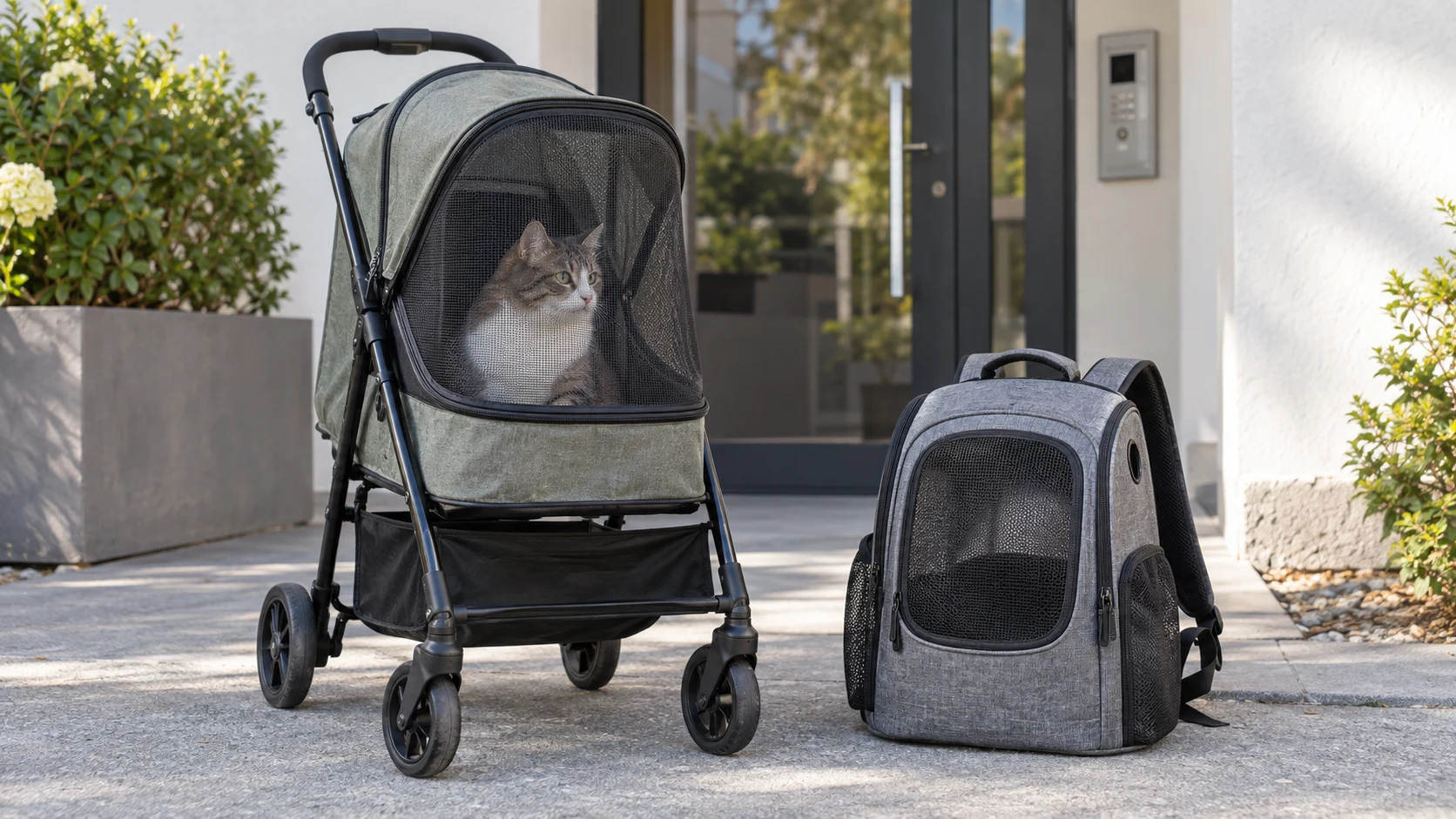
The answer in 30 seconds
Decide whether the journey should happen before choosing a device.
For an optional outing, neither may be the best purchase. Cats Protection advises against taking cats somewhere unfamiliar unless it is necessary for their health. For necessary transport, start with a secure, appropriately sized handheld carrier. Its guidance does not recommend typical backpack carriers because many restrict movement and bounce with the wearer's stride. Read the carrier guidance.
A stroller is a possible walking aid, not an automatic welfare or car-safety winner: usable cabin, closures, ventilation, ground, brakes and transfers all matter. FelineVMA's expert proceedings raise concerns about both rucksack and stroller designs. See the source and its limits.
Find the first unresolved gate ↓A more useful buying question
“Short trip = backpack, long trip = stroller” is too simple.
A feature list can help narrow products, but it cannot tell you whether your cat fits a closed enclosure, whether the mesh rubs during movement or whether your route is smooth. There is no source-backed universal time threshold or ride-comfort winner for these two categories. Start with what the trip asks of the cat and of the person moving the enclosure.
Can the trip be avoided?
A recreational outing need not become a cat-transport project. Keep normal enrichment and choice at home if the cat has no reason to travel.
Does the closed cabin fit?
Measure usable internal space with bedding in place. Weight capacity alone cannot answer whether the cat can reposition naturally.
Where does it fail?
Trace the doorway, stairs, pavement, kerbs, vehicle and destination. The hardest leg, not the smoothest photo, sets the purchase constraint.
This guide compares walking enclosures and the decision to use them. For shell construction, cleaning and airline/vehicle checks in a conventional carrier, see our hard-versus-soft carrier comparison. This page does not rerank those carrier types.
Category, mechanism, observable check
Compare what the cat experiences—not the number of pockets.
Scroll the table horizontally on a narrow screen →
| Decision factor | Cat stroller | Cat backpack | Check before ordering |
|---|---|---|---|
| Usable cabin | A cabin may give more floor area, but external dimensions and a load limit do not prove fit. | Many common backpack designs restrict repositioning; inspect actual interior width, height and base. | Check whether this cat can stand, lie naturally and turn inside the closed enclosure. |
| Movement | Wheels can reduce lifting on suitable ground; bumps, kerbs and wheel design change the ride. | The cabin follows the wearer's stride and can move unpredictably behind them. | Observe a short, gentle test of the actual movement—not a category promise. |
| Visibility and hiding | Large mesh windows may expose the cat; a cover must not block airflow or create heat. | A rear-worn cat may see stressors before the person can notice them. | Provide a way to reduce visual exposure without compromising ventilation. |
| Escape and hygiene | Inspect cabin attachment, every zipper and opening, washable floor, brakes and frame stability. | Inspect seams, zippers, ventilation, stable base and access for cleaning. | Check the entire assembled device and its cleaning instructions. |
| Route and transfers | Stairs, transit gates, narrow doors and storage may defeat an otherwise usable wheelbase. | Hands-free convenience does not solve a cat-fit or stability problem. | Map every leg and keep a secure carrier plan for any vehicle journey. |
These are category-level mechanisms, not measurements of a current model. The listed dimensions, load limit, wheel and brake design, ventilation, closures, cabin detachment, cleaning and returns must be verified on the exact product and in your market.
The gate a listing cannot close for you
External size is not the cat's usable space.
Check the interior with the floor pad in place and the doors fully closed. Can this cat stand, lie in a natural position and turn without being compressed by curved walls? Can the cat choose a less exposed position? Cats Protection specifically warns that many backpack carriers lack enough room for repositioning. Source.
Do not turn one body measurement into a universal minimum. Ask the retailer for usable internal dimensions, compare them with your own cat's resting and turning posture, and verify the actual item after delivery. If the published dimensions are only external, the fit gate stays open.
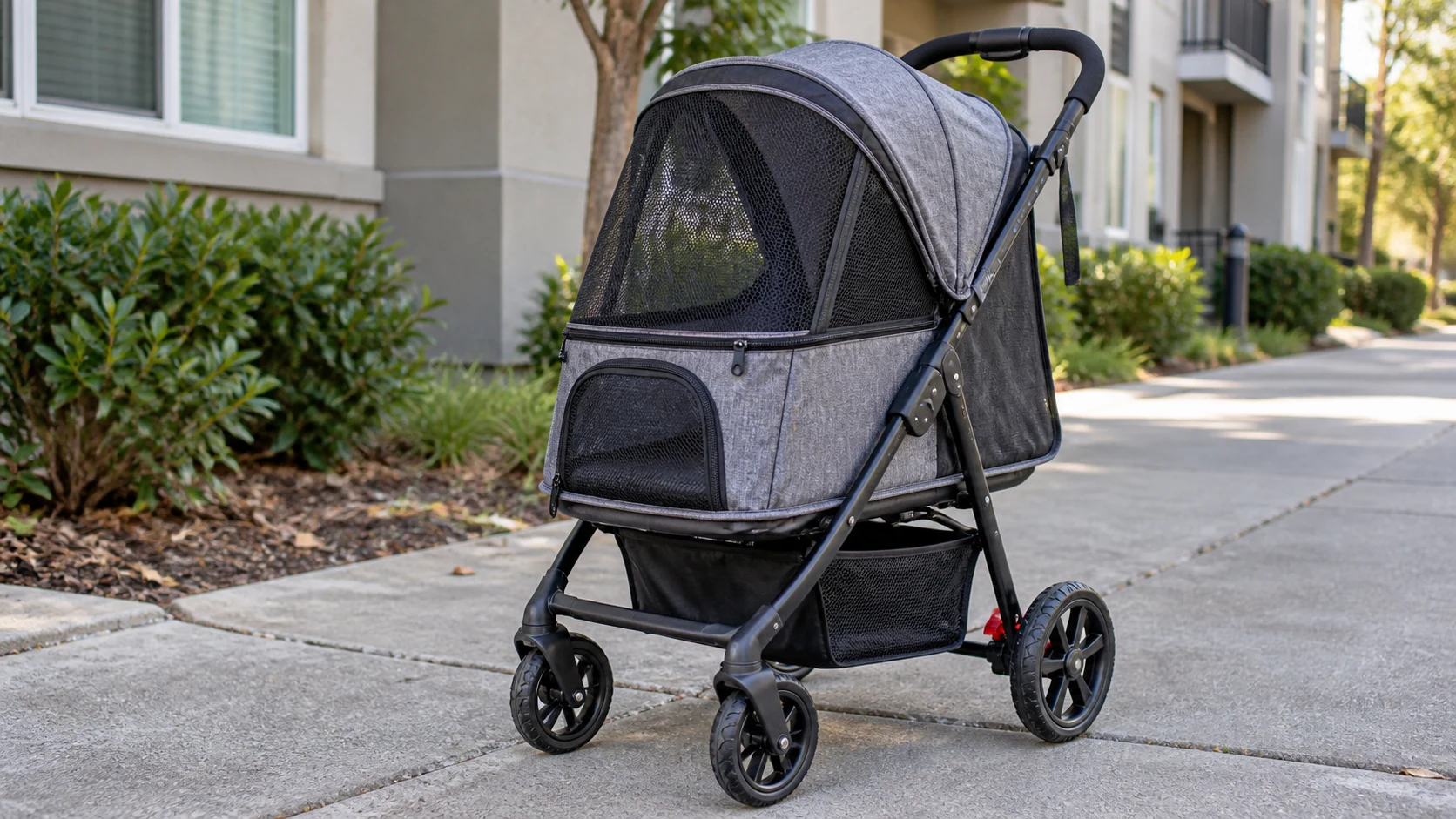
One journey, several transfer points
The wheel is only as useful as the ground and hand-off.
FelineVMA conference proceedings note that a stroller may reduce lifting, but smoothness depends on the ground, while some fabric cabins can be difficult to clean or insecure. The same guidance notes that a rear-worn rucksack may move unpredictably and expose a cat to stimuli the wearer does not see. These are expert observations, not comparative laboratory measurements. Read the proceedings.
- Home to pavement: can you pass every door and stair without tilting the occupied cabin?
- Pavement to destination: inspect joints, kerbs, noise, shade, places to stop, and any transit rule before committing.
- Waiting and return: can the enclosure stay stable and secure, and can the cat hide without blocking airflow?
- Car or taxi: plan an appropriate secure carrier for the vehicle leg. A removable stroller cabin needs exact-model evidence and instructions before it can be treated as that carrier; a seat-belt claim needs crash-test certification for the specific configuration.
Vehicle leg · current 2025 position
A wheeled frame and a “car-ready” listing are not a crash test.
FelineVMA recommends an appropriate carrier secured on the vehicle floor behind either front seat. That placement is one check. Its separate seat-belt rule says belts should be used only with crash-test-certified carriers; a belt on a non-certified carrier may crush it. A detachable stroller cabin or backpack needs exact-model suitability and instructions before it can be treated as the vehicle carrier, and any belt claim needs certification for the tested configuration. Read the 2025 position statement.
Some general Cats Protection travel pages still advise belting a carrier on the back seat without that qualification. For the belt question here, we follow the more specific, later 2025 FelineVMA position; do not infer that any stroller cabin or backpack has passed it. For the walking part of a vet visit, also consider whether the vet can examine the cat with minimal removal. FelineVMA's caregiver guide favours a stable carrier with a removable top and advises supporting it from underneath to reduce movement. Read the caregiver guide. If your only requirement is getting a cat to the vet, the conventional carrier comparison is the more direct next step.
Evidence ledger
What we can support—and what remains an exact-product question.
No controlled stroller-versus-backpack welfare trial or universal safe outing duration was found in the sources reviewed. The strongest direct statements here are veterinary and cat-welfare guidance about carrier fit, travel stress and vehicle restraint. Keep the strength of each claim aligned with its source.
Scroll the table horizontally on a narrow screen →
| Primary source | What it supports | What it cannot prove |
|---|---|---|
| Cats Protection carrier guidance | Prefers a sturdy handheld carrier, explains fit and ventilation, and does not recommend typical backpacks. | It does not test every current backpack or compare one named stroller with one named backpack. |
| FelineVMA conference proceedings · Sarah Ellis | Explains rucksack movement, exposure, space and ventilation concerns, and how stroller comfort depends on ground and cabin construction. | This is expert conference guidance, not a controlled head-to-head trial or crash test. |
| FelineVMA 2025 vehicle position | Appropriate carrier on the vehicle floor behind a front seat; seat belts only with crash-test-certified carriers. | It does not certify a stroller, removable cabin or backpack by product category. |
| AAFP/FelineVMA getting-to-vet guide | Carrier training, supporting the carrier from underneath, reducing movement and assessing travel distress. | It is practical veterinary guidance, not a product ranking or a precise maximum outing duration. |
Original, no-storage route aid
Trip Gate: find the first question that blocks a purchase.
Choose five ordinary observations. The result deliberately identifies a gate; it does not score the cat, certify a product or recommend a brand. Nothing is saved or transmitted.
Complete the five checks to see the first unresolved gate.
This is a conservative route-planning aid, not a safety certification, clinical assessment or product ranking. Nothing is saved or sent.
Trial without forcing an outing
Practice in stages; let the cat's response veto the itinerary.
Carrier acclimation is not a promise that a cat will enjoy excursions. Keep sessions voluntary and change one sensation at a time. The six-step caregiver guide progresses from familiar bedding to a closed door and gentle lifting; the Ellis conference proceedings discuss gradual exposure to travel movement and other sensations.
- 01
Familiar, open enclosure
Set a suitable carrier or candidate cabin in a quiet home space. Let the cat investigate or leave; do not use food to trap it inside.
- 02
Comfort with the door
Only once entry is easy, practise a brief closed door, then reopen. Pause if the cat resists or becomes distressed.
- 03
Gentle, level movement
Move a very short distance in a calm setting and stop. Notice orientation, breathing, vocalising, escape attempts, recovery and whether the cat voluntarily returns later.
- 04
Real route, with an exit plan
Only a necessary trip that passes the prior gates should progress to the actual route. Check weather, shade, closures and a safe return. Ask a vet for help with repeated travel distress or suspected motion sickness.
Do not infer a “safe 30 minutes” or “safe two hours” from a product category. The sources reviewed provide no universal time threshold for either design.
Direct answers
Cat stroller and backpack FAQ
Is a cat stroller better than a cat backpack?
Not as a blanket rule. A secure, roomy stroller may make a necessary, level walking leg easier to manage, but its wheels, fabric cabin and closures need checking. Cats Protection does not recommend typical backpack carriers because of limited space and up-and-down motion. For many cats, a sturdy handheld carrier—or skipping an optional outing—is a better starting point.
Can I put a cat stroller or backpack in the car?
Do not treat either label as a car-safety claim. FelineVMA's 2025 position recommends an appropriate carrier secured on the vehicle floor behind a front seat. Its separate seat-belt rule allows belt use only with a crash-test-certified carrier in its documented configuration. Check the exact enclosure and instructions; certification is not a blanket requirement for floor placement, and a stroller frame alone proves nothing.
Are clear bubble backpacks good because cats can see out?
A panoramic view is not automatically enriching. FelineVMA conference guidance flags that a rear-worn cat may be exposed to stressors the wearer cannot see, while the cabin may be small or poorly ventilated. Check usable fit, airflow and the cat's behaviour rather than assuming more view is better.
How long can a cat stay in a backpack or stroller?
The primary sources reviewed do not establish a safe universal time limit for either category. Duration depends on the necessity of travel, the individual cat, actual fit, temperature, ventilation, movement and signs of distress. Avoid turning a retailer's fixed minute or hour claim into a safety rule.
Does a stroller replace a carrier for a vet visit?
Not automatically. A stroller may help with a walking leg, but the cat still needs a secure enclosure that is suitable for the consultation and any car travel. FelineVMA guidance favours carrier features that let veterinary staff examine a cat with minimal handling, such as a removable top.
What if my cat freezes or tries to escape during practice?
Pause the outing. Practice voluntary entry at home, then closed-door comfort and very gentle movement in separate steps. Do not force a longer trial to justify a purchase. If necessary veterinary travel remains difficult, ask your veterinary team for a plan.
Primary-source ledger · checked 12 September 2026
References with their scope visible.
We use veterinary and cat-welfare organisations for welfare and vehicle claims, not retailer copy or the visual concept. Current product specifications and regional availability must be checked again for any exact item.
- Cats Protection — choosing and using a carrierFit, ventilation, carrier training, preference for sturdy handheld designs, and its explicit warning about typical backpacks.
- FelineVMA / AAFP 2022 conference proceedings, Sarah Ellis, pages 339–343Expert discussion of rucksack and stroller trade-offs, exposure, movement, fabric cabin limitations and gradual training. Not a head-to-head trial.
- FelineVMA — 2025 Transportation of Cats in Motor Vehicles positionCurrent vehicle placement and crash-test qualification for seat-belt use; supersedes its 2020 statement.
- AAFP/FelineVMA — Getting Your Cat to the Veterinary PracticeCaregiver carrier-selection and six-step training guide, plus advice on distress and movement.
- Cats Protection — travelling with your catGeneral travel preparation and welfare context; not a stroller or backpack product test.