What size cat flap does your cat actually need?
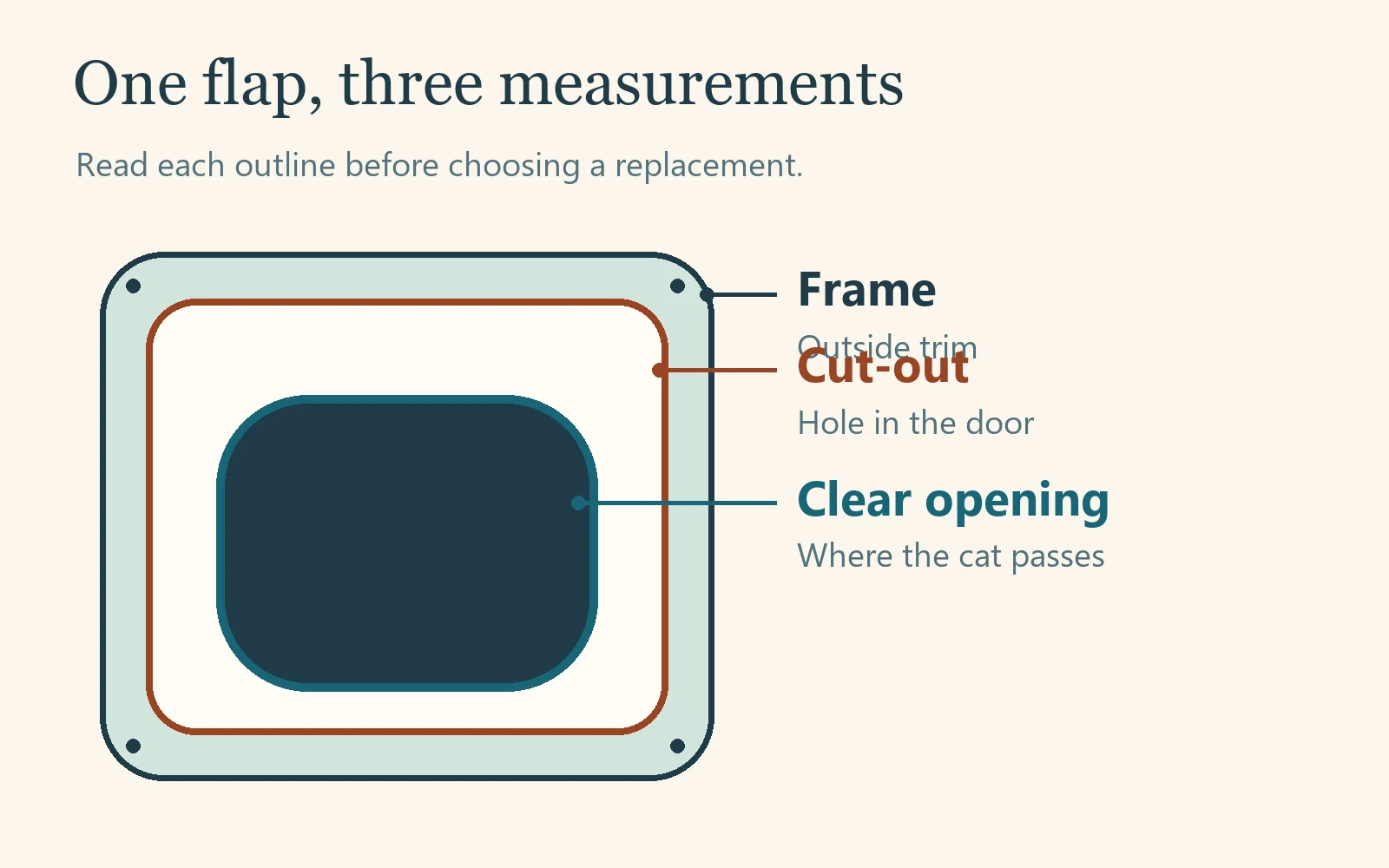
Check your existing openingThe width printed on the box might describe the trim you can see, the hole hidden in the door, or the passage your cat has to get through. Those three figures can belong to the same flap.
Which measurement decides the size?
For your cat, use the smallest clear width and height with the flap open. For the door, use the installation cut-out for that model and material. Take both measurements in millimetres and write width first. A frame measuring 210 mm across can surround a passage only 142 mm wide, as the SureFlap Microchip Cat Flap drawing shows.
If you can see only the trim of an existing flap, you already have enough information to check clearance around a handle or panel edge. You still need the old model’s template, fitting record or a fitter’s measurement to find out what hole sits underneath.
Start with the cat and the two landings
Pick a moment when your cat is standing comfortably. Viewed from the front or above, estimate the broadest part of the body and shoulders. Two parallel marks on paper or on the floor can help you take a width reading after the cat walks away. A tape wrapped round the chest measures circumference, which cannot be compared directly with a manufacturer’s opening width.
Look next at a gap your cat already uses comfortably. Notice whether they have room to bring their hindquarters through as well as their head. An older cat who steps carefully, or two cats with different builds, can make the smallest opening a poor choice even when the broadest animal appears to fit on paper.
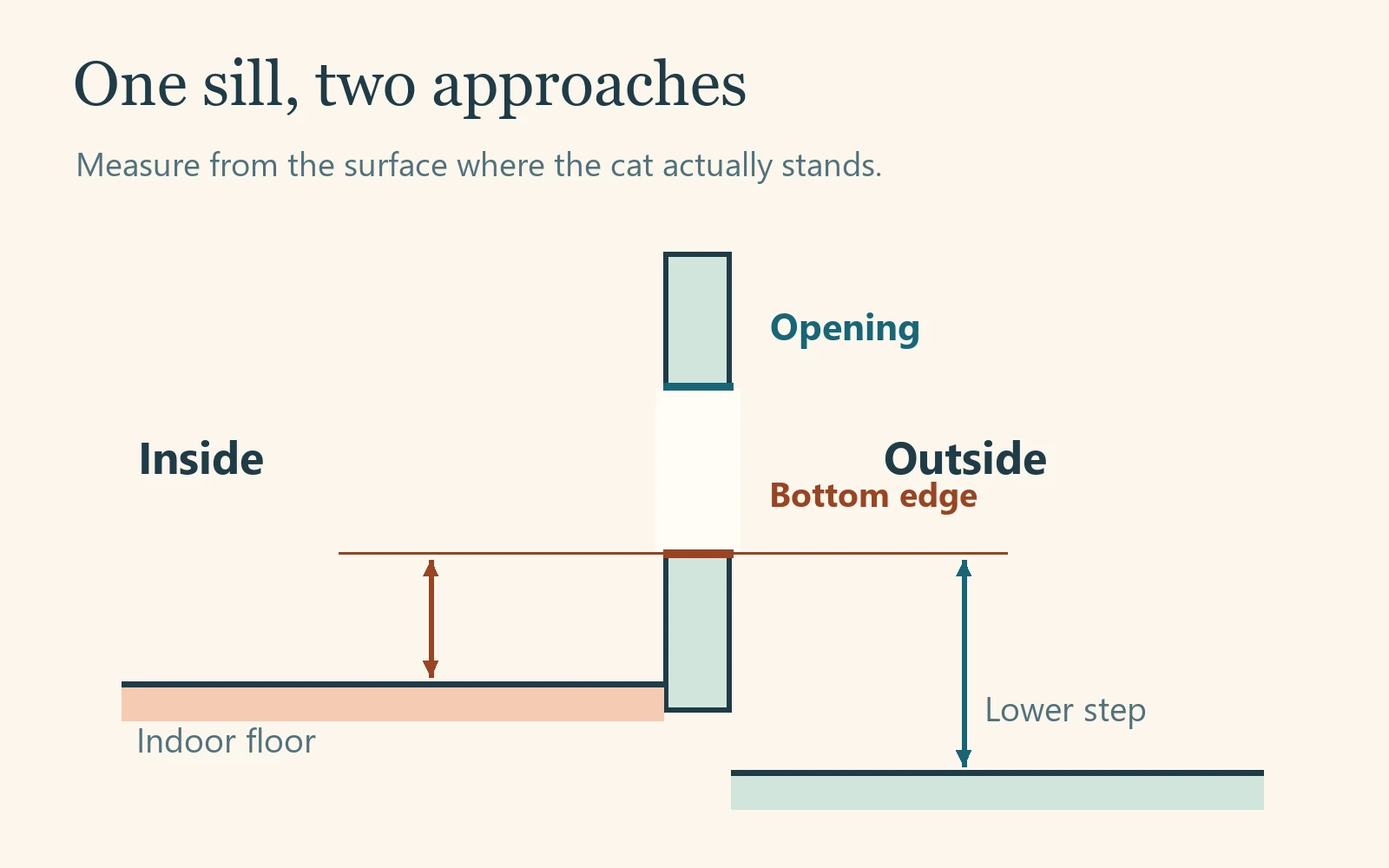
Write down the proposed sill height indoors and outdoors. A doorstep, frame lip or slope can make one approach awkward. Where there is already a flap, watch how your cat enters as well as how they leave. Avoid lifting or pushing them through to prove a fit. Cats Protection’s guidance starts with the flap held open and lets the cat build confidence in small steps.
What two real model drawings tell you
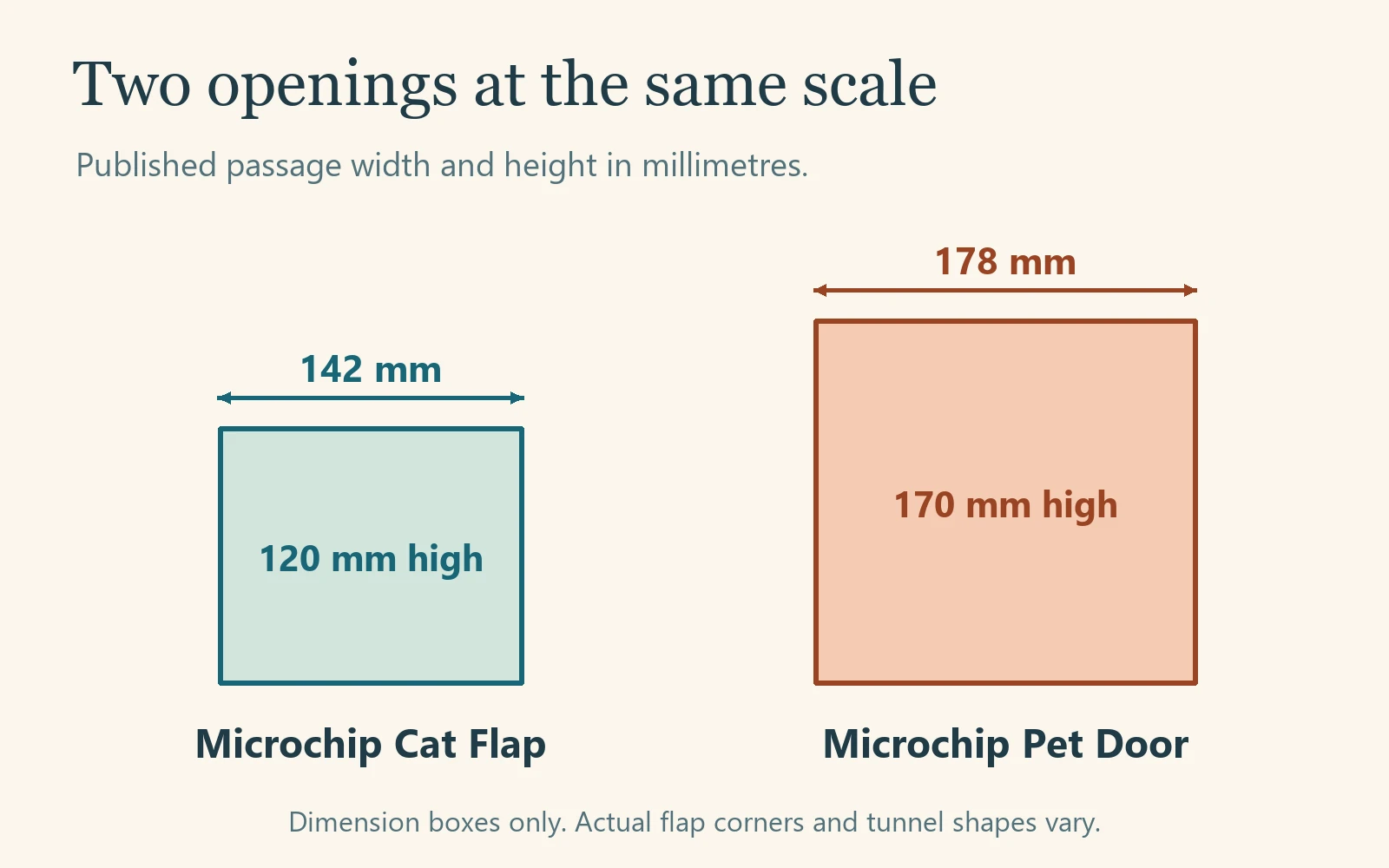
These are the standard UK models named below. Each link opens the manufacturer’s own dimension drawing. The door cut-out applies to the installation type shown there. Glass uses a separate circular specification. Measurements are width × height in millimetres.
| Measurement | Microchip Cat Flap | Microchip Pet Door |
|---|---|---|
| Clear passage | 142 × 120 | 178 × 170 |
| Door cut-out | 165 × 171 | 207 × 234 |
| Outer frame | 210 × 210 | 262 × 281 |
For the smaller model, the hole in the door is 23 mm wider and 51 mm taller than the clear passage. Imagine copying the 165 × 171 mm cut-out onto card to see what your cat could walk through. Your mock-up would give them that extra space. The discrepancy matters most for a cat already close to the width or height limit.
Will the new flap fit the old door hole?
Use this check for an existing door cut-out whose width and height you know. Enter the bare hole dimensions from a reliable measurement or the exact old unit’s template. If all you have is the visible trim, leave the fields blank until you can identify the old model.
Specified door cut-out: 165 × 171 mm (width × height).
Enter the measured hole width and height in millimetres.
A worked example. If a door already has the smaller model’s 165 × 171 mm hole, the larger model specifies another 42 mm of width and 63 mm of height overall. Those totals cannot tell you where material could be removed. The door’s construction, the panel position and the exact template decide that.
When replacing a flap in glass, give the glazier the pane type, the existing circular hole diameter if known, and the proposed model number. The rectangular checker above does not cover glass. Sure Petcare lists its glass dimensions and adapters separately.
Watch the two outlines appear on paper
This 24-second silent demonstration uses the smaller model’s published numbers. Keep the two outlines separate on your own sheet, ideally in different colours.
Read the video transcript
Read the SureFlap Microchip Cat Flap sheet. Mark the 142 × 120 mm clear passage on paper. In another colour, mark the 165 × 171 mm door cut-out. The sketch illustrates the difference. Use the manufacturer’s full-size fitting template for the installation.
If you want to explore the passage with your cat, use securely supported card indoors and allow an easy route around it. A cat declining to investigate tells you little about size. Even a willing crossing leaves the real tunnel depth, flap resistance and outward step to check. A sketch from this page or a scaled screenshot is unsuitable as a fitting template.
What to take to the fitter
- The exact current and proposed model names, including any suffixes such as “Connect”.
- The clear opening, installation cut-out and outside frame in separate rows, with units.
- A photo of each side of the door showing the panel edges and the standing surface. Include door thickness or glazing details if known.
- The manufacturer’s template for the intended material, any adapter reference, and the direction in which each pet needs access.
If the dimensions work, the next decision is which animals to admit. Our microchip and magnetic cat flap comparison explains recognition, collar keys and access direction.
How we compared. We took both sets of dimensions from Sure Petcare’s UK product sheets and calculated the differences shown above. The drawings, checker and film are Félinscope’s editorial illustrations. We did not physically fit these models or measure cats for this comparison.