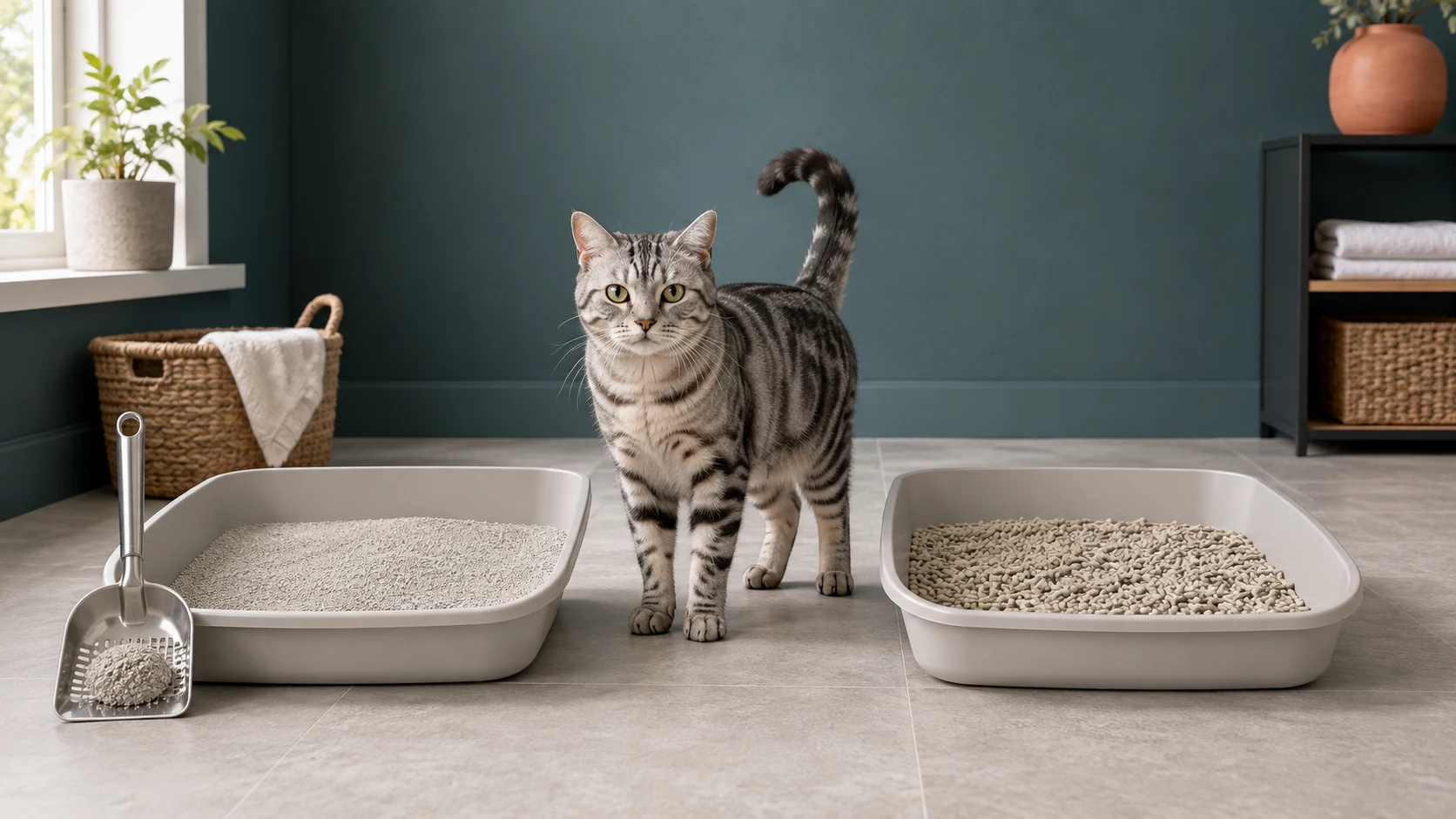
The answer in 30 seconds
Start with the cat, then audit the litter system.
Fine, unscented clumping litter is the evidence-informed starting point for many adult cats. It often supports daily urine removal and a sand-like texture. That does not make every formula low-dust, low-tracking or accepted.
Keep non-clumping litter when the cat uses it confidently, a veterinarian has specified a material, or its weight and handling fit the household better. A lower bag price is not automatically a lower monthly cost.
Do not switch during a urinary warning. Straining, crying, blood, repeated attempts or little to no urine moves the decision from shopping to veterinary care.
Run the two-box logger ↓The key distinction is behaviour versus material. Bentonite clay can clump, but plant fibres can also clump. Paper, wood, non-clumping clay and many crystal products may absorb without forming a scoopable mass. Grain size, weight, fragrance, dust and familiarity can matter to the cat independently of that wet behaviour.
Crossover control · reviewed 4 September 2026
Separate litter preference from side preference
A two-tray trial can mislead when the cat simply prefers one side of the room. The live crossover logger separates substrate totals from left-versus-right totals before it suggests a conclusion.
Convenience becomes the verdict
Pros-and-cons pages often move from easier scooping to a universal winner. They rarely test whether the cat accepts the texture or whether an apparent choice follows the tray position.
Material and behaviour are collapsed
Clay, wood, paper and plant fibres can have different granule size, weight and dust even when two bags share the same clumping label. The label describes wet behaviour, not the whole substrate.
Swap the sides before changing the answer
Our two-round logger reverses only the tray positions. It can reveal a repeated substrate signal, a left-or-right location bias, a mixed result or a stop condition.
First correction
“Clumping” does not tell you what the litter is made from
Read the material and the granule before predicting weight, dust, paw feel or disposal. Two clumping bags can differ more than one clumping and one non-clumping bag.
Does a removable mass form?
This affects spot removal, residue and what remains in the tray after each clean.
Fine sand, granule, pellet or crystal?
This affects digging, paw feel, sifter passage and the trail outside the box.
Clay, paper, wood or plant fibre?
This affects density and handling, but no material name guarantees low dust or acceptance.
What has this cat used confidently?
Prior learning can dominate a neat theoretical comparison, so protect the accepted option.
System comparison
Clumping vs non-clumping, without bag-level promises
These are operating tendencies. The product instructions, tray geometry and the individual cat can reverse a category assumption.
| Decision point | Clumping | Non-clumping | What to audit |
|---|---|---|---|
| What urine does | Liquid binds into a removable mass when the formulation works as intended | Liquid is absorbed or distributed without a scoopable mass | Observe the actual bag in the actual tray; weak clumps and saturated pellets change the workload. |
| Daily removal | Urine clumps and stool can usually be removed during each scoop | Stool can be removed, while urine-bearing material remains until stirred or replaced as directed | Time a real clean rather than accepting ‘easy’ on the pack. |
| Urine visibility | Discrete clumps can make a change in event pattern easier to notice | Highly absorbent material can hide individual urine events | Neither system measures urine volume. Record behaviour and seek veterinary help for warning signs. |
| Cat preference | Fine, sand-like, unscented clumping litter is the guideline starting point for many cats | An individual cat may reliably prefer familiar paper, wood, crystal or another non-clumping texture | Offer a controlled choice; do not remove a reliably accepted option to force novelty. |
| Tracking | Fine or lightweight grains can travel on paws and fur | Large pellets may cling less but can bounce, crumble or feel unfamiliar | Measure the exit trail over seven days; clumping alone does not predict tracking. |
| Dust and fragrance | Varies by material, granule and handling | Also varies; a pellet or crystal label is not proof of zero dust | Choose unscented when possible, pour slowly and ask a veterinarian about respiratory disease. |
| Full resets | Often less frequent when clean litter remains and clumps stay intact | Often more dependent on saturation and complete replacement | Follow the product instructions and reset for residue or persistent odour, not an invented universal calendar. |
| Automatic boxes | Commonly required, but granule size, density and clump strength still matter | Often incompatible with a sifting machine unless its exact manual permits the material | Check the exact machine, sifter and maximum pellet size before ordering either bag. |
| Real cost | Spot removal may reduce whole-tray waste but poor clumps can contaminate clean litter | A lower bag price can be offset by larger scheduled replacements | Weigh every top-up and discard during one stable week, then multiply the measured use. |
The observability paradox
A clump is a signal, not a millilitre reading
Clumping litter can make urine events easier to see. It cannot turn a tray into a calibrated medical device.
Notice a change from the cat’s own baseline
A sudden cluster of small clumps, repeated tray visits or a new outside-box event can prompt closer observation and a veterinary call.
Convert diameter into urine volume
Formula, depth, spread, breakage and scoop timing change the apparent size. Comparing two brands can change the clump without changing the cat.
Non-clumping material can merge events
Absorbed urine may spread through a bed of material. A clean-looking surface does not prove the tray is unsaturated or that urinary output is normal.
Interactive two-round crossover logger
Did the cat choose the litter or the location?
Enter deposit counts after two comparable rounds. The tool totals both the substrate and the side of the room, then deliberately refuses a winner when the signal is mixed.
Separate litter choice from room-side bias
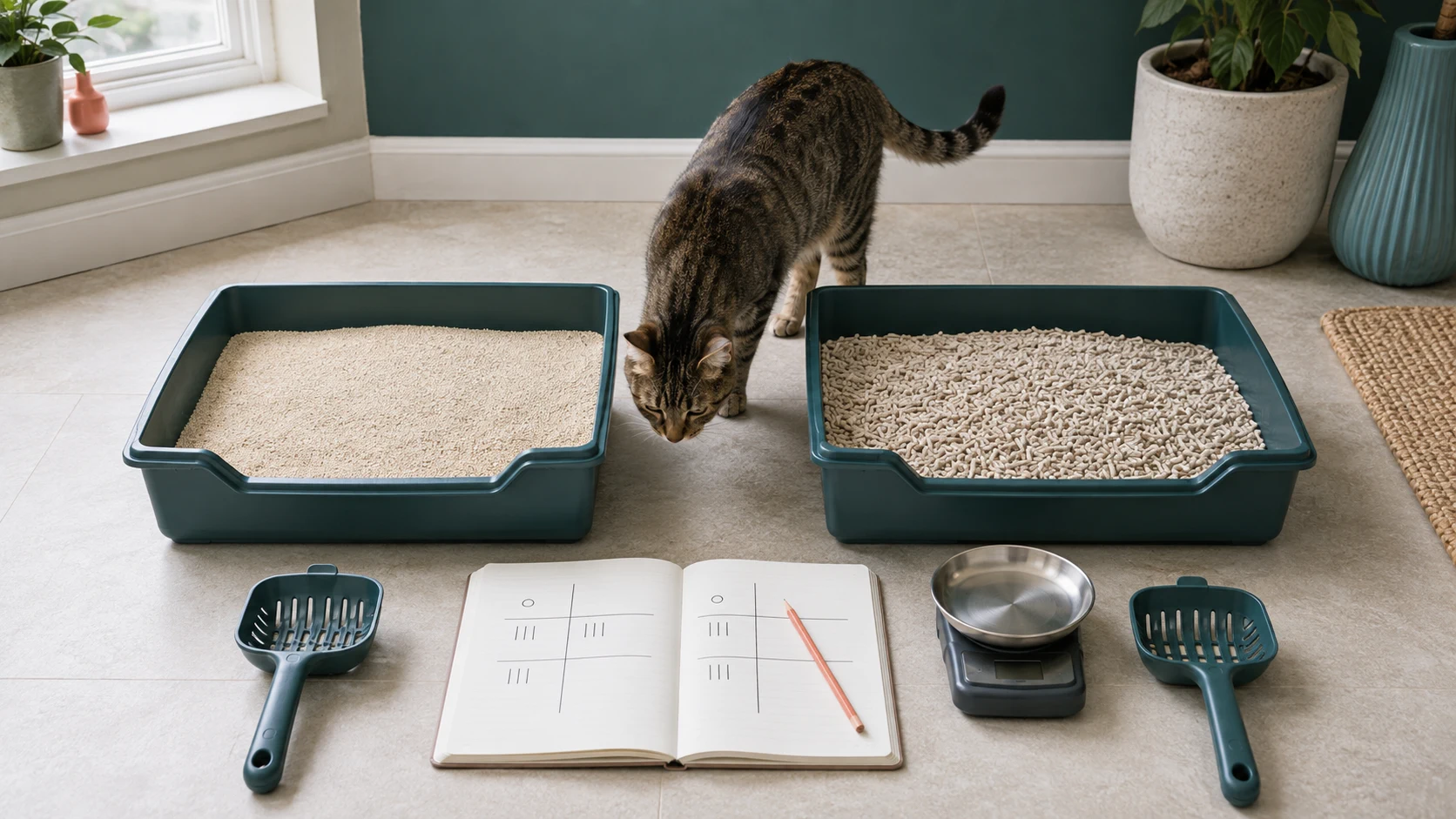
Use two identical, clean trays at the same depth. Round one places A on the left and B on the right; round two swaps only their positions. Record deposits, never force an entry.
A cautious 14-day household protocol
Change one variable, then reverse one position
AAFP/AAHA life-stage guidance supports offering different litters in separate boxes to let the cat express a preference. This protocol translates that principle into a transparent home log; it is not a clinical trial.
- 01
Protect the familiar option
Use two identical, large, accessible trays. Keep the cat’s accepted litter in one and put the candidate in the other. Match depth, cleanliness and approach space.
- 02
Record deposits for round one
Place A on the left and B on the right. Count urine and stool deposits, plus any rapid exit, edge balancing or elimination elsewhere. Do not count inspections as choices.
- 03
Reverse only the positions
After both trays are clean and confidently used, put B on the left and A on the right. Keep box shape, depth, room, schedule and cleaning effort as stable as practical.
- 04
Read substrate and side separately
A litter that wins on both sides gives a stronger household signal. A winner that follows the left or right side points to location. Stop immediately if reliable toileting deteriorates.
Seven-day waste ledger
Price the kilograms that leave the bag
Bag price alone rewards the wrong number. Weigh material added, clumps removed and whole-tray discards during one representative week.
Calculate price per kilogram
Delivered bag price ÷ usable bag mass. Include delivery only when it is actually charged.
Measure weekly material used
Start and finish with the same target depth. Count every top-up and complete replacement.
Separate time from material
Record scoop minutes, stuck residue, tracked grains and bag handling. The cheapest substrate can still be the wrong system.
Project only stable use
Weekly material × price per kilogram gives a working weekly cost. Repeat after seasons, health or household use changes.
Observed weekly litter cost=(bag price ÷ bag mass) × kilograms actually used
Health and hygiene before commerce
Some decisions should stop the comparison
Litter choice is environmental support. It does not diagnose pain, infection, stones, obstruction or a respiratory condition.
Straining, distress, blood or little urine
Seek prompt veterinary care. Little or no urine with repeated attempts can indicate an obstruction and is an emergency.
Read Cornell’s urinary warning signsRemove deposits and wash hands
CDC advises changing the litter box daily; it notes that Toxoplasma shed in faeces takes one to five days to become infectious. Pregnant or immunocompromised people should follow medical guidance.
Read CDC prevention guidanceRecovery and litter eating are not category debates
A veterinarian may choose a specific non-adhering or low-dust material for an individual case. Repeated litter eating, new coughing or eye irritation deserves advice rather than another marketing claim.
Open the feline life-stage guidanceDirect answers
Clumping vs non-clumping cat litter FAQ
Is clumping or non-clumping litter better for cats?
Fine, unscented, sand-like clumping litter is a strong starting point for many adult cats and is reflected in feline guidelines, but it is not a universal winner. A cat that confidently uses a familiar non-clumping substrate may be better served by keeping it. Preference, comfort, health instructions and maintenance all matter.
Do larger urine clumps mean my cat produced more urine?
Not reliably. Clump size changes with litter formula, fill depth, the angle and location of urination, breakage and scoop timing. Clumps can help you notice a pattern change, but they are not a calibrated urine-volume measurement.
Does non-clumping litter control odour better?
The label cannot decide odour control. Absorption, number of cats, tray size, ventilation, cleaning and replacement before saturation all matter. Fragrance can mask odour for people without making a dirty tray acceptable to a cat.
Can I mix clumping and non-clumping litter to switch?
A gradual mixture is sometimes used, but separate identical trays produce a clearer preference signal because the cat can choose. Preserve the accepted option and stop if the cat avoids the trays or eliminates elsewhere.
Is clumping litter safe for kittens?
There is no reason to force an internet age rule onto every kitten. Keep the familiar product initially and ask a veterinarian which material is appropriate if a kitten mouths or eats litter, has diarrhoea, is recovering from a procedure or has another clinical concern.
How deep should cat litter be?
The AAFP/ISFM house-soiling guideline describes a fine, sand-like, unscented clumping material at least 3 cm deep in most cases. A 2025 preference study used 5 cm. Treat those as evidence-informed starting points, then follow the product and accommodate the individual cat.
Can non-clumping litter work in an automatic litter box?
Only when the exact machine manual permits the material and granule dimensions. Many sifting systems rely on firm clumps and exclude long pellets or certain crystals. Do not transfer compatibility from one model or sifter to another.
When is a litter change a veterinary issue?
Straining, repeated attempts, crying, blood, urinating outside the tray or producing little or no urine require prompt veterinary attention. Cornell describes urethral obstruction with little or no urine as an absolute emergency.
Where can I compare current clumping and non-clumping litter?
Félinscope provides separate Amazon category searches for France, Belgium, the United States, Canada, the United Kingdom and Ireland. They are shopping routes, not endorsements; verify material, fragrance, dust information, bag size, seller, delivery and returns.
Evidence, limitations and dates
Preference evidence is useful when its limits stay visible
Guidelines give a sensible starting point; studies describe their samples. Neither guarantees one litter for every cat or every home.
- AAFP/ISFM Guidelines for Diagnosing and Solving House-Soiling Behavior in Cats · fine, sand-like, unscented clumping material, depth and box-choice framework.
- Iwabuchi-Inoue et al., 2025: litter box size and litter type preference · 46 adult cats in the litter experiment; clumping clay was preferred over the tested clumping wood and paper products. One author was employed by the product company, which the paper discloses.
- 2021 AAHA/AAFP Feline Life Stage Guidelines · separate-box preference choice, daily scooping and household setup.
- 2025 iCatCare lower urinary tract disease guidelines · optimal tray provision and the general sandy, clumping-style preference.
- Cornell Feline Health Center: feline lower urinary tract disease · clinical signs and emergency obstruction boundary.
- CDC: preventing toxoplasmosis · daily litter-box change and hygiene rationale.
- Ishikawa, Uchida and Yamada, 1999: preference of cats for different litter types · eight-cat comparison of five substrates; a small sample that should not be universalised.
- IAABC Foundation Journal: household substrate preference study · nine-to-eleven companion cats, 201 deposits and explicit limitations including prior experience and room setup.
Source review completed 4 September 2026. No physical litter test, dust measurement, urine-volume validation or long-duration product trial was performed. Product formula, price, stock and instructions can change.