The answer in 30 seconds
Choose the mechanism only after the feeding pattern is already known.
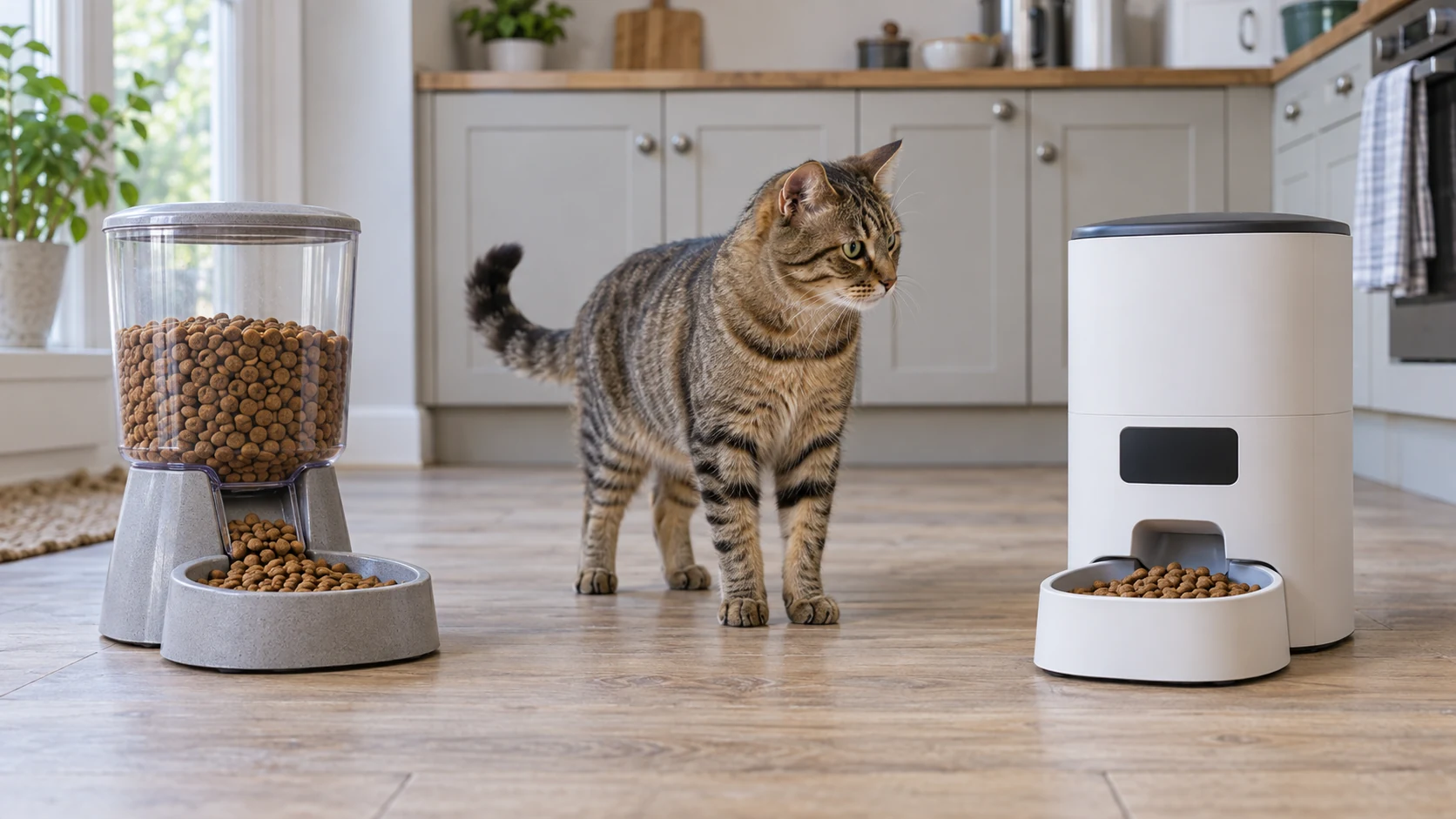
Choose a gravity feeder only when continuous free access to dry food is already appropriate for this cat, every eater can be accounted for and a person still checks the system.
Choose a timed feeder when the plan requires known release times or amounts, but first weigh ten releases with the exact kibble and verify the permitted power, low-food and recovery conditions.
Choose neither when food needs refrigeration, medication or identity-protected access, or when hardware is being used as a substitute for in-person care.
Run the ration and failure ledger ↓This page owns one narrow intent: a free-access gravity hopper versus a scheduled or portioned dry-kibble dispenser. It does not rank smart-camera feeders, selective RFID access or refrigerated wet-food machines. For those decisions, use our camera-feeder evidence comparison, selective-feeder comparison or wet-food cooling comparison.
The missing audit
“Automatic” describes a command, not a completed meal
Price, convenience, portioning and backup power describe only part of the decision. The unresolved part is the evidence chain. A hopper can empty without showing which cat ate. A programmed feeder can turn without releasing the planned mass. An empty bowl can mean eating, theft, spill or removal.
Félinscope therefore treats every step as a separate claim. The result can stop before a purchase when food format, access attribution or human care does not fit either mechanism.
Seven gates before checkout
Close the feeding problem before comparing features
Every gate has an “unknown” state. That is deliberate: missing evidence should keep the decision open rather than quietly favouring the more expensive device.
Ration source
Import an amount from the food label plus monitoring or from an individual veterinary plan. A feeder must not invent the ration it dispenses.
Food format
This comparison covers dry kibble only. Wet, raw or refrigerated food, as well as medication or other special handling, falls outside this decision tree. A dry therapeutic kibble remains in scope only when the veterinary plan and exact manual permit it.
Access pattern
A gravity hopper supports continuous free access. A timed feeder supports release events. Decide which pattern is appropriate before comparing hardware.
Exact-kibble fit
Shape, maximum dimension, crumbs and oiliness can change flow. Check the current manual, then use the actual food and lot in the bench test.
Release evidence
A programmed unit is not automatically grams. Weigh ten releases and keep zero or partial releases in the record.
Cat attribution
Released food can be stolen or shared. If the eater cannot be identified, the intake remains unattributed, especially in a multi-cat home.
Failure and care
Test permitted low-food and power conditions, preserve a recovery path, and keep a person responsible for the cat, water, litter and device.
Mechanism, not marketing label
Gravity hopper versus timed release
A phone app is optional to this distinction. The core question is continuous passive access versus discrete release events.
| Decision factor | Gravity feeder | Timed automatic feeder | Evidence to collect |
|---|---|---|---|
| What it controls | Passive refill from hopper to an accessible bowl; no meal clock or release event. | When or how often the mechanism releases a programmed unit, subject to the exact device. | Write the feeding job before naming a category. |
| What it cannot prove | How much the intended cat ate, even when food disappeared from the hopper or bowl. | That a command became a complete release, or that the intended cat ate it. | Observe released, accessible and eaten as separate events. |
| Portion evidence | Loaded minus remaining food can describe system removal, not individual intake without controlled observation. | Ten weighed releases reveal the range for this kibble and setting; the manual defines the programmed unit. | Use a kitchen scale and retain failed releases as zero. |
| Failure surface | No mains or software dependency, but food still has to move, remain protected and stay inspectable. | Power, batteries, clock, motor, chute, bowl state and sometimes connectivity can affect delivery or discovery. | Challenge only conditions permitted by the manual. |
| Several cats | The shared bowl is ordinarily open to every cat that can reach it. | Scheduling alone does not protect access after food reaches an open bowl. | Different diets, theft or weight plans may require selective access. |
| Best first fit | Free access to dry food is already appropriate and observable; simplicity is the actual goal. | Known release opportunities are required and real output, recovery and acceptance pass a trial. | Neither mechanism is the default winner. |
Important evidence boundary: the FelineVMA consensus supports individualised feeding programmes and mentions automatic feeders in some cases. It does not turn “automatic” into a universal nutrition or welfare outcome. Read the consensus summary .
Evidence with the limits attached
What the research can and cannot transfer to your feeder
The strongest outcome study here tested a specific technology bundle. Guidance defines the feeding job; manuals define each machine; neither replaces household verification.
| Source | Population or authority | Relevant finding | Transfer limit |
|---|---|---|---|
| FelineVMA consensus | Professional consensus for household feeding programmes | Supports individualised feeding, solitary safe access, foraging, frequent small meals and automatic feeders in some cases. | It does not declare every automatic feeder superior or prescribe one schedule for every cat. |
| Witzel-Rollins et al. · 2022 | 23 overweight cats in multi-cat homes; up to 26 weeks | The studied separating automatic-feeder groups were easier for owners and more cats reached the study body-condition target; six meals did not speed weekly weight loss versus two. | Small, imbalanced groups; one dry therapeutic diet; RFID separation and automatic portioning were bundled. Vet Innovations funded the work, Hill’s supplied food, and an author disclosed company grants. |
| Eyre et al. · 2025 | 134 healthy cats aged seven years or older in their homes | Observed meal frequency and energy intake differed with dry, wet or mixed ad-libitum food format. | Short observational exposure, ageing cats and industry-employed authors; not a gravity-versus-timed causal test. |
| AAHA/AAFP life-stage guidance | Veterinary life-stage and nutrition guidance | A feeding plan follows age, reproductive status, body and muscle condition, activity, disease and future health concerns. | Clinical guidance, not a feeder performance comparison. |
| FEDIAF caregiver guidance | European pet-food industry federation guidance | Ad-libitum access may not suit obesity-prone cats, and weighing dry food is more precise than using cups. | Industry guidance; it does not validate a specific feeder or create an individual ration. |
| FDA + manufacturer documents | US regulatory storage guidance and exact-model support | Food identity, cool dry storage, cleaning and drying matter; current timed-feeder examples publish volumetric units and model-specific food or power limits. | Manufacturer specifications describe only the named model and do not independently prove household performance. |
Original interactive decision aid
Record the ration, the release and the failure path
The calculator reports what was entered and observed. It deliberately does not prescribe calories, define a universal acceptable error or convert released grams into confirmed intake.
Import an existing ration, define whether free access or scheduled release is actually required, confirm dry-food handling, identify who can reach the bowl, and document cleaning and human checks.
- Releases recorded
- 0/10
- Mean released
- Not provided
- Median released
- Not provided
- Observed range
- Not provided
- Zero releases
- Not provided
- Mean minus target
- Not provided
Setup incomplete. No mechanism verdict yet
A reversible eight-stage protocol
Make ten mechanism checks more useful than ten feature claims
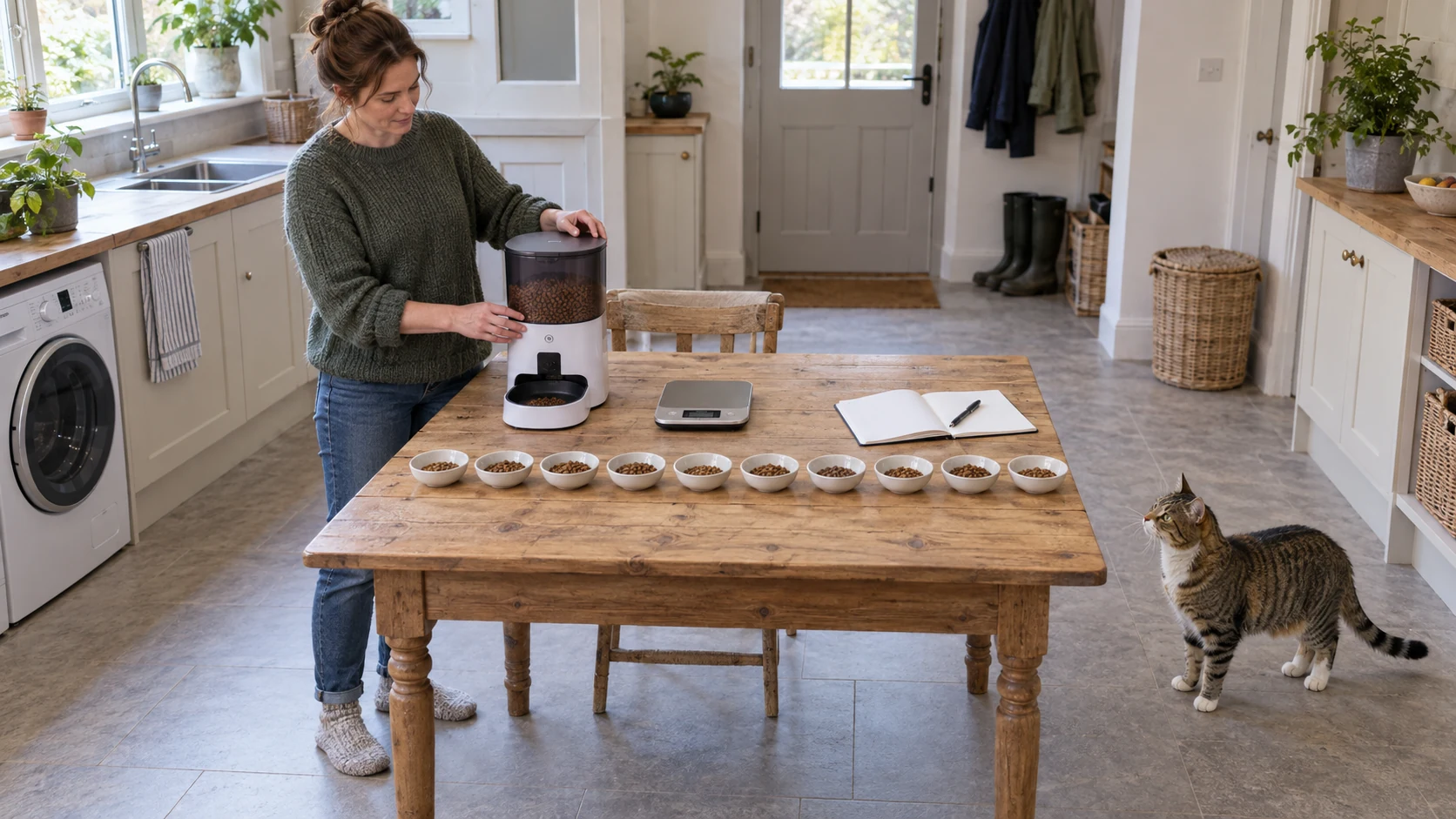
Run the dry bench test before the feeder controls a real meal. For a timed feeder, measure all ten releases and keep every zero; for a gravity feeder, document ten controlled refill cycles. Do not withhold food, alter a medical plan or damage a device to create a failure.
- 01
Import the feeding plan
Record the food, daily amount, source and whether free access or release times are intended. If the plan is therapeutic, medicated or changing because of illness, stop and ask the veterinary team before changing delivery.
- 02
Pin the exact food path
Identify hopper, rotor or conveyor, chute and bowl. Read the current manual for permitted food format and dimensions; do not assume a category page or another generation uses the same mechanism.
- 03
Test the mechanism ten times
Timed feeder: tare one dry bowl, command the same unit ten times, weigh each result and keep every zero. Gravity feeder: away from the cat, remove a small controlled mass from the bowl ten times and record whether the outlet clears and returns food to an accessible level.
- 04
Repeat near the documented low-food boundary
Without starving the cat or leaving the instructions, repeat the timed release series or gravity refill cycles near the manual’s low-food condition. Keep full- and low-hopper records separate so the effect of food level remains visible.
- 05
Challenge only applicable failures
For either mechanism, inspect bridging, stability, access and recovery. For a timed model, also follow the manual while checking permitted mains loss, battery behaviour, unavailable Wi-Fi and clock restart. Never force a mechanism or insert a hand where it can move.
- 06
Observe access separately
Record when food became available, who approached, whether another cat blocked or stole it, and what remained. A camera event, empty bowl or dispenser log is not proof of eating by the intended cat.
- 07
Audit cleaning and storage
Disassemble only as directed. Confirm every food-contact part can be inspected, cleaned and fully dried, retain the food bag or lot details, and avoid topping a dirty hopper with a new bag.
- 08
Run a monitored home trial
Keep the familiar safe feeding route while the new system earns trust. Compare the observed range with the tolerance in the existing plan, monitor weight and appetite, and preserve an immediate fallback.
Do not collapse the evidence
Trace all six events to the intended cat
Planned
The label or veterinary team supplies a starting amount and monitoring context.
Loaded
The hopper receives a known food and mass, with bag and lot identity retained.
Released
Food physically reaches the bowl; a command or notification alone is not enough.
Accessible
The intended cat can approach without blockage, fear or another cat controlling the bowl.
Removed
Food leaves the bowl through eating, theft, spill, disposal or human action.
Eaten
Only observed or otherwise attributable consumption supports an intake statement.
If the chain breaks at access or identity, continue with the microchip-versus-collar-tag selective-feeder guide. If it breaks at bowl evidence, the camera-feeder comparison explains what a scale, image or timeline can actually support.
Failure is part of the product
Test discovery and recovery, not just backup power
A battery can keep a motor alive while an app, alert or camera is unavailable. Conversely, a local schedule may continue when Wi-Fi is absent. The exact model, firmware, regional plug and manual decide; category assumptions do not.
The no-unattended-days rule
A feeder is not a sitter, health check or clean bowl
Cats Protection advises that cats still need daily human care and more frequent checks when young, elderly or medically complex. Treat any quoted time as that organisation’s general advice, not permission generated by hopper capacity.
FDA guidance supports retaining the original food bag or its UPC, lot, product, manufacturer and best-by information; keeping dry food cool and dry; washing and drying storage containers between bags; and washing and drying food bowls and utensils after use.
Contact a veterinarian for a new appetite change, vomiting, unexplained weight change, weakness, difficulty eating or a medical feeding question. Do not solve a symptom by silently changing access or portion timing.
Direct answers
Gravity and automatic cat feeder FAQ
Is a gravity feeder or automatic feeder better for cats?
Neither is universally better. A gravity feeder fits only when continuous free access to dry food is already appropriate and observable. A timed feeder fits when known release opportunities are needed and its real output, food compatibility, failure recovery and cat access pass a monitored test.
Does an automatic cat feeder prevent overeating?
Not by itself. It can limit scheduled release opportunities, but output may differ from the programmed unit and food in an open bowl can be stolen or eaten later. The feeding plan, measured output, access and body-condition monitoring still matter.
Are automatic feeder portions measured in grams?
Do not assume so. Current manufacturer examples may programme cups, fractions of a cup or proprietary portions, and the weight depends on the exact kibble. Read the manual and weigh at least ten real releases with the food you use.
Can a gravity feeder control a cat’s daily ration?
Loaded food minus the later remainder can estimate how much left the system, after accounting for spills and discarded food. It does not prove how much one cat ate unless access and eating were controlled or directly observed.
Will a timed feeder work if Wi-Fi goes down?
It depends on the exact model, firmware, stored schedule and power state. Some functions may continue locally while remote controls or alerts do not. Verify the current manual and test the permitted offline condition before relying on it.
Can I leave my cat alone for days with an automatic feeder?
No feeder is a substitute for in-person care. A person still needs to check the cat’s health and appetite, refresh water, maintain litter, inspect the food and recover a device failure. Arrange care based on the individual cat’s needs.
Which feeder is best for two cats on different diets?
An ordinary gravity hopper and an ordinary timed bowl do not identify or exclude a cat once food is accessible. Different diets, theft, bullying or individual weight plans point to a selective-access system and separated resources.
Can these feeders hold wet cat food?
This comparison is for dry kibble. Wet food creates a different temperature and time-control problem; use a system designed for that format and follow food-safety and veterinary guidance rather than improvising with a dry hopper.
How do I test automatic cat feeder accuracy?
Use the exact kibble, tare one scale and bowl, weigh ten identical releases with a full hopper, retain zeros and partial releases, then repeat near the documented low-food boundary. Report the range and median as well as the mean.
How often should a cat feeder be cleaned?
Follow the exact product manual and the food’s handling requirements. FDA guidance says food bowls, scoops and measuring utensils should be washed and dried after each use; food storage containers should be washed and dried between bags.
Source ledger
What supports each part of the decision
Clinical and welfare guidance defines the feeding and care boundaries. Studies carry their population, design and conflict limits. Manufacturer pages establish only model-specific mechanics. Accessed 9 September 2026.
- FelineVMA: Feline Feeding Programs consensus statement Individualised programmes, solitary feeding, foraging, small meals and the conditional role of automatic feeders.
- AAHA/AAFP: Nutrition and Weight Management Individual factors that precede a specific feeding plan; industry-grant support disclosed on the guideline page.
- Witzel-Rollins et al.: Separating automatic feeder and meal frequency Twenty-three overweight cats, specific RFID feeder, two versus six meals, owner experience and important transfer limits.
- Eyre et al.: In-home feeding patterns of ageing cats Food-format associations in 134 cats; short observation and Mars Petcare employment declared.
- FEDIAF: Maintaining a healthy weight for your cat Ad-libitum caution for obesity-prone cats, scale-versus-cup precision and monitoring context.
- FDA Center for Veterinary Medicine: Proper storage of pet food Bag and lot traceability, dry storage, container turnover, bowl and utensil cleaning.
- AAFCO: Reading pet-food labels Feeding directions as adjustable guidelines and calorie content per kilogram plus a familiar unit.
- Cats Protection: Leaving a cat alone General human-care, food, water and litter boundaries; individual cats may require more frequent attention.
- PetSafe: Healthy Pet Food Station Primary example of a gravity mechanism, capacity, materials, indoor use and disassembly claims.
- PetSafe: Healthy Pet Simply Feed support Primary example of cup-based programmed portions, food-size claims, batteries, cleaning and error support.
- PETLIBRO: Granary Wi-Fi feeder support Primary example of model-specific kibble and backup-mode constraints; not independent performance evidence.