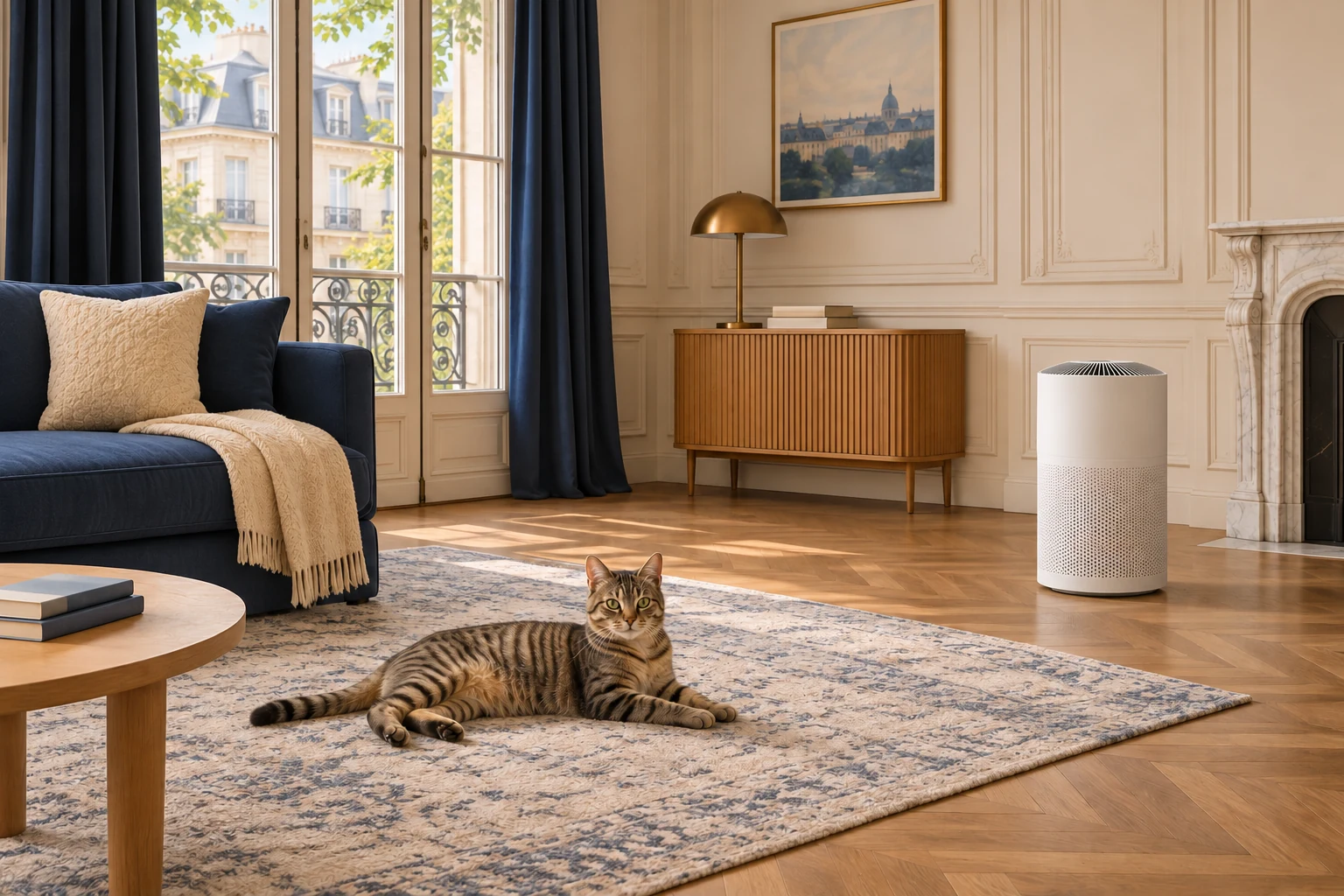
The answer in 30 seconds
Start with documented filtration. Check electronic features separately.
For a cat household with an airborne-particle concern, a mechanical-filter purifier is the simpler option to verify. That is our buying approach, not a claim that we measured every competing technology. Confirm the model, useful airflow and maintenance before purchasing.
A combined HEPA-and-ionizer device is not automatically an intentional ozone generator. It needs its own emissions evidence and operating instructions. A filter badge alone does not answer those questions.
Do not shortlist an intentional ozone generator for an occupied home. The EPA advises against their use in occupied spaces. Nor should a purifier trial delay care for a cat struggling to breathe: Cornell treats difficulty breathing as a potentially serious clinical sign.
Check the evidence for your modelFour different machines can share a similar sales description.
HEPA describes physical particle filtration. It does not tell you whether an additional electrical stage is inside the appliance. Equally, “ionizer” does not tell you whether there is a fan, a collector or a separate filter. Start with the manual's description of the whole machine.
| Device type | What it does | Your next check |
|---|---|---|
| Mechanical filtration | A fan moves air through physical filter media. | Particle performance, filter fit and the required replacement reference. |
| Stand-alone ionizer | Charges particles; collection may occur on a device collector or room surfaces. | Where particles end up, emissions evidence and maintenance. |
| Filter plus electronic stage | Combines physical filtration with an additional technology. | Exact mechanism, emissions record and performance in your chosen mode. |
| Intentional ozone generator | Purposefully produces ozone as its treatment method. | Exclude it from this occupied-home shopping comparison. |
The EPA explains that charged particles may deposit on surfaces and become airborne again. Some systems collect them within the unit. These are different maintenance situations, so a general “filter-free” promise is not enough to establish less work.
If your main problem is fur embedded in the sofa, first read air purifier versus vacuum for cat hair. This article addresses device technology, not which appliance cleans upholstery.
Three pieces of evidence answer different questions.
A certificate is useful when you know its scope. Match the full model identifier, including the regional suffix, rather than accepting a badge on a brand's general homepage.
| Evidence | What it establishes | What it does not establish |
|---|---|---|
| CARB listing | California certification; electronic devices meet a tested ozone limit of 0.050 ppm, or 50 ppb. | Pollutant-removal effectiveness, a zero-ozone claim or health safety. |
| UL 2998 validation | A zero-ozone emissions claim assessed against a 0.005 ppm, or 5 ppb, quantifiable detection threshold. | Literal absence of every ozone molecule, particle-cleaning output or feline health benefit. |
| AHAM particle CADR | A separate way to compare clean-air delivery for particle removal. | An emissions certificate, odour-removal result or medical outcome. |
CARB distinguishes mechanical from electronic devices in its registry. Its regulatory remit is California; do not present that listing as universal legal approval. UL validation is also model-specific. The numerical difference between thresholds is not a calculation of how much safer one purifier is for a cat.
For bipolar ionization specifically, EPA recommends a device meeting UL 2998 if you choose that technology. It also identifies evidence limitations and possible by-products. An ozone claim therefore leaves other performance questions open.
Be cautious with “EPA approved” wording. EPA says it does not certify or register air-cleaning devices or recommend their manufacturers. Ask what the seller's statement actually refers to.
If the feature switches off, check what remains on.
A switchable electronic stage gives you an operating choice. It does not document that choice by itself. Before buying, find the manual's explanation of the control, indicator and startup behaviour.
- Can the fan and filter operate with the electronic feature disabled?
- Does the indicator refer to ionization, an ordinary display light or something else?
- What happens after normal restart or loss of power?
- Does the published particle-performance figure apply in the intended configuration?
Do not assume the setting is remembered or that disabling a stage leaves the advertised maximum performance unchanged. If the manual does not answer, ask the manufacturer. Do not open the electrical housing, bypass components or modify a device to make it “mechanical”.
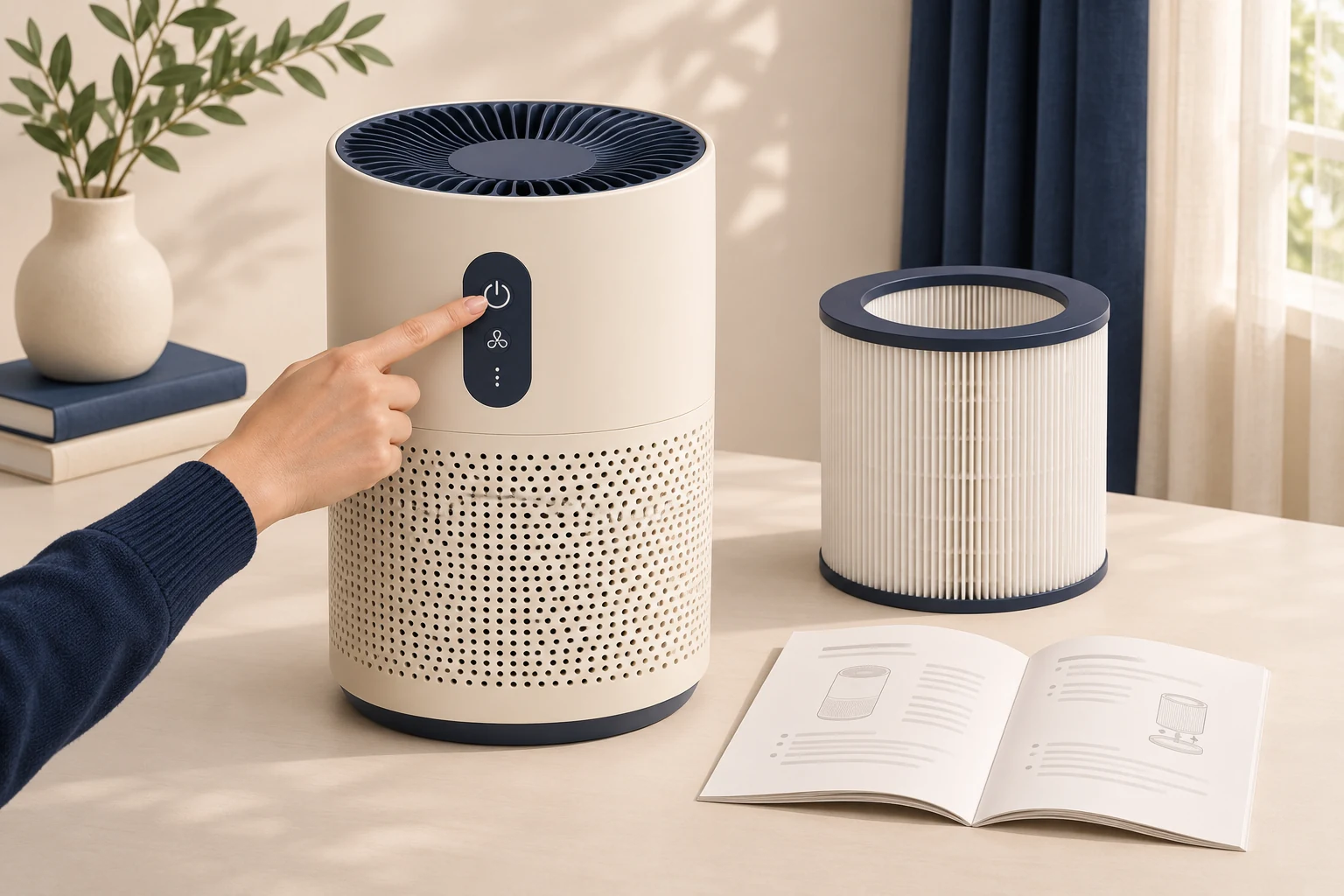
Original practical resource · Version 1.0
Make a record for one exact model.
Our worksheet separates missing information from an unfavourable finding. It cannot inspect the device, search a registry or authenticate a certificate. Its purpose is to show what still needs an answer before you compare products.
Mark only what you have documented. An unchecked item stays unresolved. Nothing is sent to us or looked up automatically; reloading clears this worksheet.
Pause the purchase comparison while these questions remain open.
- Match the full model reference and regional version to its manual.
- Identify the cleaning mechanism from the exact manual.
- Document the intended operating mode, relevant controls and restart behaviour.
- Find particle-cleaning performance for the mode you intend to use.
- Confirm the required filter or collector maintenance and local supplies.
The same check without the tool
Write down the full model and country, cleaning mechanism, matching emissions evidence where relevant, intended operating mode, performance evidence and maintenance supplies. Keep source links or manual page numbers beside each entry. Leave unavailable information explicitly marked unknown.
A useful manufacturer question is: “For this exact regional model, which stage produces ions, can it be disabled independently, what state follows a restart, and which clean-air delivery result applies with that stage disabled?”
Editors and carers may cite André Ribeiro, Félinscope, Exact-model air-cleaner evidence check, version 1.0, 14 November 2026, using this section link. No purchase, account or backlink is required to use it.
The same HEPA badge can lead to different next steps.
The evidence matches
A manual identifies physical filtration only. The exact replacement filter is available locally, and the published airflow information matches a setting the household can use.
Next: compare the device with the room and budget. This is still not proof that it will improve anyone's symptoms.
The brand badge is not enough
A combined unit advertises HEPA and a low-ozone claim. The certificate names a different suffix, and the manual does not explain the mode you want.
Next: obtain the matching documents. Missing evidence does not establish that it is hazardous, but it cannot support your intended purchase decision.
These examples are invented to explain the method. They contain no product measurements, market prices or implied recommendations. Adding a shopping link would not resolve either example's missing technical evidence.
The operating routine matters after the paperwork.
Read the manufacturer's clearance and cable instructions. Choose a stable position, protect the cord from damage and keep a quiet resting option accessible to the cat. An appliance that cannot be run at a usable setting may be a poor practical fit even when its documentation is complete.
Maintain filters and collectors as instructed. Wash only parts explicitly marked washable and follow the drying instructions. A visually similar replacement is not automatically the specified part.
Do not deliberately expose the cat to an unfamiliar electronic mode to “test tolerance”, and do not use smell to clear an ozone concern. EPA warns that odour is not a reliable indication of ozone concentration.
Filtration also leaves source control and suitable ventilation important. The EPA's household guide explains that relationship. For room requirements and recurring electricity/filter costs, use our separate running-cost comparison.
Shop after the missing evidence is resolved.
If a purifier still has a defined job, take your completed model record to the shortlist. Check the seller, regional electrical specification, return terms and replacement supply. Keeping a suitable existing machine is a valid outcome.
These optional country-labelled searches use our existing Amazon affiliate identifiers. Search wording does not verify results: listings may include electronic models, incompatible filters or unrelated accessories. Match every item to the exact manual.
As an Amazon Associate I earn from qualifying purchases. These country-labelled searches are not recommendations: verify the exact model, seller, price, delivery and return terms.
We have not verified individual listings' current prices, stock, emissions or performance. The official sources and registries above are ordinary references. See our affiliate policy.
Common questions
Can a HEPA air purifier also contain an ionizer?
Yes. A filter label describes one part of the system. Read the full model's mechanism and controls to determine whether an electronic stage is present.
Does CARB certification mean ozone-free?
No. The electronic-device limit and the UL 2998 zero-ozone claim threshold are different. Neither label alone establishes that a machine is suitable for every cat or household.
Does UL 2998 prove a purifier treats feline asthma?
No. It concerns an emissions claim, not treatment. Discuss respiratory problems and environmental management with a veterinarian; do not change prescribed care because of an appliance label.
Is switching the ionizer off enough?
It may remove that function from normal operation, if the exact model supports it. Confirm the control, restart state and remaining performance. A generic instruction from another model is insufficient.
Will a HEPA filter remove litter odours?
A particle-filter label is not evidence of gas or odour removal. Address the source. If the issue is a urine accident, our urine-cleaner comparison covers surface treatment.
Do I need to replace a working mechanical purifier?
Not simply because newer models advertise more stages. Check its condition, correct filters, documented output and suitability for the intended room before considering replacement.
Sources, method and limits
André Ribeiro prepared this documentary comparison from the primary references below, checked on 14 November 2026. No devices were physically compared; we measured no emissions, particle reduction, noise or health effects. No veterinary review is claimed.
The tables, worksheet and fictional examples are our editorial synthesis. The worksheet evaluates the completeness of your entries, not their truth. All three images are AI-generated illustrations of generic equipment. Certification details can change, so consult the current record for a purchase.
- US EPA: What is a HEPA filter? Physical filtration.
- US EPA: Ionizers and other ozone-generating air cleaners. Mechanisms and deposition.
- CARB: Certified air-cleaning devices. Model registry and certification limits.
- UL Solutions: Zero Ozone Emissions Validation. UL 2998 threshold and claim lookup.
- US EPA: Air cleaners, HVAC filters and respiratory viruses. Bipolar-ionization caveats.
- US EPA: Ozone generators sold as air cleaners. Exposure and interpretation limits.
- US EPA: Does EPA certify air cleaners? Endorsement boundaries.
- AHAM Verifide: Air Filtration Standards. Clean-air delivery.
- US EPA: Guide to Air Cleaners in the Home. Use and upkeep.
- Cornell Feline Health Center: Difficulty breathing. Veterinary-care boundary.
Read our review method or contact Félinscope with a correction or newer primary evidence.