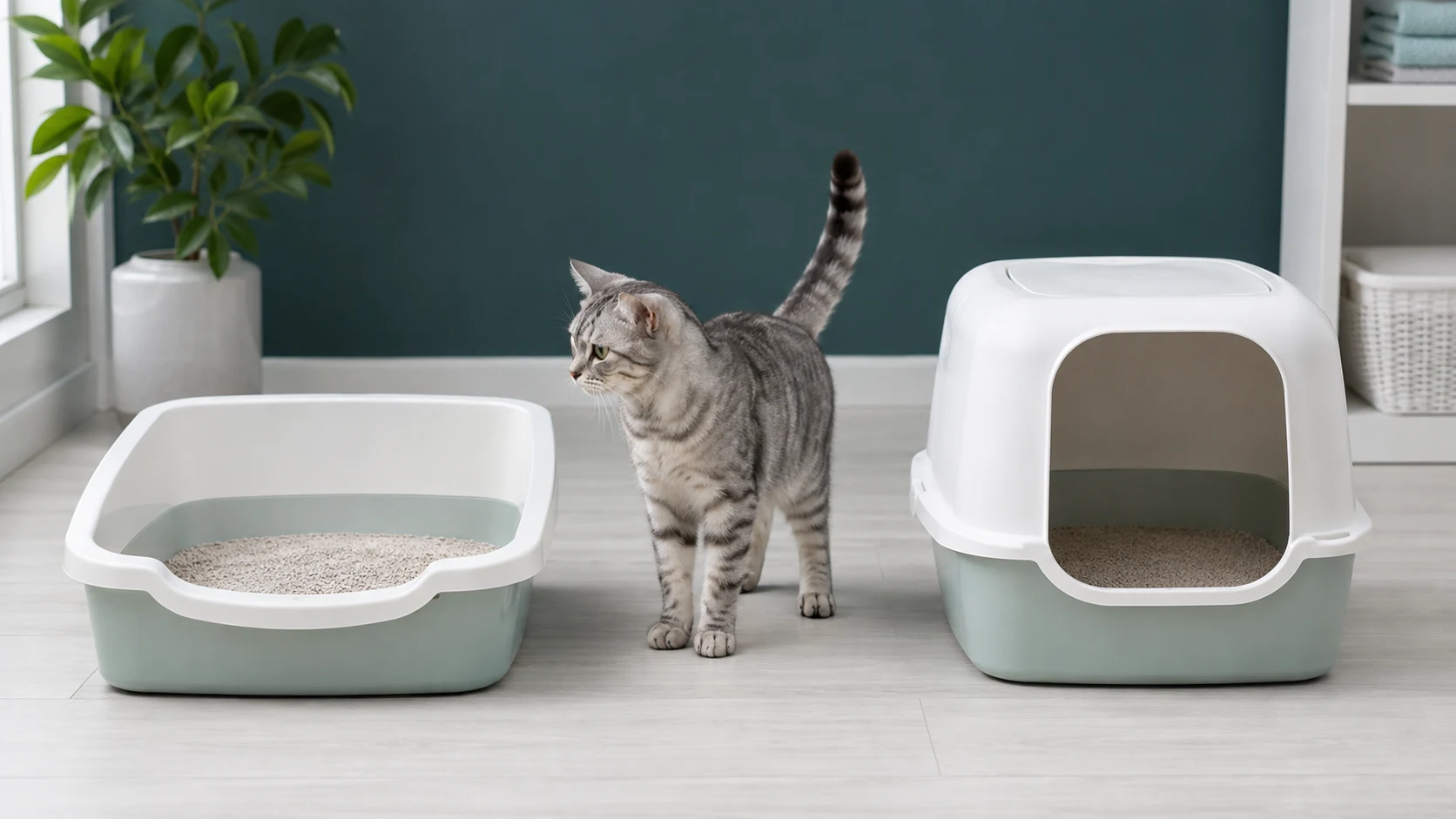
The answer in 30 seconds
There is no group winner. There may be an individual one.
A controlled 14-day study found no overall use difference between very large covered and uncovered boxes. Of 27 cats analysed, 19 showed no preference; four preferred covered and four preferred uncovered.
Start with fit and reliable use. An open box is the simpler default when a hood reduces space, adds a narrow door or leaves one easily blocked exit. A covered box remains a valid option when it is genuinely large, clean and confidently used.
Do not run a buying experiment during a toileting change. Pain, straining, blood, repeated attempts or little to no urine moves the decision to veterinary care.
Run the cover-isolation check ↓The study is more useful than the slogan, but narrower than most summaries. It tested the cover while deliberately controlling box size, litter, cleaning and position. A compact hooded tray with a flap is a different bundle of variables.
Controlled choice · reviewed 5 September 2026
Separate cover preference from room preference
A fair home trial keeps litter, usable floor area, cleaning and access comparable, then reverses the box sides. The logger below separates cover totals from a simple left-versus-right habit.
A hood is treated as the whole product
A commercial covered box can also change usable floor, entrance height, door resistance, seams and cleaning access, so privacy, odour and scatter are not the only variables.
The experiment disappears from the headline
The main study used unusually large matched tubs, equal litter, daily scooping and a position reversal. Its group result cannot validate every compact hooded model.
One week of choice needs a control ledger
Total cover choice separately from left-right location, and stop the trial if reliable toileting deteriorates.
Read the denominator
The famous result came from boxes larger than most shop shelves
Grigg, Pick and Nibblett built the pair from identical 82.5 × 50.2 × 47.3 cm storage tubs. The covered version kept its lid; the open version was cut down. Both used about 5 cm of the same litter, were scooped daily and switched sides after week one.
All had no elimination disorder in the previous 12 months.
Four preferred covered and four preferred uncovered.
The study boxes were larger than typical commercial trays.
The two box positions were switched after week one.
Whole-system comparison
Covered vs uncovered is eight decisions, not one
Use the category as a starting label. The exact interior, doorway, location and cleaning workflow determine whether that label is helpful.
| Decision factor | Covered | Uncovered | What actually decides |
|---|---|---|---|
| Usable interior | The hood can reduce headroom, turning clearance and the practical route through the entrance | The full space above the base remains available | Measure the inside with the hood fitted; do not compare exterior dimensions. |
| Sight and exit | A front opening narrows the visual field and concentrates the route in and out | The cat can usually look and leave in more directions | Audit approach, body posture and whether another animal can block the route. |
| Cleaning visibility | Waste can be hidden from the caregiver until the hood is lifted | Deposits and litter condition are visible at a glance | Use a fixed daily schedule rather than memory or appearance. |
| Room odour | A hood may change where odour is noticed, but the key trial did not measure room odour | Air exchange is less obstructed, but this is not an odour-control guarantee | Scoop equally and judge the box interior and room as separate observations. |
| Scatter and high urination | Walls can contain some kicked litter; seams can become leak paths | Low walls expose the room; an open high-sided base can retain more without a roof | Choose wall geometry for the actual behaviour, not the word covered. |
| Access | Entrance height, tunnel length or a flap can add effort | A cut-down entry can be made very low | Prioritise kittens, senior cats, pain and mobility before tidiness. |
| Cleaning work | The hood, door, filter recess and seams add surfaces | Fewer parts are usually easier to inspect and wash | Time a complete empty-wash-dry-refill cycle before buying multiples. |
| Preference evidence | Some individuals prefer it; the study found no overall group advantage | Some individuals prefer it; the study found no overall group advantage | Run a matched choice only when both options remain reliably used. |
Interactive two-round logger
Did the cat choose the cover or the side of the room?
The tool checks the controls before reading the counts. It can return covered, open, location, mixed, unisolated or stop; it never forces a winner from incomplete evidence.
Prove that the hood is the variable
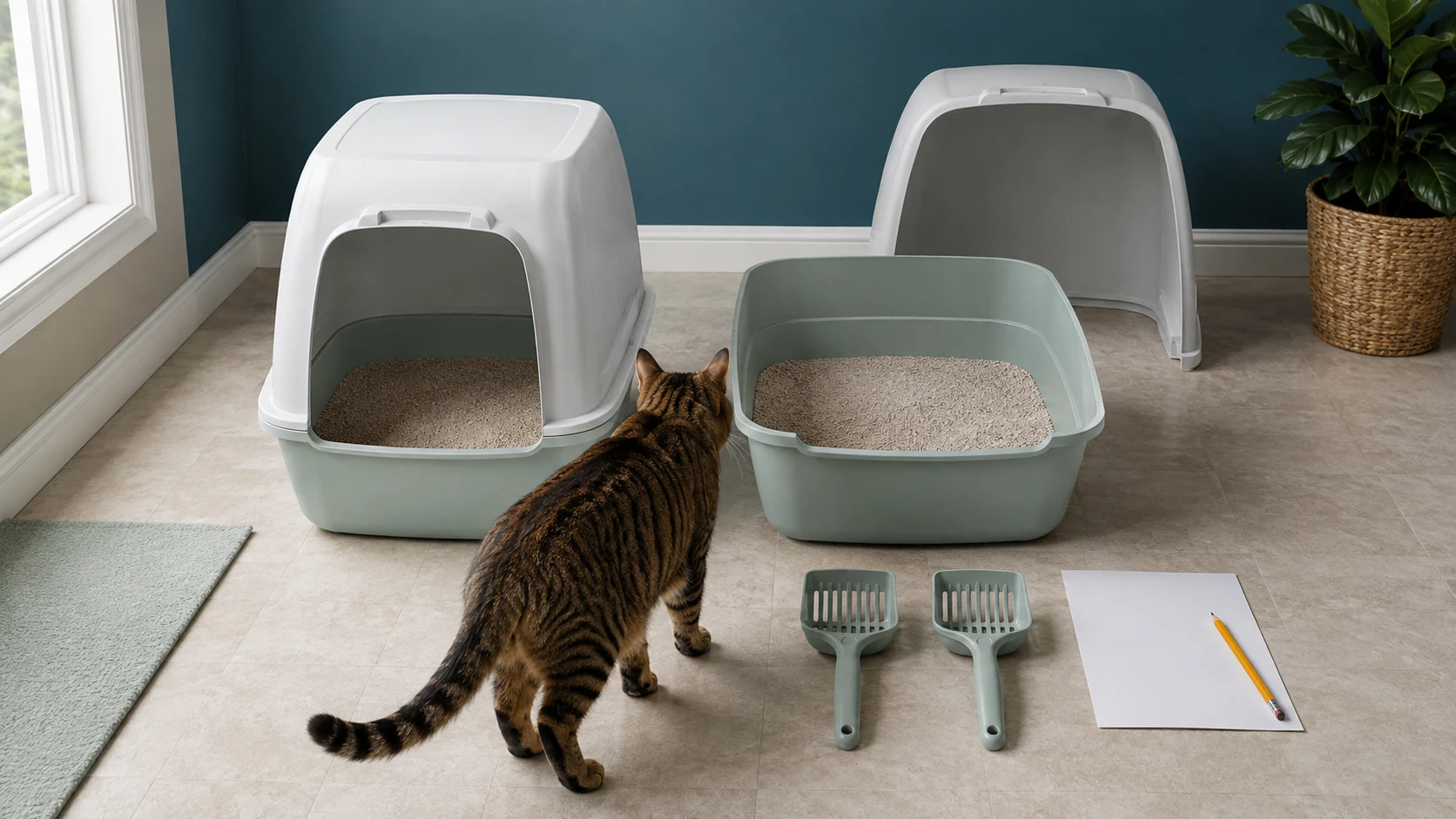
Use two equally large bases with the same litter and routine. Round one places covered left and open right; round two reverses those positions.
A cautious 14-day home protocol
Change the hood and box position while keeping everything else steady
This protocol adapts the published paired-box design for household observation. It is deliberately conservative and cannot reproduce a controlled study.
- 01
Pass the fit gate
Use two large matched bases. With the hood fitted, confirm that the cat can enter, turn, dig, posture and leave without compressing the body or touching a restrictive doorway.
- 02
Remove the flap
A swinging door is a second variable. Test the hood first with a wide unobstructed opening; evaluate a flap only after the box is already accepted.
- 03
Hold the routine still
Use the same familiar unscented litter, depth, scoops and cleaning times. Do not add deodoriser, liner or a new room during the comparison.
- 04
Record round one
Place covered left and open right. Count urine and stool deposits, rapid exits, edge balancing, aborted approaches and any elimination elsewhere.
- 05
Reverse the positions
After stable use, place open left and covered right. Keep every other practical condition unchanged and never block access to the familiar accepted setup.
- 06
Read two signals
A style that wins on both sides is a cover signal. A side that wins after the reversal is a location signal. A mixed result does not require a winner.
The room is part of the box
Mobility and social access can overrule the cover result
A box that is accepted in isolation may still fail when stairs, a high entrance or another cat controls the approach.
Lower the entry before adding privacy
Guidelines emphasise easy entry for cats with limited mobility. If a hood requires a tall or tunnelled threshold, the enclosure question comes second.
Open the life-stage guidanceCount routes, not just boxes
Separated resources reduce the chance that one cat can stare, stalk or block another. Two boxes touching each other do not create two independent safe locations.
Open the intercat tension guidanceMeasure inside the hood
The covered-box study intentionally removed size as a confounder. A 2025 study also found preference for boxes measuring at least 50 cm over smaller options in its sample.
Open the 2025 study recordFor urine that has reached the carpet or floor outside the tray, see our enzyme cleaner versus vinegar comparison. It checks surface compatibility and exact product instructions, a separate task from routine box washing.
Caregiver observability
A lid can hide the reminder without removing the waste
Set the cleaning schedule before deciding whether either box controls odour. The published cover study maintained daily scooping; the FelineVMA guidance recommends removing waste at least daily.
Remove deposits and inspect use
Record changes in deposit pattern, litter condition and hesitation. A cover should never make the box invisible to the person responsible for it.
Wash every surface you bought
Count the hood, entry rim, door pivots, filter recess, seams and base. Follow the product instructions and rinse and dry fully.
Keep the hygiene boundary explicit
CDC advises changing litter daily and washing hands. Pregnancy or reduced immunity calls for personal medical guidance, not a different marketing claim.
Read CDC prevention guidanceDirect answers
Covered vs uncovered litter box FAQ
Do cats prefer covered or uncovered litter boxes?
There is no universal winner. In a 14-day study of 27 analysed cats using very large matched boxes cleaned daily, 19 showed no preference, four preferred covered and four preferred uncovered. Individual fit and management still matter.
Are covered litter boxes bad for cats?
Not automatically. A covered box can work when it is large enough, easy to enter, kept clean and confidently used. The risk is treating a compact hood, door flap or single exit as harmless without checking the individual cat and household.
Do covered litter boxes control odour better?
A cover may change where people notice odour, but the main covered-versus-uncovered study measured box use, not room odour. Daily waste removal, litter condition, ventilation and full cleaning are separate variables.
Should I remove the door from a covered litter box?
Remove the flap during an initial cover comparison. A swinging door changes resistance, noise and visibility, so leaving it attached prevents the trial from isolating the hood itself.
What size should a covered litter box be?
Measure usable interior space with the hood attached. Feline guidelines recommend a rectangular box around one and a half times the cat's length from nose to base of tail; a corrected guideline cites 86 × 39 cm as a preferred larger option in one study.
Is an uncovered box better in a multi-cat home?
An open box can improve sightlines and exit options, but the room route and resource distribution matter too. Provide separated resources so one cat cannot stare at, stalk or block another at a single litter station.
How do I test covered versus uncovered without confusing location?
Use matched large bases with the same litter and cleaning. Start with covered left and open right, then reverse the positions. Compare cover totals with left-right totals and stop if any cat avoids both boxes or soils elsewhere.
When should I stop changing litter boxes and call a veterinarian?
A sudden toileting change, repeated attempts, pain, crying, blood, constipation, reduced mobility or little to no urine needs veterinary assessment. Do not continue a preference experiment while a medical cause is possible.
Where can I compare current covered and open litter boxes?
Félinscope provides separate Amazon category searches for France, Belgium, the United States, Canada, the United Kingdom and Ireland. They are optional shopping routes, not ranked products; verify usable interior dimensions, entrance, seller and returns.
Evidence, attribution and limits
The cover result is only as portable as its conditions
Primary studies answer narrow questions. Veterinary guidelines translate evidence and clinical experience. Neither turns a category label into a guaranteed outcome for one cat.
- Grigg, Pick and Nibblett: covered versus uncovered litter-box preference · full five-page comparative study, including dimensions, cleaning, side reversal, results and limitations.
- PubMed record for the covered-box study · authorship, DOI, abstract and conflict-of-interest statement.
- AAFP/ISFM house-soiling guidelines · litter-box optimisation, individual choice and clinical framework.
- Corrected litter-box size statement · 1.5-times cat-length recommendation and cited 86 × 39 cm larger box.
- 2021 AAHA/AAFP Feline Life Stage Guidelines · separate preference choices, daily scooping and accessible entries.
- Iwabuchi-Inoue et al., 2025 · box-size and litter preference study; one author affiliation with a pet-products company is visible in the record.
- 2024 AAFP Intercat Tension Guidelines · resource separation and recognition of subtle blocking or competition.
- Cornell Feline Health Center: house soiling · medical, box-aversion and location-preference boundaries.
- CDC: preventing toxoplasmosis · daily litter change and hand-hygiene guidance.
Evidence review completed 5 September 2026. No physical box, odour, leakage, scatter or long-duration product test was performed. Dimensions, availability, prices and product instructions can change.