The answer in 30 seconds
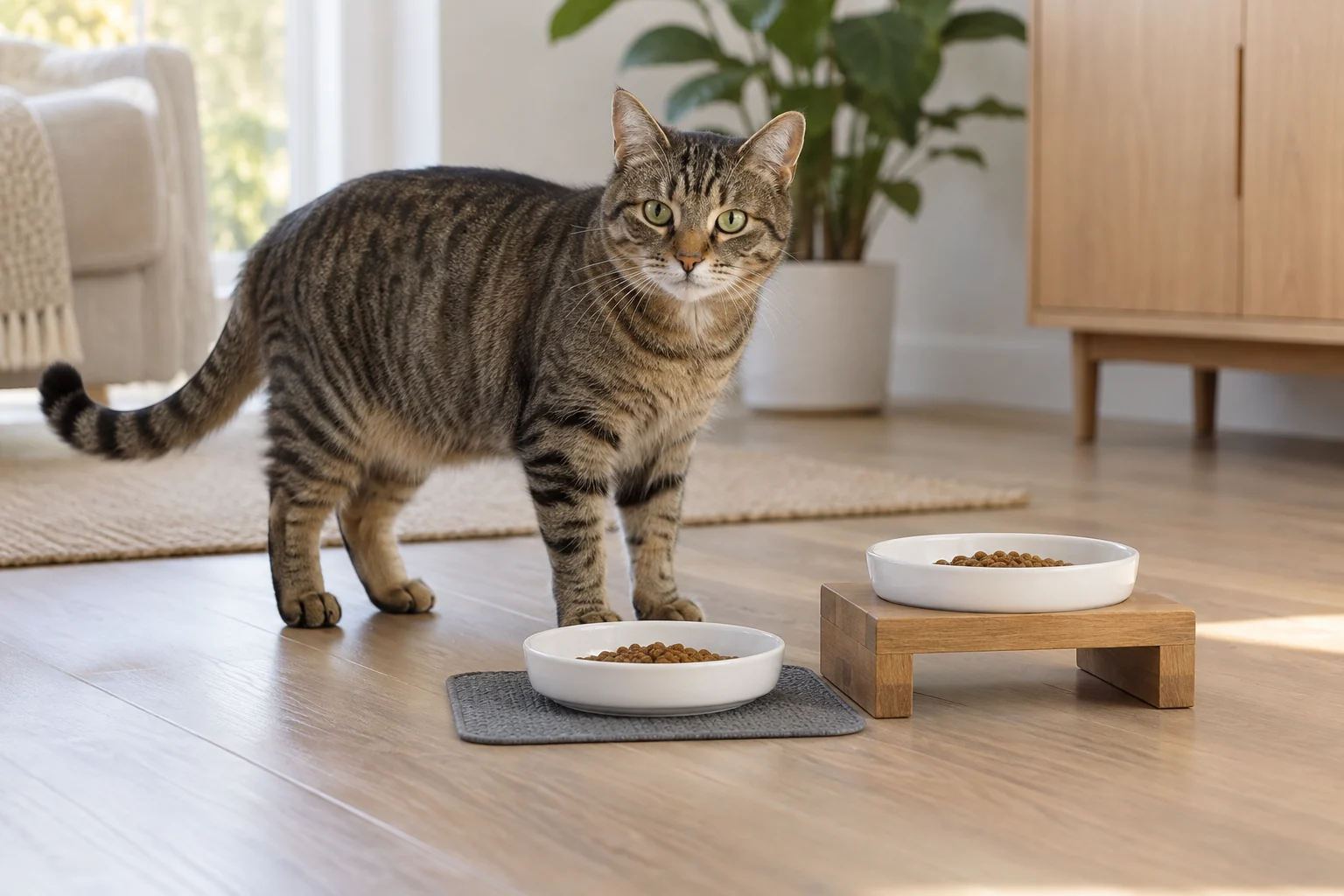
Keep a comfortable floor dish. Lift it when access, rather than marketing, calls for it.
A well cat eating easily does not need a mandatory raised bowl. For a cat with arthritis or painful bending, a low and stable elevation may make feeding more accessible; veterinary guidance treats this as an individual accommodation, not a universal digestive improvement. International Cat Care and FelineVMA both put comfort and access first.
Do not buy a stand as a vomiting remedy. Persistent vomiting, poor appetite or new movement difficulty changes this from a shopping question to a veterinary one. Cornell explains the warning signs.
See the same-dish check ↓The missing variable in a typical comparison
Most “raised versus regular” photos change more than height.
A raised set may also have a narrower dish, a deeper rim, a sloped surface, a new smell, a different material or a new feeding location. If a cat prefers one arrangement, none of those changes alone identifies the cause. The useful question is narrower: with the same familiar dish and food, does a safe change in height improve this cat's access?
Same dish and place
Keep width, rim, material, food, portion and location familiar. Height is the only planned change.
Comfort and intake
Record voluntary approach, posture, food actually eaten and avoidance, not a promise on the box.
Health overrides shopping
Do not re-test a painful floor position or delay care for vomiting, appetite loss or new difficulty moving.
This page isolates food-dish height and access. For difficulty obtaining food from an enrichment device, read puzzle feeder vs slow-feeder bowl. For drinking-source choice, read cat water fountain vs bowl. Neither article answers this height question.
Floor, low lift, observable next step
There is no one-height-fits-all winner.
The distinctions below describe plausible access and setup trade-offs, not results measured in a controlled head-to-head trial.
Scroll the table horizontally on a narrow screen →
| Decision factor | Floor-level dish | Low raised dish | What to check |
|---|---|---|---|
| Access when bending hurts | May ask a cat with reduced mobility to crouch farther than is comfortable. | A modest, steady lift may make the familiar food easier to reach. | Watch voluntary approach, posture and actual intake; discuss a new difficulty with a vet. |
| Otherwise comfortable cat | A stable, familiar floor dish remains a valid choice. | No established blanket benefit or mandatory upgrade for every healthy cat. | Do not infer a medical advantage from a product photo or bowl-height number. |
| What changes in a bowl set | Dish width, rim, texture and location may already suit the cat. | Commercial sets often change height and the dish at once. | Keep the exact same shallow dish and feeding place if comparing heights. |
| Movement and cleaning | Can slide if light; still needs routine cleaning and an undisturbed location. | A narrow, rocking or hard-to-wash riser can create a new problem. | Test the whole assembled setup with gentle hand pressure before serving. |
Original, reversible household check
Move the same dish, not the goalposts.
This is an observation plan for an otherwise well cat, not a clinical test. Do not withhold a meal, force a posture or repeatedly move food away from a cat with known pain. Start by watching an ordinary familiar meal.
- Baseline: note the dish, food, portion, usual location, voluntary approach, posture, food left and whether the dish moves.
- One change: place that same clean dish on a broad, non-slip, modest riser in the same location; preserve normal access to food and water.
- Observe, then reverse if needed: note whether eating seems easier, unchanged or less comfortable. Stop if the cat avoids food or the stand rocks. A single meal does not prove a medical effect.
- Decide locally: keep the arrangement this cat uses comfortably. If the reason for changing height was new pain, vomiting or loss of appetite, ask a vet rather than extending the experiment.
FelineVMA feeding guidance also reminds us that location, social access and individual preference matter. A quieter feeding place may be the more important change for some households.
When elevation has a credible job
For painful bending, accessibility matters more than a fashionable angle.
International Cat Care's home-modification guide notes that cats with osteoarthritis may prefer a raised bowl when crouching hurts, while also recommending accessible feeding stations and easy routes. FelineVMA senior-care guidance mentions wide, low-sided bowls and possible elevation for painful bending. Neither source requires a specific stand height or claims that every older cat benefits. Read the home-modification guide; read the senior-care guidance.
Keep the route to food easy and the dish familiar. If mobility is already impaired, the aim is to accommodate the cat, not to prove a before-and-after result by making it crouch again. New trouble reaching, eating or moving should be discussed with the veterinary team. FelineVMA's chronic-pain resources reinforce individual adjustment.
Medical boundary
A bowl cannot tell you why a cat vomits.
Claims that an elevated dish will prevent regurgitation or treat reflux do not follow from the primary guidance reviewed here. Cornell advises prompt veterinary evaluation when a cat vomits more than once a week, or vomiting is accompanied by lethargy, weakness, reduced appetite, blood, changes in thirst or urination, or diarrhoea. Read Cornell's clinical guidance. If a cat cannot keep food down or looks unwell, do not wait for a product experiment.
For a cat who eats too fast but is otherwise well, height and eating pace remain different mechanisms. Our feeding-pace comparison addresses access and intake without turning a slower meal into a medical diagnosis.
The whole feeding station
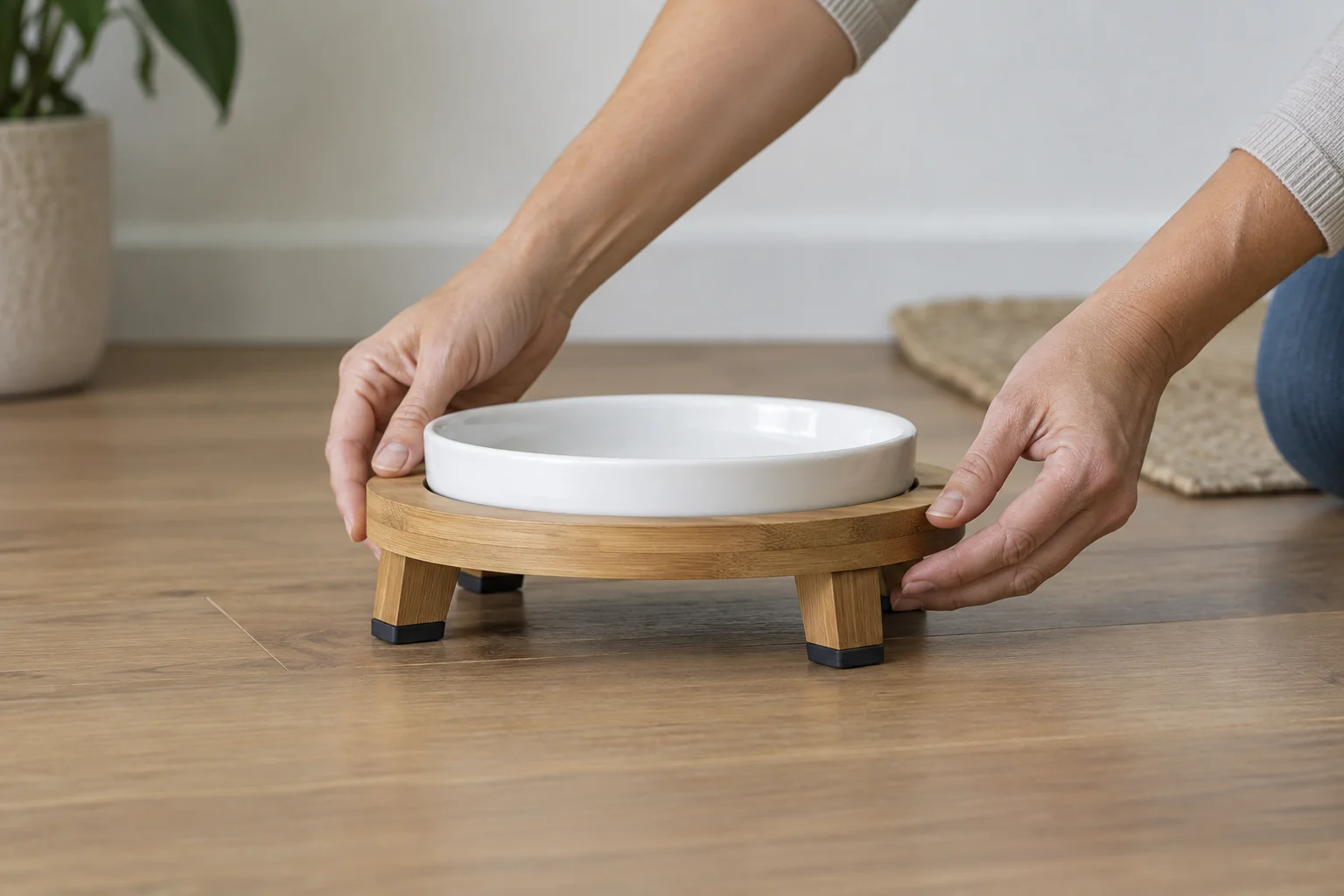
A useful lift must stay still.
- Use a broad base that holds the full dish, with non-slip contact and a surface you can clean.
- Check the assembled stand for rocking or sliding before adding food; recheck after cleaning.
- Keep a shallow, accessible rim if it already suits the cat. Do not add tilt, deep sides and elevation in one unexplained swap.
- Leave a comfortable approach and separate fresh water access; avoid crowding the dish into a stressful location.
- Do not chase an advertised “ideal height.” Observe natural posture and intake in this cat, and involve a vet if access is difficult.
On-page decision aid · no data stored
Bowl Height Check: find the first useful action.
Answer four simple setup questions. This tool cannot diagnose pain, certify a product or replace veterinary care. It changes only the message you see on this page.
Complete the four checks before drawing a conclusion.
This private on-page aid does not diagnose a cat or measure clinical benefit. Nothing is stored or sent.
Evidence ledger
Separate supported access advice from unproved product promises.
The sources reviewed support individual adaptation for painful bending and careful attention to feeding access. They do not establish a universal bowl height, prove improved digestion in healthy cats or compare named current stands in a controlled trial.
Scroll the table horizontally on a narrow screen →
| Primary source | What it supports | What it cannot prove |
|---|---|---|
| International Cat Care · home modifications | Accessible feeding stations for reduced mobility; some cats with osteoarthritis prefer a raised bowl because crouching can hurt. | Does not establish an ideal centimetre height, a general benefit for every cat or an anti-vomiting treatment. |
| FelineVMA · senior care guidelines | Wide, low-sided bowls and possible elevation when bending is painful; eating difficulty calls for veterinary assessment. | Care guidance, not a controlled trial ranking raised against floor dishes. |
| FelineVMA · chronic pain patient support | Height, accessibility and the cat's food-serving preference can be adapted when pain limits movement. | Does not prescribe one stand, product or measured height for all cats. |
| Cornell Feline Health Center · vomiting | When recurring vomiting or accompanying illness signs merit prompt veterinary evaluation. | Does not validate changing dish height as a diagnosis or treatment. |
| FelineVMA · How to Feed a Cat consensus | A safe feeding location, individual preference and access to food matter independently of the bowl. | Does not isolate bowl height or show that elevation improves digestion. |
Optional research after the access check
Look for the dish you need, not a cure in a listing.
These are direct, country-labelled category searches, not rankings or endorsements. Marketplace results change. Check dish width and depth, stand stability, material, cleaning instructions, actual dimensions, seller, price, delivery and returns before choosing an exact item.
As an Amazon Associate I earn from qualifying purchases. These optional country-labelled category searches are not recommendations. No dish, stand or marketplace result has been physically tested or ranked by Félinscope; a listing cannot establish a medical benefit. Verify the exact item, seller, size, cleaning, price, delivery and returns.
Direct answers
Elevated cat bowl FAQ
Are elevated cat bowls better than floor bowls?
Not universally. A floor-level dish can work well for a comfortable cat. A low, stable raised dish may help a cat for whom bending is painful or difficult. Keep dish shape, food and location in view, and ask a veterinarian about a new mobility or eating change.
Will a raised cat bowl stop vomiting?
There is no reliable basis in the primary guidance reviewed to promise that bowl height treats vomiting. Repeated vomiting, or vomiting with weakness, lethargy, reduced appetite, blood, changed thirst or urination, or diarrhoea, needs prompt veterinary advice. Do not replace assessment with a purchase.
How high should I elevate my cat's food bowl?
The veterinary sources reviewed give no universal height in inches or centimetres. If elevation is useful, begin with a modest, stable lift that allows this cat to eat without awkward neck extension, keep the familiar dish and watch access and intake. Ask your veterinary team about individual mobility needs.
Can an older cat benefit from a raised bowl?
Possibly, especially if painful crouching or reduced mobility makes the food difficult to reach. International Cat Care and FelineVMA describe feeding-area adaptations for those situations. Age alone is not proof of benefit; difficulty eating or new pain deserves veterinary assessment.
Should I buy a tilted or whisker-friendly bowl at the same time?
If your question is height, changing tilt, rim width, material and location simultaneously makes the result hard to interpret. First keep the same wide, shallow, washable dish and change only its supported height. Later evaluate any other design change separately.
What if my cat ignores the raised dish?
Keep the familiar food available and do not force a switch. Check stability, smell, dish shape and location before assuming the height is the cause. Return to the familiar arrangement if the cat avoids food; seek veterinary advice if appetite or behaviour changes.
Primary-source ledger · checked 13 September 2026
Read the evidence in its actual scope.
Veterinary and cat-welfare guidance informs the access and health boundaries. The same-dish observation plan is our editorial decision method, not a claimed published experiment.
- International Cat Care: Cat Caregiver Guide: Home Modifications (PDF)Accessible feeding for reduced mobility, including possible raised bowls when crouching is painful.
- FelineVMA: Senior Care Guidelines (PDF)Wide low-sided dishes, possible elevation for painful bending, and assessment of eating difficulty.
- FelineVMA: Chronic Pain Toolkit: Patient SupportIndividual food-access and environmental adjustments when pain affects ordinary behaviour.
- Cornell Feline Health Center: VomitingClinical warning signs and when veterinary evaluation is needed; not an endorsement of bowl-height treatment.
- FelineVMA: How to Feed a Cat consensus statementFood location, individual access and safe feeding context independent of dish height.