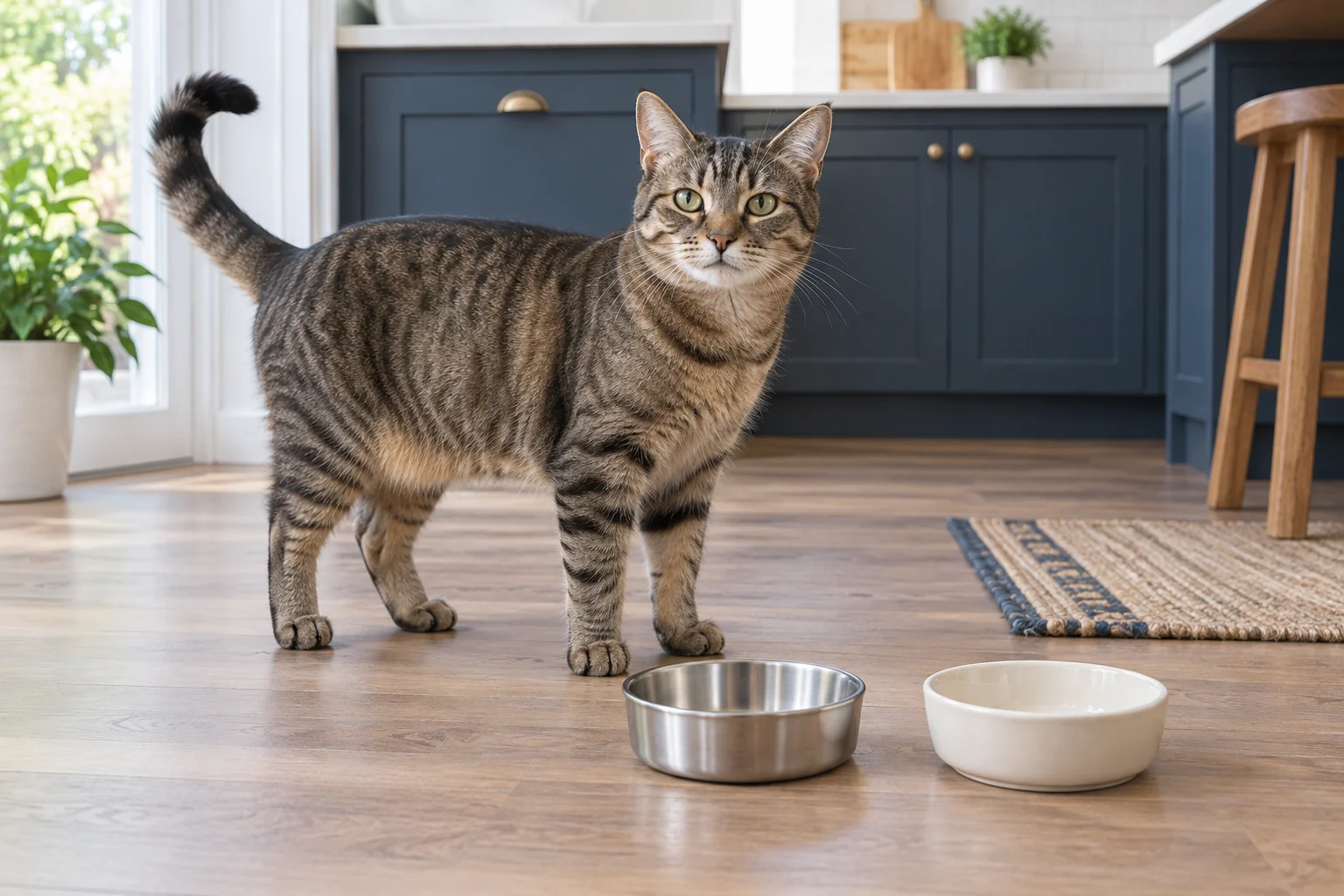
The answer in 30 seconds
Choose a maintainable dish, not a promise of perfect hygiene.
Stainless steel is a useful default for easy handling and resistance to breakage. Ceramic can be a good fit when an intact food-use dish offers a comfortable shape and useful weight. Neither material stays clean by itself.
Our deciding question is practical: can this exact bowl go from a finished meal through washing, rinsing, drying and inspection, then return ready for use? Check the base and rim, not only the visible interior. If your existing bowl meets that requirement and your cat eats comfortably, there may be nothing to buy.
Check the bowl you own ↓Two materials, several different jobs
Steel solves breakage. Ceramic may solve movement. Neither solves everything.
A material comparison becomes useful when you connect it to the problem in your home. A heavy dish that is hard to grip may be worse for one caregiver; a very light dish that skates across tile may be worse for another.
On a small screen, scroll the table sideways.
| Question | Stainless steel | Ceramic | Your check |
|---|---|---|---|
| Everyday handling | Often lighter and less vulnerable to a dropped rim. | Often heavier, which may help it stay put but can make washing awkward. | Can you lift, wash and return this exact dish comfortably? |
| Food-contact surface | Check the actual interior, seams and any coating, not just the word steel. | Check intended food use and an intact, smooth glaze. | Who made it, what is the food surface, and are care instructions available? |
| Damage | Look for a sharp dent, persistent corrosion or a failing coating. | Look for chips, cracks, rough edges or a network of fine glaze cracks. | Remove a damaged dish from feeding use; do not cover the defect with a mat or repair. |
| Stability | A light bowl may move; a washable mat or removable base can help. | Weight alone does not prevent rocking on an uneven base. | Try the complete empty setup on the actual floor before offering a meal. |
| Washing | A rolled rim or fixed rubber foot can hide residue. | An awkward foot ring or decoration can complicate cleaning. | Check the underside as well as the part that holds food. |
| Cat acceptance | Sound, reflections and movement may differ between dishes. | Rim shape, depth and surface feel may differ too. | A preference between two different designs is not proof of a material preference. |
This comparison concerns the dish material and its upkeep. For posture, use our elevated versus floor-level bowl guide. For drinking equipment, see fountain versus bowl. For meal enrichment, see puzzle feeder versus slow-feeder bowl.
Evidence, without the leap
Dog-bowl bacteria studies do not identify the healthiest bowl for cats.
“Hygienic” can describe an easy-to-wash design, a bacterial count after sampling, or a claim about illness. Those are three different things. A smooth-looking dish is not a laboratory result, and a lower count is not automatically a measured health benefit.
Ceramic was not sampled
Raspa and colleagues sampled 96 dog bowls: 48 metal and 48 plastic. Ceramic was excluded. Metal bowls had higher overall aerobic bacterial counts in this household sample, but material and washing habits were not randomised. This cannot establish that steel caused the difference, or rank steel against ceramic for cats.
A routine can change the result
The Luisana study followed 68 dog bowls from 50 owners, allocated to two hygiene-instruction groups and a control group. Bacterial counts fell within both instructed groups over roughly a week. It found no significant baseline material effect; only about one in ten bowls was ceramic. There were no feline or clinical outcomes.
Our conclusion is about usability, not sterilisation: prioritise a sound food-contact surface and a routine you can sustain. We found no basis in these two studies for a cat-specific clinical ranking of steel against ceramic.
Read the underside of the promise
Ask for evidence about the complete bowl.
Imagine a listing that advertises a steel grade but says nothing about the painted interior or fixed base. Another calls its ceramic glaze “lead-free” without identifying the maker. The missing detail is more useful than the headline claim.
Intended use
Look for a named manufacturer and a product intended to hold food. Decorative pottery is not feeding equipment. Keep the product reference and seller details.
Care instructions
Confirm which parts can go in a dishwasher, whether a base should be removed, and which cleaning products to avoid. Do not infer instructions from the material alone.
Usable geometry
Check interior width, depth, rounded corners and the actual base. An outside diameter does not tell you how much comfortable feeding space remains inside.
The FDA's traditional-pottery guidance highlights particular problems with unknown, decorative, damaged or poorly manufactured ceramics. It also explains that washing cannot remove lead from pottery. That is a reason to verify provenance, not to claim that every ceramic pet bowl is unsafe. A home look-and-feel check cannot certify chemical migration.
If the seller cannot explain the food-contact surface or permitted cleaning method, leave the question unresolved. A plausible photo, a magnet sticking to metal or a “premium” badge is not the missing documentation.
From the last mouthful to the next meal
Compare a complete wash cycle, not just a clean showroom bowl.
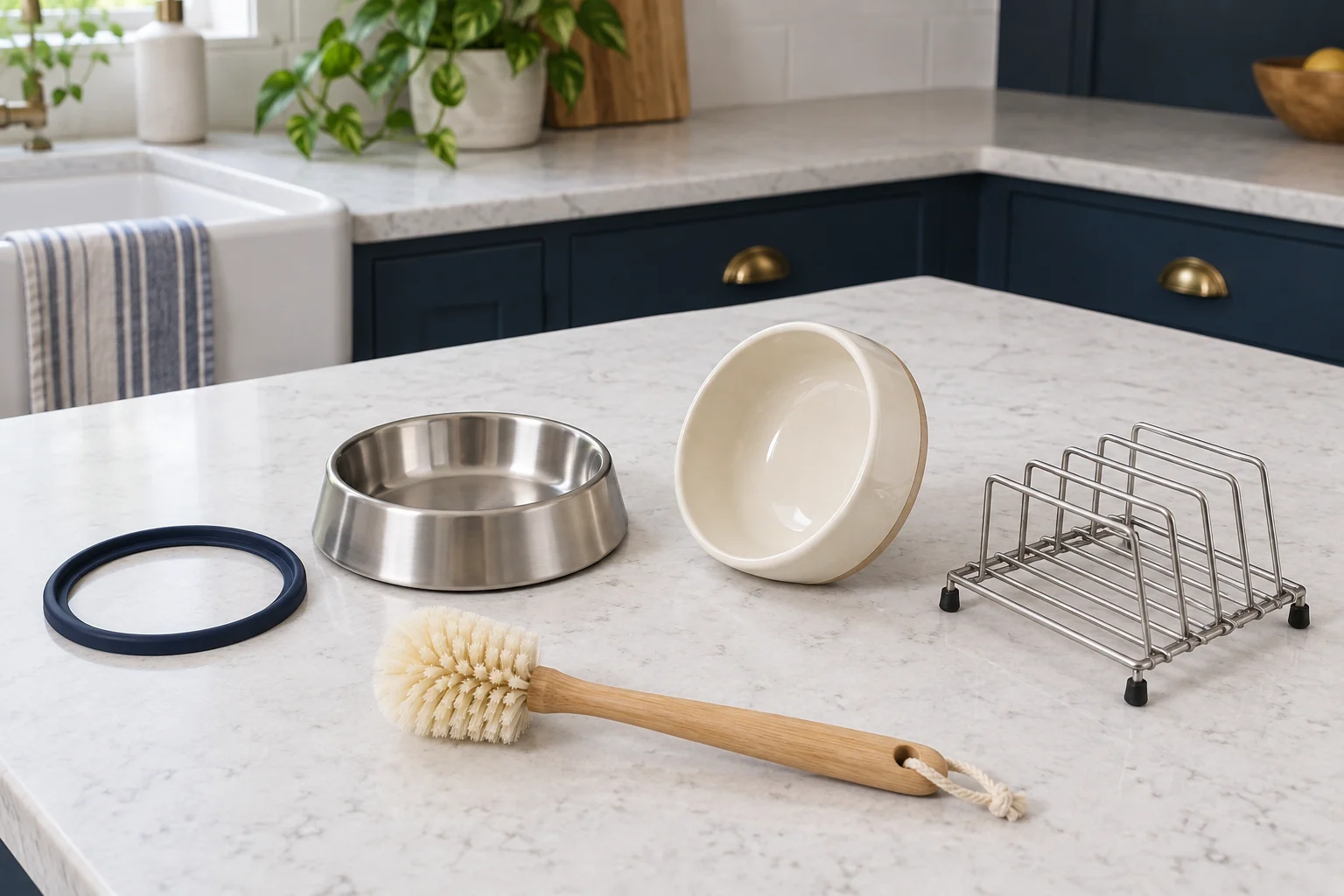
FDA recommends soap and hot water after each use of a food bowl. CDC's example schedule specifies every wet-food use and daily for dry-food and water bowls. A clean food dish for each meal is an uncomplicated approach; water containers need washing, not only topping up.
- Empty and separate. Remove leftover food. Take off removable parts only as the manufacturer directs. Check where residue collects.
- Wash the whole object. Reach the rim, underside and permitted base parts. Follow the product's care instructions, including any dishwasher restrictions.
- Rinse and dry. Remove detergent thoroughly and let washed parts dry before reassembly. Do not fit a wet ring over a damp recess.
- Inspect before reuse. Look under good light for damage, trapped residue, rocking or a deteriorating foot. A clean spare keeps the feeding routine moving while another bowl dries.
This sequence is our household usability check, not a disinfection protocol. CDC distinguishes cleaning from disinfection; a sick pet or a vulnerable household may need additional precautions. Follow veterinary advice and product directions rather than improvising chemical mixtures.
Keep, adjust, retire
Give the existing bowl a fair decision.
Keep it when the surface is sound, its food use is clear, cleaning is manageable and your cat eats normally.
Adjust the setup if an otherwise suitable dish moves: a flat washable mat may be enough. Recheck the underside and stable access, without simultaneously changing bowl height or feeding location.
Retire it from feeding when there is a chipped ceramic rim, cracking glaze, a sharp metal edge, persistent corrosion, peeling coating or an inaccessible area that stays dirty. We use these as conservative replacement triggers, not laboratory thresholds.
A practical next step
Bowl Care Check
Answer about one actual bowl, not the material category. This tool identifies the next unresolved question. It does not diagnose your cat, certify a product or measure bacteria.
Your answers stay in this page's memory. They are not saved or sent by this tool and clear when you reload.
Start with the bowl you already own.
Answer the five questions. Unanswered checks remain unknown; this is not a safety score.
No diagnosis. No product certification. No material score.
The cat is not a material test instrument
Comfort and skin changes deserve separate attention.
Two bowls can differ in depth, rim, weight, noise and location as well as material. If you offer an alternative, keep the familiar food and feeding area, preserve access to the usual dish, and watch whether the cat actually eats comfortably. Do not withhold food to force acceptance. A one-meal choice between unlike bowls cannot isolate why the cat chose it.
VCA describes feline chin acne as incompletely understood and notes that smooth non-porous dishes and daily washing may help some cats. That is not a promise that steel prevents acne or that ceramic causes it. Seek veterinary advice for swelling, sores, recurring irritation, pain or reduced eating instead of repeatedly buying a new bowl.
Only if something needs replacing
Start with the specification. Then open your local store.
Write down the interior dimensions, stable base and care instructions you need. These are Amazon category searches, not tested models, product certifications or a ranking. A result can include unsuitable products; verify the exact item, seller, delivery and returns.
As an Amazon Associate I earn from qualifying purchases. These country-labelled searches are not recommendations: verify the exact model, seller, price, delivery and return terms.
There is no need to replace an intact, suitable dish just to follow this guide. See our affiliate directory for how commercial links are organised.
Useful follow-up questions
Cat bowl materials: FAQ
Is stainless steel or ceramic better for cat bowls?
Stainless steel is a practical choice when light handling and resistance to breakage matter. Intact ceramic made for food use can be useful when its weight and shape suit the household. Choose an undamaged dish that you can wash properly and that your cat uses comfortably. There is no cat-specific clinical winner established by the dog-bowl studies discussed here.
Should I replace a ceramic bowl that my cat already likes?
Not simply because another material is advertised as better. Check its food-use provenance, glaze, rim, underside, stability and care instructions. If those checks are satisfactory and your cat eats comfortably, keeping it is a reasonable outcome.
Can a stainless steel bowl prevent cat chin acne?
It cannot guarantee prevention or cure. VCA describes chin acne as a condition with an incompletely understood cause. Smooth non-porous dishes and regular washing may be part of management, but chin swelling, sores or recurring irritation need veterinary advice.
How often should I wash a cat's bowl?
FDA advises washing pet food bowls with soap and hot water after each use. CDC gives after each wet-food use and daily for dry-food and water bowls as examples. A clean food dish at each meal is a straightforward routine; follow the exact bowl's care instructions and clean sooner whenever it is dirty.
Does dishwasher-safe mean the bowl is safe for food?
They are different claims. Dishwasher-safe concerns an allowed cleaning method. You still need a product intended for food contact, an intact surface and clear manufacturer instructions. Neither a marketplace label nor a home inspection certifies migration of metals or microbiological safety.
Can I use a ceramic human-food dish for my cat?
A suitable intact dish from a reliable foodware manufacturer may serve the same feeding job. Check its condition, care instructions, stability and comfortable access. Do not use decorative-only pottery or an unknown antique as a substitute just because it looks like a bowl.
Sources checked 19 September 2026
Method and evidence limits
This is an editorial comparison of ordinary food dishes, based on public-health guidance, veterinary information and the research below. It is not a hands-on product review, a metal-migration assessment or a clinical trial. The Bowl Care Check and replacement workflow are our practical synthesis, not validated diagnostic instruments. No named bowl is awarded a score.
- FDA: safe handling of pet food and treatsFood-bowl washing after use. Practical hygiene guidance, not a comparison of bowl materials.
- CDC: cleaning and disinfecting pet suppliesCleaning frequency, product-compatible methods and the distinction between cleaning and disinfection.
- FDA: lead-glazed traditional potteryFood-contact concerns for particular ceramics. This does not mean all ceramic pet bowls contain hazardous lead.
- Raspa et al., 2023: microbiological contamination of dog food bowlsObservational sampling of 96 metal and plastic dog bowls. Ceramic was not sampled; there were no feline health outcomes.
- Luisana et al., 2022: dog feeding practices and bowl hygieneHousehold hygiene intervention. Useful for the washing question, not a cat-specific steel-versus-ceramic trial.
- VCA Animal Hospitals: chin acne in catsVeterinary explanation of a multifactorial skin condition, including dish hygiene as one part of management.
Read how we review and our transparency policy. If you spot a source or product-documentation issue, contact Félinscope with the exact reference.