Which mount fits?
Choose suction cups when the model fits one uninterrupted area of smooth interior glass. Choose a hook-on sill perch when its hook fits the window slot and its lower supports sit against the wall as designed. If either mount blocks the latch, prevents the window closing, or leaves your cat without an easy way down, use another window or a stable floor-standing perch.
“Window sill” on a product box can describe where the cat sits without telling you what holds the bed up. The K&H EZ Mount Window Kitty Sill Single Level attaches to glass. The Zakkart Easy Seat hooks into a slot. If a listing shows tape, screws or a clamp, that is a different installation: use the instructions supplied with that model.
What to measure with the window closed
Look at the window from inside the room. A tape measure, a sheet of cardboard and your phone are enough for a first check. Photograph the whole window and its side profile. If the sill has decorative molding, take the side photo low enough to show the wall under the projecting edge.
| At your window | What to record |
|---|---|
| Glass | Width and height of a single clear pane, inside the frame. Exclude raised bars and handles from the usable area. |
| Sill and wall | Hook-slot depth and width, sill depth, and how far its front edge projects past the wall below. These are three different places to measure. |
| Space in the room | Outline of the bed with the perch open. Check the curtain, blind, handle and route down from the platform. |
Hang a piece of cardboard the size of the bed at the proposed height or hold it there with a second person. Can you reach the latch? Does the bedroom blind clear the outline? Is there somewhere for your cat to step off without landing on a lamp? Use the cardboard only as a visual guide and keep the cat off it.
Glass-mounted example: the K&H Single Level
K&H specifies a minimum window size of 24 inches wide by 19 inches high (about 61 by 48 centimetres) for its EZ Mount Window Kitty Sill Single Level. It lists a 50 lb capacity for the assembly. Compare the dimensions with the clear mounting area and read the supplied manual for the exact model. Adding up individual suction-cup figures gives a meaningless estimate for the finished perch. K&H specifications, instructions and Q&A.
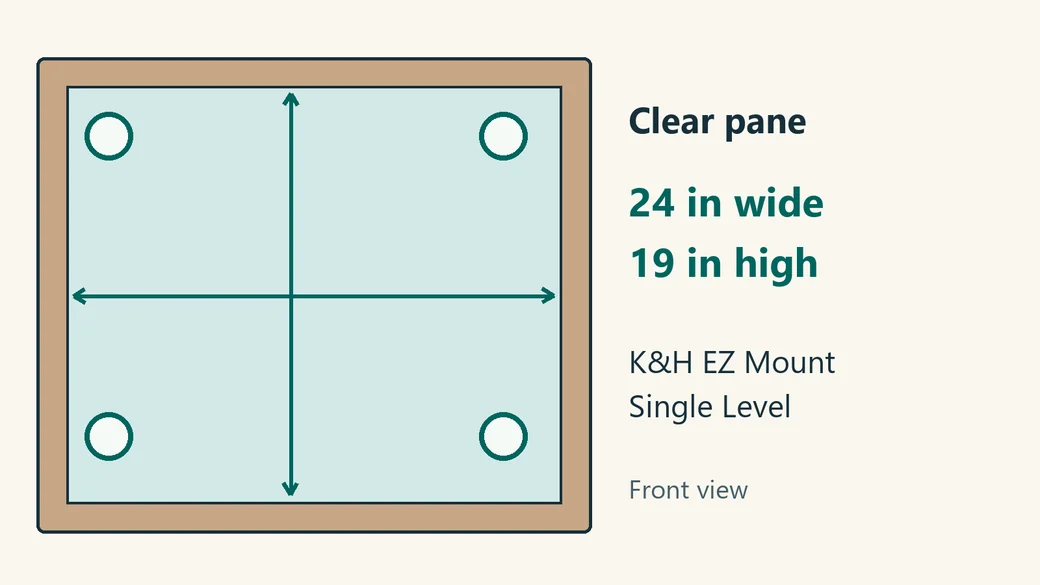
For example, a 30-inch-wide window frame can surround two separate 14-inch-wide panes. If a raised divider interrupts the mounting area, the frame width alone cannot establish compatibility. Likewise, a wide pane may be too short. If the glass is textured, cracked, filmed or otherwise outside the installation guidance, choose another location or ask the manufacturer about that exact surface before fitting anything.
The K&H instructions distinguish the two cups on the platform from the upper push-and-turn cups on the support straps. Follow that sequence with the cat away. Check the attachments before access and after cleaning, moving the perch or operating a nearby blind. If a cup lifts or the platform moves, take it out of use until the issue is resolved.
Hook-on example: the Zakkart Easy Seat
An apparently generous ledge can still fail a hook-on design. For the Easy Seat, Zakkart specifies a slot at least 0.5 in deep, a sill no deeper than 9 in, and a distance of at most 3 in from the sill’s leading edge back to the wall below. The listed hook is 0.08 in thick. Check all dimensions and that the hook seats correctly without force. Zakkart Easy Seat window requirements.
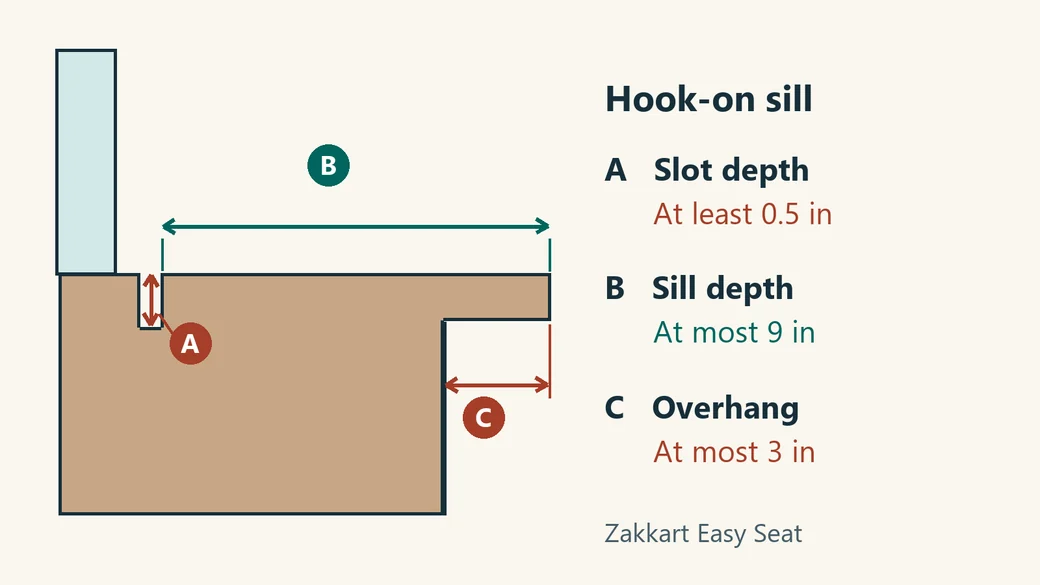
Suppose the slot measures 0.6 in and the sill measures 8 in, but the ledge projects 3.5 in past the lower wall. Two checks pass; the overhang still exceeds the stated limit. A different bed size does not correct that mismatch. Avoid packing the gap with a book or forcing the hook into a seal.
Also distinguish the bed from the outer frame. Zakkart lists the medium frame at 23 × 14 in, with a 21 × 13 in bed. Its large frame is 26 × 14 in, with a 24 × 13 in bed. Compare the smaller, usable dimensions with the place your cat already likes to curl up. The maker lists up to 40 lb. A cat within that limit can still prefer more room to turn.
Keep the view, the exit and the window usable
A perch gives your cat easier access to the window. Keep it closed during fitting and first use. Cats Protection warns that cats can fall through open windows and become trapped in the V-shaped gap of inward-tilting windows. Move the cat to another room before opening an unprotected window. A perch, its straps and an ordinary insect screen do not establish that an opening is secure. Cats Protection on indoor window and balcony safety. Guidance on tilt-and-turn windows.
Once the perch is fitted according to its manual and the glass is closed, let your cat discover it at their own pace. Watch the descent as well as the climb. A cat that needs several attempts, hesitates on the way down or can be cornered by a second cat may benefit more from a lower seat with a clear approach. For existing furniture, see how to choose a ramp or steps.
Your window record
On one line, write down the room, model and size. On a second, record clear pane width × height, slot depth, sill depth and overhang. Finish with two observations: “I can close and latch this window” and “My cat can get down here.” A missing measurement is an excellent reason to postpone the purchase.
Enter each measurement to compare it with the published dimensions.
When a floor-standing lookout makes more sense
If the cat already rests comfortably on a secure piece of furniture beside a closed window, keeping that spot costs nothing. If the glass and sill both fail the fitting requirements and you need extra resting space, a suitably stable cat tree may put a bed at the same height. Allow room for the base and follow the maker’s anchoring instructions. Our cat tree and wall shelf comparison covers those decisions.
Optional shopping link for US and Canadian readers. Félinscope may earn a commission on qualifying purchases. For the floor-standing alternative, you can browse Tuft + Paw cat trees. Check the exact model and delivery destination.
How we compared
Félinscope reviewed the two manufacturers’ published requirements and Cats Protection’s guidance. We did not physically load-test the perches or assess your window. The worked examples are hypothetical. Specifications refer to the named models and may differ across designs, including products from the same brand.