The answer in 30 seconds
Contain the route you can actually see.
Choose the tray geometry first when granules are thrown over a wall during digging. Choose an exit mat first when granules appear on the cat's first steps away from an otherwise suitable tray. If both happen, you may eventually need both, but make one change at a time.
Neither product should make toileting harder. An older cat or one with painful movement may need a low entrance even if the other walls are tall. New straining, pain, avoidance, blood or very little urine calls for veterinary advice, not a shopping fix. Cats Protection explains the urgent signs.
Check your exit path ↓Start at the floor
Two escape routes, two different interventions.
Digging and kicking scatter.
Dry granules gather beside or behind the tray while the cat is still inside. A mat at the front exit has little chance of catching material thrown beyond it. Look at usable inside floor area, the height of the side facing the scatter and whether the cat can turn without crowding.
Granules carried after exit.
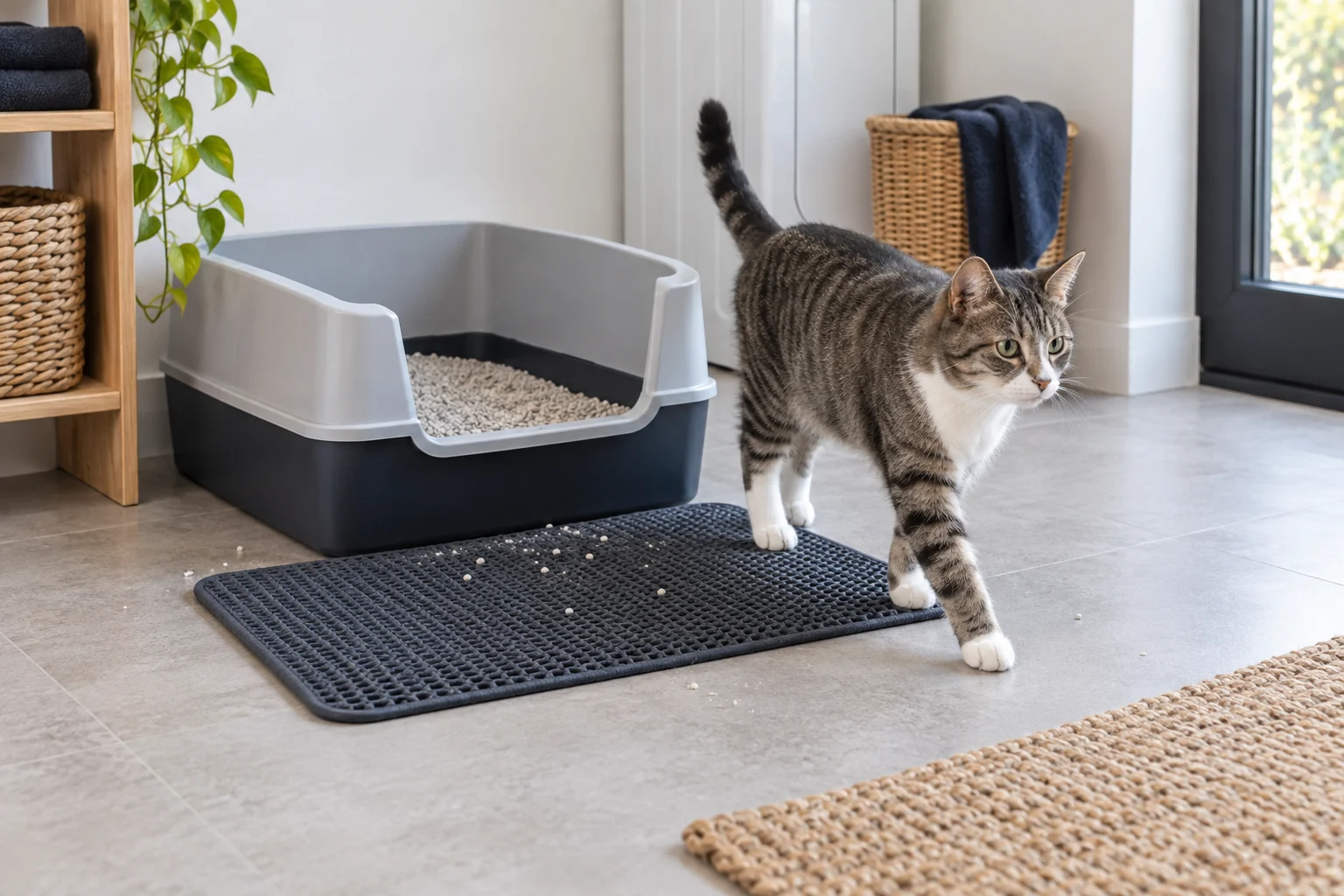
Loose litter appears on the first steps or along the route from the entrance. Here a stable, low-profile mat on that actual path has a plausible job. A taller rear wall does not remove grains already on paws.
The distinction is a practical inference from how the two products work, not a measured capture-rate comparison. Purina's tracking guide also describes these two mechanisms, though it is commercial brand guidance. If you cannot tell which route dominates, watch an ordinary, unprompted exit before buying.
This is narrower than our covered versus uncovered box article, which asks about enclosure and acceptance. Our clumping versus non-clumping litter article evaluates the substrate itself. Keep those separate from the mat-versus-wall decision.
The decision at a glance
What each purchase changes and what it cannot.
On a small screen, scroll the table sideways.
| Question | Litter mat | High-sided open tray |
|---|---|---|
| Where it acts | On the floor after the cat exits. | At the walls while the cat uses the tray. |
| Best clue | Grains appear on the first steps away. | Grains collect beside or behind the walls. |
| Access risk to check | A raised edge, unstable texture or blocked approach. | An entrance that is too high or cramped. |
| Cleaning job | Lift, empty and wash to the maker's instructions. | Clean the tray and the surface around it regularly. |
| What it cannot establish | That a cat will willingly cross it or it will catch every grain. | That the cat will accept a new tray or no granules will be carried. |
Cats Protection suggests a wipeable surrounding surface, but placement still has to suit the cat. Avoid interpreting a cleaner floor as proof that a reluctant cat has an acceptable toilet.
Original decision aid
Where does the litter first escape?
Use these four observations to decide what to investigate next. The result is deliberately allowed to say “pause” or “seek care”. It does not diagnose disease, score a product or store your answers.
Map one ordinary exit first
Observe the tray without moving it: is the loose litter beside the walls, on the first steps after the exit, or in both places? Also check that your cat enters and leaves comfortably.
Editorial sorting aid, not a diagnosis or a product performance test. Answers stay on this page and disappear when you leave.The welfare gate
Do not make a tidy floor cost the cat an easy toilet.
Cats Protection advises a tray with enough room to turn around and a location that works for the cat. Its guidance also recognises lower sides for cats with mobility difficulties. Its older-cat guide and FelineVMA's pain toolkit emphasise accessible entry. A tray can have taller side and back walls yet still need a low front opening. Inspect the actual entry, not just a listing that says “senior friendly”.
Changed toileting is a different problem.
New straining, repeated attempts, pain, blood or little to no urine should not be treated as a tracking problem. If a cat cannot pass urine, seek emergency veterinary care. This article does not offer a diagnosis or a home treatment.
A covered box is not automatically an access solution. A cat may dislike its entry or interior. See our separate covered-box comparison if enclosure is the proposed change.
Make an observable change
A small home check beats a promise on the package.
- Start with a normal day. Note where loose grains first appear, where the cat actually exits and whether entry, turning and leaving look comfortable. Do not move the tray just for a photograph.
- Keep the current toilet available. If you try a different tray, avoid removing the familiar one abruptly. Cats Protection suggests offering another tray when exploring preference.
- Change one feature. For paw-carried grains, place a stable, cleanable mat on the actual exit path. For thrown grains, assess a roomy open tray with appropriate walls and an accessible entrance. Do not simultaneously change litter, location and tray if you want to learn what mattered.
- Watch the cat, not just the floor. Does the cat enter, turn, dig and leave normally? Does it walk across the mat or go around it? A clean floor with new avoidance is not a success.
- Keep the result modest. Record observations rather than “80% less tracking” or another invented figure. Your household result does not prove general product performance.
This is a reversible observation framework, not a clinical protocol. If toileting changes, prioritise veterinary advice. If the existing setup is comfortable and the mess manageable, “buy nothing” is a valid outcome.
Optional product research
Shop for the feature that solves the observed route.
A mat search should lead you to check full dimensions, edge profile, stability, cleaning instructions and how it lies on your floor. A high-sided open tray search should lead you to check usable interior dimensions, wall heights, the front entrance and how you will clean it. Search listings are not an approved shortlist; inspect the exact product before buying.
As an Amazon Associate I earn from qualifying purchases. These country-labelled searches are not recommendations: verify the exact model, seller, price, delivery and return terms.
These country-labelled Amazon searches include affiliate tracking where the listed country tag is active. The retailer may show products that fail the criteria above. Buying through them is optional. See our commercial-link policy.
Frequently asked questions
Before changing the setup
Will a litter mat stop litter being kicked out of the box?
Not reliably. A mat can collect granules that land on it, especially along the cat's exit route. If litter is being thrown beyond the tray walls, check tray space and geometry while keeping entry comfortable.
Are high-sided litter boxes suitable for older cats?
Some older cats can use a tray with higher walls and a low front entrance, but access is individual. If stepping in, turning or leaving looks difficult, keep a familiar low-entry tray available and ask your veterinary team about new movement changes.
Should the mat cover the entire floor around the tray?
There is no evidence-based universal size. Observe where the cat actually leaves the tray and where granules first fall. Choose a low-profile, stable, cleanable surface that the cat willingly crosses; do not block the entry.
Can I change the tray and mat on the same day?
If there is no urgent welfare problem, one reversible change at a time makes it easier to see what the cat accepts and what affects the mess. Keep the familiar toilet available during a preference check.
When is litter outside the box a veterinary concern?
Loose granules alone are a housekeeping question. New avoidance, straining, painful toileting, blood or little to no urine is a different issue. A cat unable to pass urine needs emergency veterinary care.
Sources checked 23 September 2026
Evidence, limits and editorial method
The welfare and veterinary sources guide access and warning signs. A commercial brand article helps name the two escape mechanisms, but is not independent testing. We did not find a controlled head-to-head trial in the reviewed sources that establishes a universal winner between a mat and a high-sided box. We have not tested products, measured tracking or had a veterinarian clinically review this page. The exit-path rule is our clearly labelled editorial synthesis, not a clinical claim.
- Cats Protection: toiletingTray size, location, access and preference checks. Welfare guidance, not a mat-versus-box trial.
- Cats Protection: elderly cats guideComfortable, low-entry trays for older cats. PDF guide.
- FelineVMA: chronic pain toolkit patient supportAccessible litter-box entry for cats whose movement is uncomfortable.
- Cats Protection: urinary problemsWarning signs and emergency advice. This guide does not diagnose them.
- Cats Protection: keeping a clean homeCleanable surfaces around a tray and the need to suit the cat's preferred location.
- Purina: how to stop cat litter trackingCommercial brand guidance distinguishes kicked litter from granules carried on paws. Not independent comparative testing.
For a separate question about tray material, see stainless steel versus plastic litter boxes. For floor-system planning, see automatic versus manual boxes. Neither is a substitute for checking the escape path here.